RePart
Built at Meta Global AI Developer Hackathon · Oct 26, 2026 · Remote
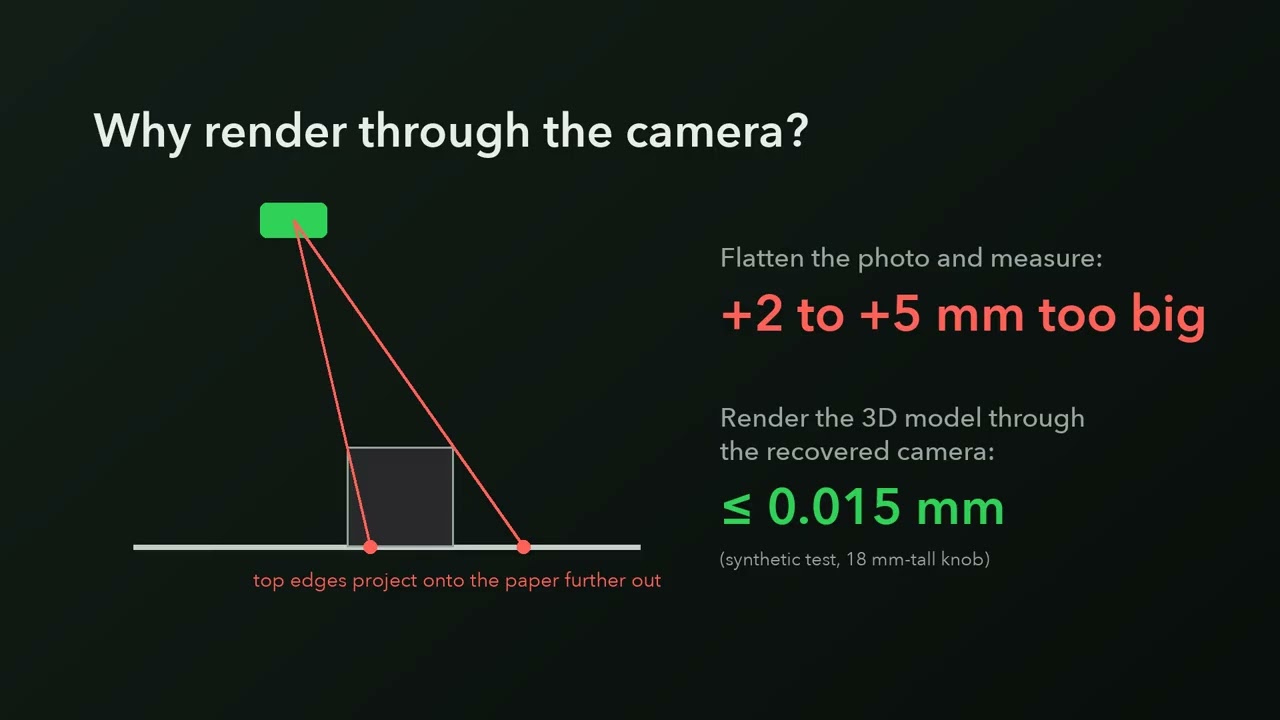
RePart turns two phone photos of a broken plastic part into a printable, editable replacement. The problem: a cracked fan-regulator knob, a snapped cable clip or a lost bottle cap usually means throwing away a working appliance. Nobody sells that exact part, and 3D printing doesn't help if you can't do CAD. How it works: put the part on a white A4 sheet and take two photos, one gently tilted and one steep from another side. Our iPhone app (RePart Capture) tracks the sheet live and turns green when the angle, distance and light are right, then shoots automatically. SAM 3.1 segments the sheet and the part; the sheet's four corners give the exact camera pose, so every pixel has a real size. A Muse Spark agent writes a parametric OpenSCAD model, labelling each dimension as tunable, user-measured or hidden. RePart renders the model through the recovered camera, compares it with the photo silhouette, and an optimizer fits the tunable dimensions across both photos. Spark reads per-photo residuals ("0.5 mm missing at 11–12 o'clock"), geometry-check notes and hole candidates, then revises the structure or declares done. If the fit stalls, Muse Wonder rethinks the structure. The user can describe the part by voice (Muse Voice Transcribe) and type what the photos can't show, like a D-shaped shaft hole. RePart adds material-specific clearance (PETG 0.2 mm) to mating holes. Why rendering through the camera matters: the top of a part sits closer to the lens than the paper, so measuring a flattened photo overestimates an 18 mm-tall knob by 2–5 mm. Comparing in the camera's own image removes parallax. Results: over 5 test parts and 15 dimensions (synthetic photos, real SAM 3.1 and Muse Spark in the loop), median error 0.10 mm, 93% within 0.5 mm, 100% within 1 mm, $0.85 total. On photorealistic photos of a tapered knob, RePart recovered the taper and pointer ridge and added the D-shaft hole, at 97.6% overlap, in about 2 minutes for under $0.10. Four runs agreed on the diameter within 0.02 mm. Output: an STL ready for any printer or print shop, OpenSCAD source with every dimension named, per-dimension provenance (fitted / measured / assumed), and follow-up questions that re-run the part in seconds. Everything was built during the hackathon: the measurement core, the agent loop, the web app, voice input, the iPhone app, the eval harness, 19 tests and a hard API spend cap.