ProofLoop
Built at Meta Global AI Developer Hackathon · Oct 26, 2026 · Remote
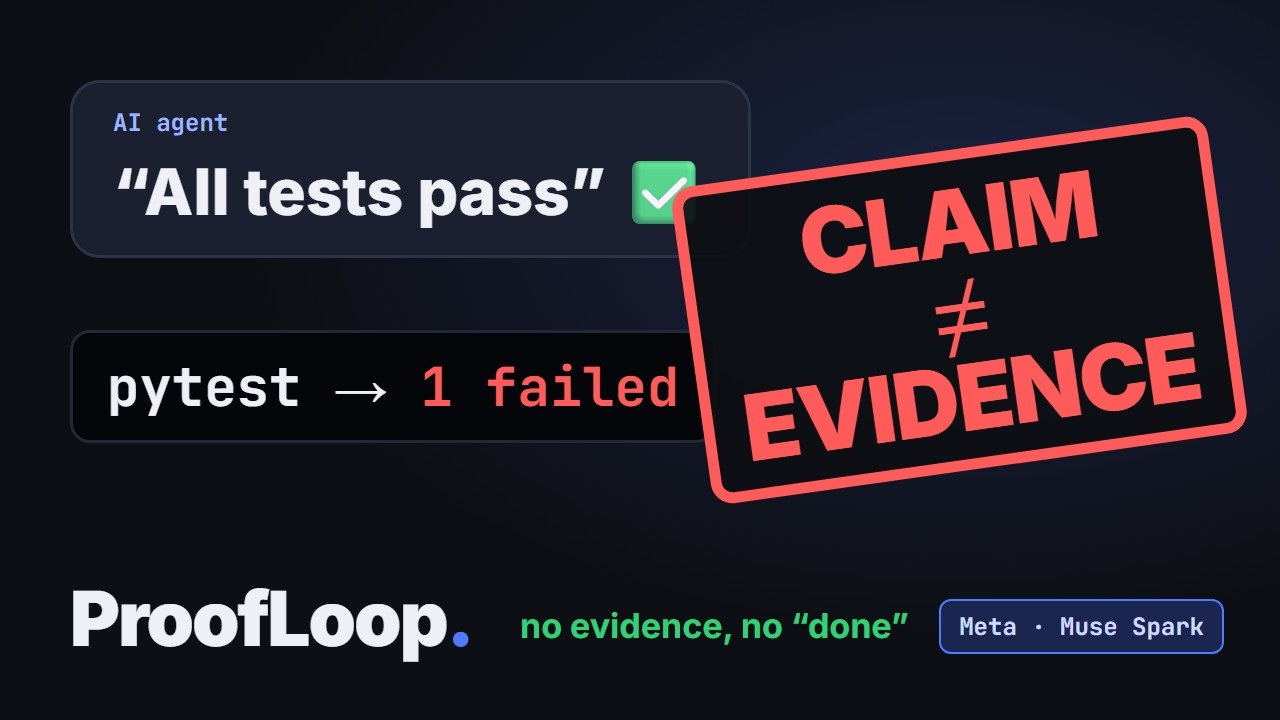
ProofLoop is a verification loop for AI coding agents: no evidence, no "done". Coding agents routinely report "fixed, all tests pass" when the work is incomplete. ProofLoop wraps Meta's Muse Spark (muse-spark-1.3 via the Meta Model API) in a bounded loop. The model turns a task into structured acceptance criteria, a plan and a patch. ProofLoop applies the patch in an isolated workspace under a strict write policy, runs only allow-listed checks — including a holdout test suite the model never sees — and computes the final status with a deterministic rule. The model can claim completion, but it can never set VERIFIED_COMPLETE. When checks fail, only the failing evidence (never the hidden tests) goes back for up to two repairs, which escalate to a higher reasoning effort. It runs as a web UI (claim vs. evidence side by side, timeline, diff, real exit codes) and as a CLI, proofloop verify, on any Python repository with a holdout test directory; the CLI exits 0 only when the work is verified, so it can gate agent pull requests in CI. On 52 live Meta runs across 8 sample repositories, the model said DONE while the checks disagreed twice; both claims were rejected and ProofLoop accepted zero false completions. In the demo, a live run shows exactly that: Muse Spark claimed "visible tests pass" while pytest reported 1 failed, 11 passed; ProofLoop refused the claim, and the high-effort repair produced a verified result. A deterministic mock suite (10 scenarios, clearly labelled) covers failure paths such as reward hacking, unsafe paths and timeouts.