Along
Built at Meta Global AI Developer Hackathon · Oct 26, 2026 · Remote
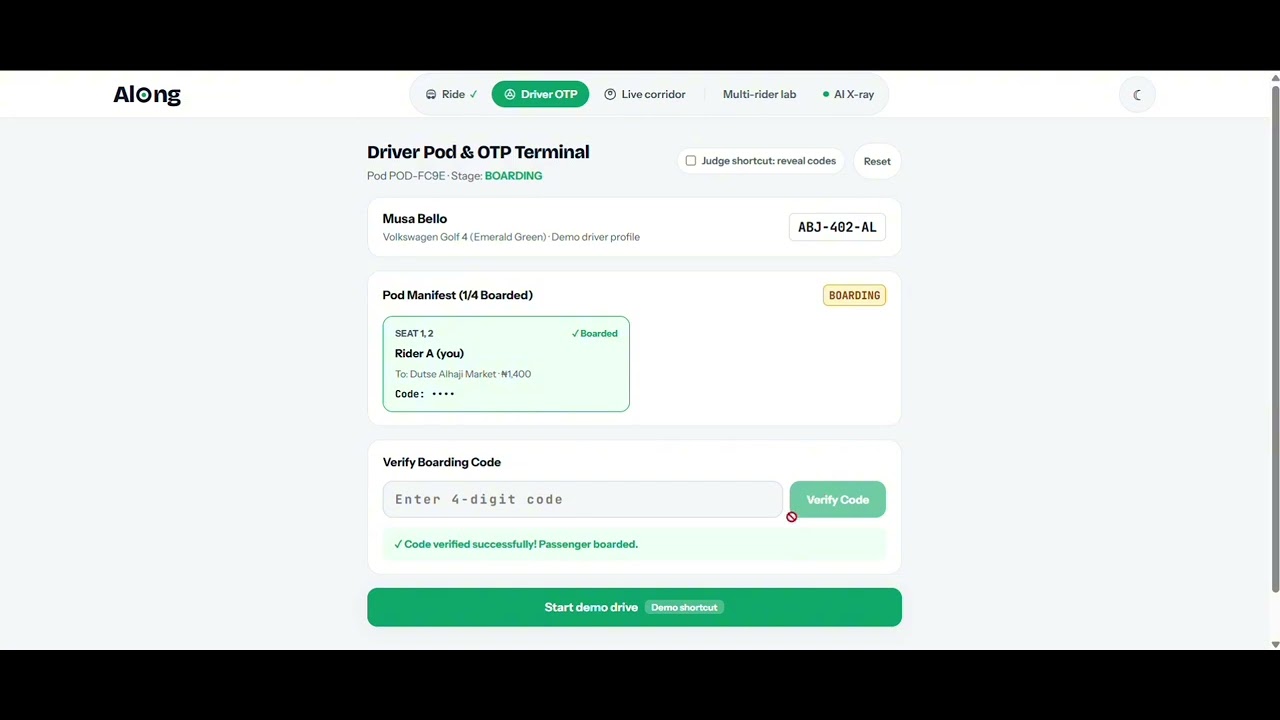
Along lets people in Abuja book a seat in a shared 4-seat ride on a fixed corridor by typing or recording a message in English, Nigerian Pidgin or Hausa. I built it because I ride the Berger, Wuse and Banex routes myself. Roadside boarding means haggling, unclear prices, extra fees and waiting in unsafe places, while drivers often leave with empty seats. How it works: a rule-based gate checks each message for distress words. Muse Spark Open (served by Baseten) extracts pickup, drop-off and seat count in one JSON call, with a fallback chain to Llama 3.2 Vision (NVIDIA NIM) and then a rule-based extractor. A landmark resolver (a FAISS index over character n-grams, reranked with Jaro-Winkler) maps local names such as "that Oando after Katampe bridge" to 142 known landmarks and snaps the pickup to a filling-station forecourt. The rider confirms the fare and gets a random boarding code and a family tracking link. The driver terminal verifies the code (HMAC, 30 minute expiry, 5 attempt lock). The server derives trip stage and vehicle position from its own clock, so the rider, driver and family views agree on every device, and each browser session gets its own pod. Real versus simulated: understanding, the fallback chain, speech-to-text, landmark matching, boarding codes and trip state are live. Payments (escrow), vehicle GPS and WhatsApp are simulated. The chat is WhatsApp-style and there is no real WhatsApp connection. Speech uses Whisper through Groq because Muse Voice Transcribe does not list Hausa or Pidgin. Whisper is not a Meta model. Evaluation: I recorded 30 clips with my brother and labeled them before testing. On typed text, Muse Spark Open got 13 of 19 booking details exactly right, against 10 of 19 for a rules-only baseline. It scored 11 of 12 on places already in my alias list and 2 of 7 on unseen phrasing. By voice, exact accuracy drops to 2 of 19 because Whisper struggles with Nigerian accents (word error rate about 44 percent). The rule-based path recognized 1 of 2 distress clips on typed text. The sample is small and has two speakers, so I do not claim it generalizes. Everything was built between Oct 26 and Nov 4. A planning document from Oct 23 (no code) is disclosed in the repository. I used AI coding assistants under my direction. Along is independent and not affiliated with or endorsed by WhatsApp or Meta.