Team Zekraa
Built at Meta Global AI Developer Hackathon · Oct 26, 2026 · Remote
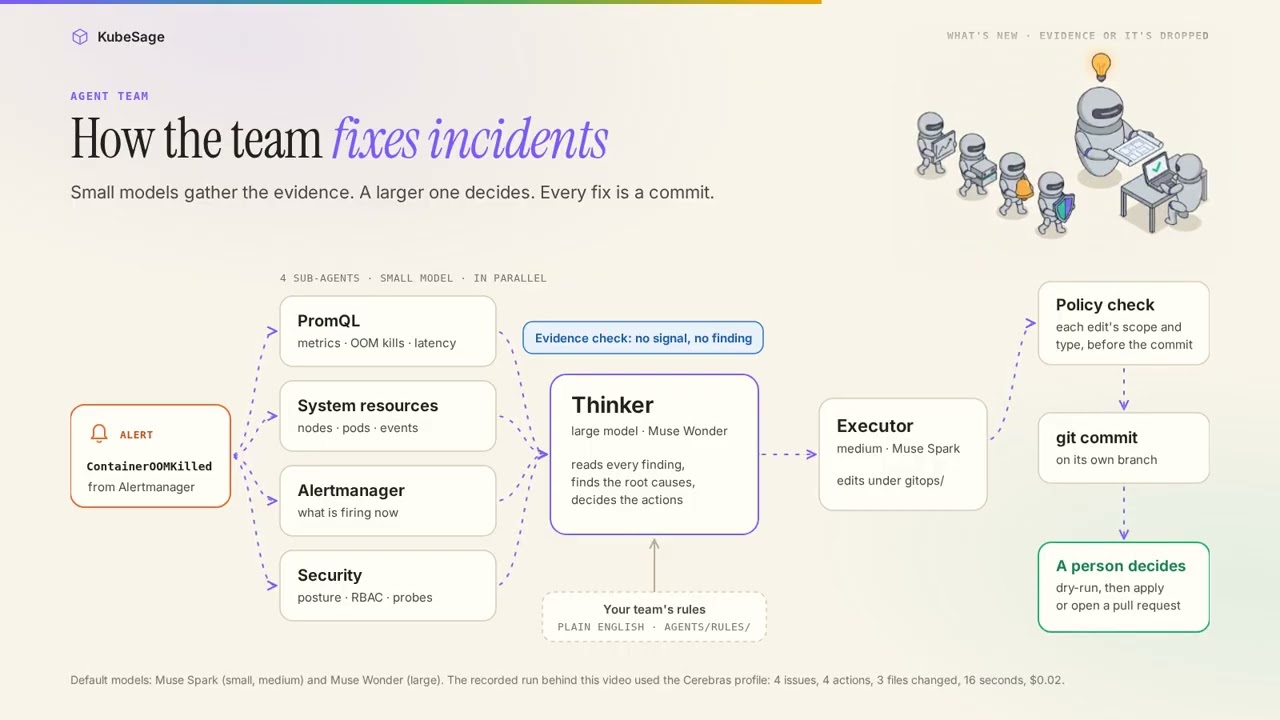
KubeSage is an AI SRE team for Kubernetes. It brings FinOps and SRE together in one system: it cuts the capacity you pay for and don't use, scales ahead of your busy days, and fixes incidents as reviewable git commits, for cents a run. The problem: teams either pay for peak capacity all year or scramble when traffic spikes. FinOps knows the sales calendar, engineering runs the cluster, and the two rarely plan together. What it does: - Right-sizing on Meta Muse. Statistics from 30 days of usage are computed without a model. One Muse Spark call triages every workload, Spark handles the routine fixes, and Muse Wonder takes the hard cases and plans the node pool. The output is right-sized requests, KEDA autoscaling rules, a machine-type plan and the dollar math. - Scaling before the rush. FinOps and engineering share one business calendar (working hours, Black Friday, Christmas week). A forecast that needs no model call combines it with usage history to set pre-warm times and pod counts. A CPU trigger catches flash sales nobody planned. - Incident response. When an alert fires, four small-model sub-agents gather evidence in parallel. A larger Thinker finds the root cause, following the team's plain-English rules. An Executor writes the fix as a git commit, and policy checks limit what each edit can change. Built to be trusted: a finding with no collected evidence is dropped, guardrails reject unknown targets and impossible requests, and plans and fixes reach the cluster only when a person presses Apply. Results, on a real k3s cluster at Azure list prices: - Right-sizing on Muse Spark and Muse Wonder cut reservation cost by 70%, from $168.73 to $50.65 a month, for $0.27 in model calls: 55% less than running every call on Muse Wonder. To fit the scheduled peaks, the node pool grows to 3x F4s_v2, which costs 32% more. - In an out-of-memory incident, the team went from alert to fix commit in 16 seconds for $0.02 (that run used Cerebras-hosted models). Stack: Python, the Meta Model API (Muse Spark 1.3, Muse Wonder 1.0), Kubernetes (k3s/k3d), KEDA, VictoriaMetrics/Prometheus and Grafana. It works with any OpenAI-compatible API and runs in a labelled mock mode without a key. 226 unit tests and 40 browser tests.