Fugees
Built at Meta Global AI Developer Hackathon · Oct 26, 2026 · Remote
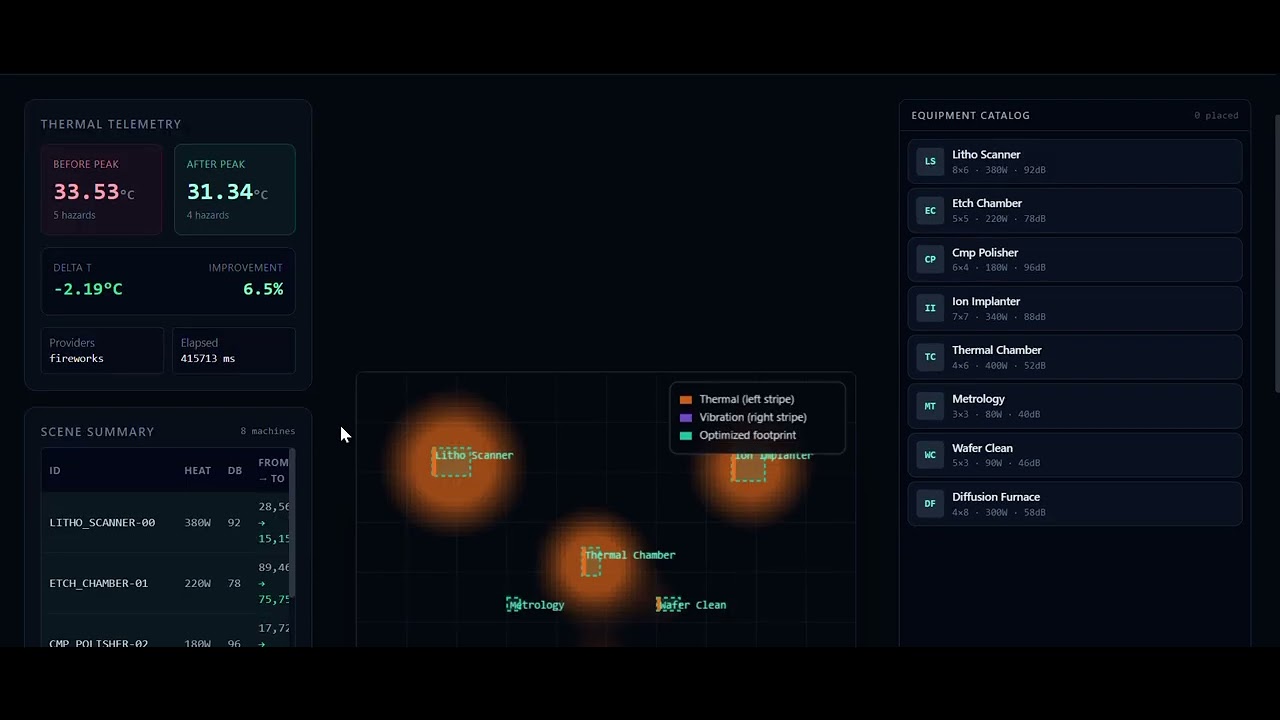
In a semiconductor cleanroom, three forces fight for the same floor space. Heat accumulates where the Gaussian output of machines overlap. A Litho scanner runs at 380 watts, an ion implanter at 340, a diffusion furnace at 400. Two near each other bake the third between them. Vibration between two machines inside a critical distance and both at or above 70 decibels will contaminate adjacent tooling. A Litho scanner at 92 cannot sit near a polisher at 96. And the heat solver uses zero-flux reflective boundaries, so heat concentrates at walls and corners. Every hot rack must sit at least 8 cells away from the perimeter or it will pull room temperature up by itself. The interesting question for a process engineer, before committing capital to a buildout, is whether a given machine set can share the same floor without breaking the 26 degree thermal limit or violating those vibration exclusion zones, and what the trade-offs are when they cannot. That is a continuous constraint-satisfaction problem with no clean optimum. Every practical layout is a compromise. The engineer needs both a verdict and a documented reason, not just a magic number. We solve it with four cooperating layers that fire on every simulation request. An FDM heat solver runs 200 timesteps on a 100 by 100 grid with reflective boundaries and reports the peak temperature. A vibration analyzer checks pairwise distance and decibel level and flags any conflicting pair. An LLM, typically the Meta Model API in production with Fireworks AI as both dev backend and cross-provider fallback, reads the simulated scene plus the open error codes and proposes JSON layout adjustments. And a trust-but-verify gate re-runs the actual FDM on the proposed plan before accepting it. Every model proposal that would have made the layout worse is rejected, and the loop falls through to a deterministic physics-only hill-climb. The Meta Model API is the production primary. Fireworks AI is both the dev fallback and a cross-provider mirror. If both providers go offline at once, the spatial renderer falls back to a deterministic local rasterizer and the strategy stage falls back to deterministic physics-only relaxation. The corrector is bounded to 3 turns and never regresses. Every accepted layout is re-verified by the actual heat solver before it ships to the canvas. End-to-end latency is 40 to 80 seconds on the Meta primary in production and 5 to 15 seconds on the Fireworks fallback in dev. The pipeline runs entirely in-memory, ships without a database, stores nothing between requests, and is bounded to a single serverless invocation per call. The backend runs on Modal and the frontend on Vercel, both managed, so there is no nginx, no reverse proxy, no certificate renewals to manage.