egan
Built at Meta Global AI Developer Hackathon · Oct 26, 2026 · Remote
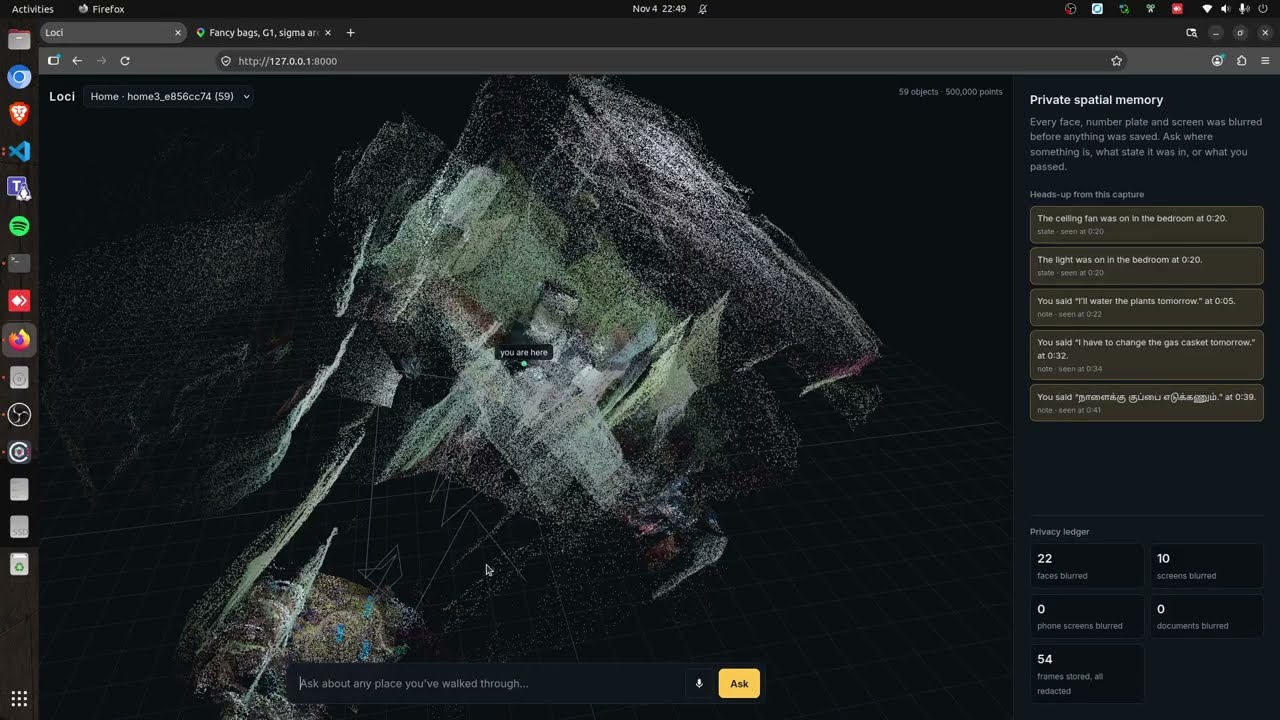
Loci gives AI glasses and robots a private memory of the places you move through. Glasses and robots can see, but they forget what they saw. Walk through your home or down a street with a camera at eye level, then ask "Did I leave the stove on?" or "Where was Lenovo?" and get a checked answer: "When you left the kitchen at 0:15, the right burner was lit," with the frame it saw as proof, a position in metres, and the object highlighted in a 3D view. Privacy first: SAM 3.1 blurs faces, number plates, screens and documents before any frame is saved, and raw frames are deleted. On the street, nothing about people is kept beyond counts. A forget command erases an object from frames, points and evidence. 3D and location: MapAnything gives per-pixel metric depth and camera poses. Long walks are rebuilt in overlapping chunks joined on shared cameras, with "up" taken from the floor plane. SAM 3.1 masks are mapped onto the depth grid, lifted into 3D, cleaned of low-confidence and outlier points, and merged into one object per real thing. At home Loci measures "on", "inside", "left of" and distance to the door; on the street, distance along the walk, side of the road and time passed. Repeat captures align on furniture, so Loci can say what moved. Every answer includes a robot goal with a floor path, and the evidence photo hangs in 3D where it was taken. Understanding: Muse Glimmer names objects and rooms, reads signs as written and in English (English and Kannada boards), and judges states like burners and fans, each with a time and confidence. Muse Voice Transcribe turns spoken notes, including Tamil, into text linked to what was in view. Trust: an agent with 14 tools answers from the memory, in the language of the question. Every answer cites its observations, and a plain-code verifier checks the object, position, relations, sign text and state. If a check fails, the agent retries once, then says "not sure" and gives the last sighting instead of guessing. States are always "as of when seen". A leaving-check agent reviews each walk on its own and flags things like a lit burner or a fan left on, with evidence. Meta models: Glimmer 30B (open weights) runs locally on one 16 GB GPU via llama.cpp and does the core work, including every answer when offline, so your home never has to leave your machine. Muse Spark 1.3 answers when online, with Glimmer as fallback. The cloud only sees blurred crops; LOCI_CLOUD=0 keeps everything on device. Results: 40 questions on my own walks in English, Kannada and Tamil, including 4 refusals. Spark got 40/40 (median 12.8 s), Glimmer 39/40 fully on device (21.1 s). Scale is within 7% of real distances (260 m vs 278 m; 1.5 m vs 1.6 m).