Jojolapa
Built at Meta Global AI Developer Hackathon · Oct 26, 2026 · Remote
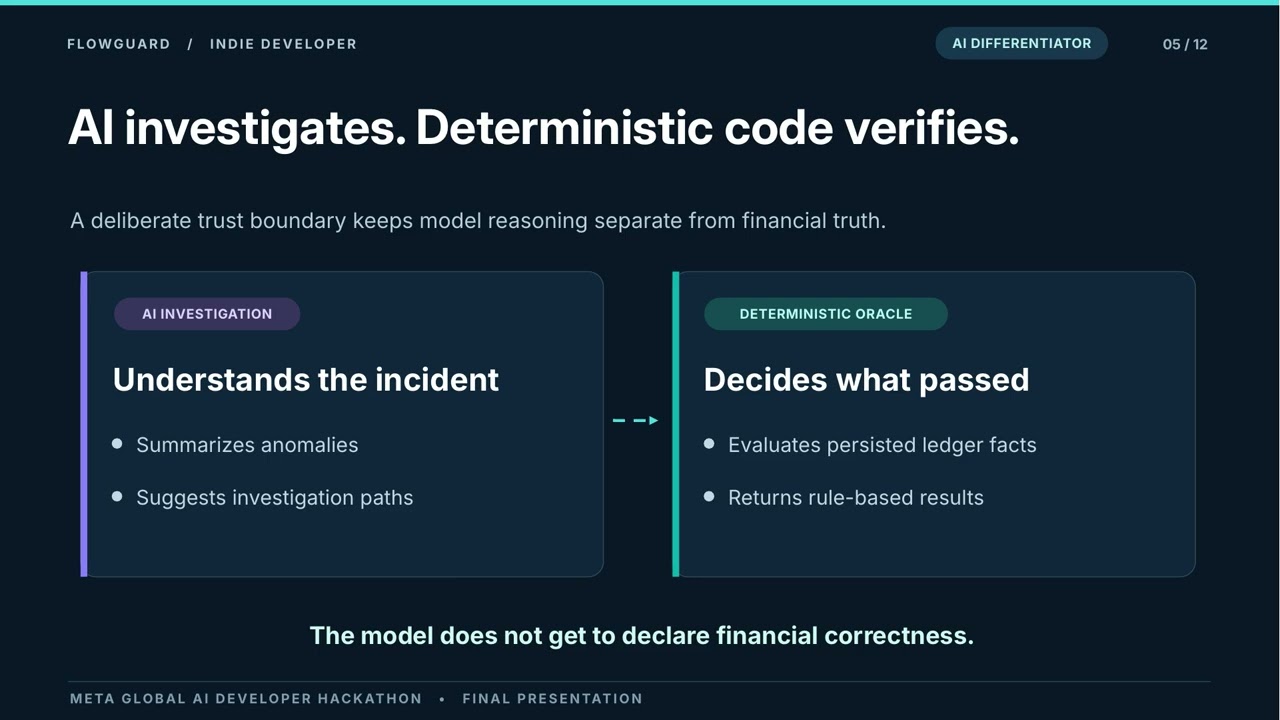
FlowGuard AI — Verifiable Financial Integrity A successful payment API response does not guarantee that the financial ledger is correct. Duplicate requests, concurrent transactions, partial failures, and inconsistent service configurations can silently compromise financial integrity. I built FlowGuard AI to address this problem through an end-to-end, AI-assisted financial reliability and investigation platform. FlowGuard combines four capabilities: Prevent: Enforce safe execution boundaries, startup validation, idempotency, and transaction safeguards. Verify: Use deterministic Java and SQL checks to validate double-entry balance, duplicate settlement, concurrent debits, and transaction state transitions. Explain: Use AI-assisted investigation to analyze anomalies, propose diagnostic steps, and make complex failures understandable. Prove: Preserve transaction and saga evidence through Kafka-backed event processing and hash-chained records. The completed system includes a synthetic financial wallet, an investigation backend, an API gateway, authentication, a web-based operator console, and an evidence processor. It uses Java, Spring Boot, PostgreSQL, Redis, Kafka, Docker, and a Vite-based frontend. Users can deliberately inject financial failure scenarios, replay operations, run trusted verification checks, and investigate the resulting evidence. Core innovation: AI can reason about financial incidents, but it cannot declare financial correctness. Deterministic code remains the final authority. FlowGuard demonstrates how financial systems can become more explainable, testable, and trustworthy without putting real money at risk.