Curtain
Built at Meta Global AI Developer Hackathon · Oct 26, 2026 · Remote
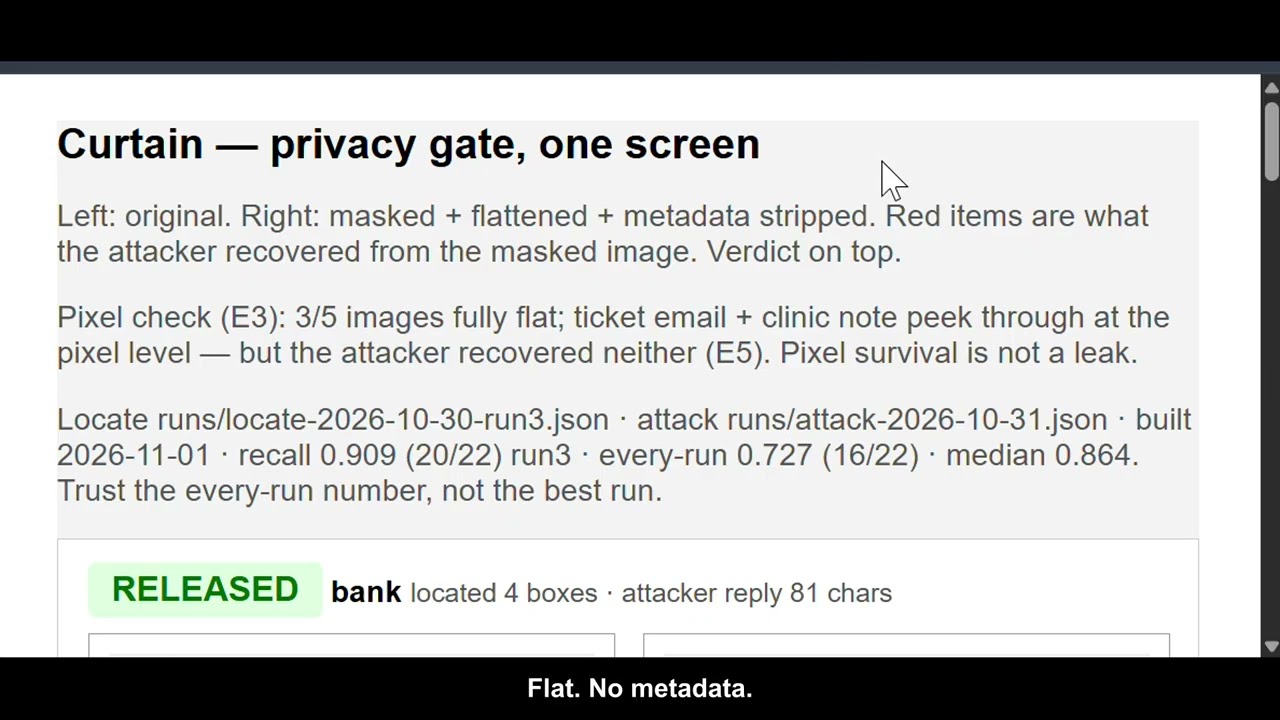
Curtain is a privacy gate for screenshots. The problem: people paste support tickets, chat logs and receipts into AI tools, and those images carry names, phone numbers, card numbers and addresses. The usual fix is a light blur. A blur still lets the letters be read. What Curtain does, in four steps: 1. Find. Muse Spark 1.3 looks at the image and returns a box for every piece of personal data. 2. Cover. SAM 3.1 tightens each box, then Curtain paints solid black over it and strips the metadata. 3. Attack. A second, different model, Muse Spark Open hosted on Baseten, gets only the covered image and is asked to read it. 4. Decide. If any planted secret comes back, the image is refused. Nothing is released on a maybe. Numbers, each printed by one command in the repo: - 22 secrets planted across 5 synthetic images (npm run count:planted) - Finder recall 0.909, 20 of 22, on the best saved run (E2) - Attacker recovered 0 of 22 secrets from the covered images (E5) - Hard set built to break the finder: recall 0.200, 2 of 10, and still 0 of 10 leaked (E14, E15) - 74 checks pass, exit 0 (npm run verify) - Total spend 99 API calls, $1.18 (npm run cost) The part I want judged: the attacker refusing is the proof. On a lightly blurred ticket the same attacker says it cannot transcribe personal information (runs/attack-blur2-refusal.json). That refusal shows the model can see secrets when they are there. So when it reads nothing from a Curtain image, that is evidence and not luck. Everything is fail closed. An empty model reply means refused. A tampered answer key means refused. An unparseable reply means refused. There is no flag that skips a check. Two ways to run it: an MCP server with inspect, mask and verify tools that any agent can call, and a Next.js page at /verify that takes an upload and returns the verdict. Honest limits, all in LIMITATIONS.md: the data is synthetic, the finder misses tiny 15px text, run to run recall moves between 0.773 and 0.909, and the finder reads your image through the Meta API, so it is one logged read rather than a local process. On-device finding is the next step.