VestiCare
Built at Meta Global AI Developer Hackathon · Oct 26, 2026 · Remote
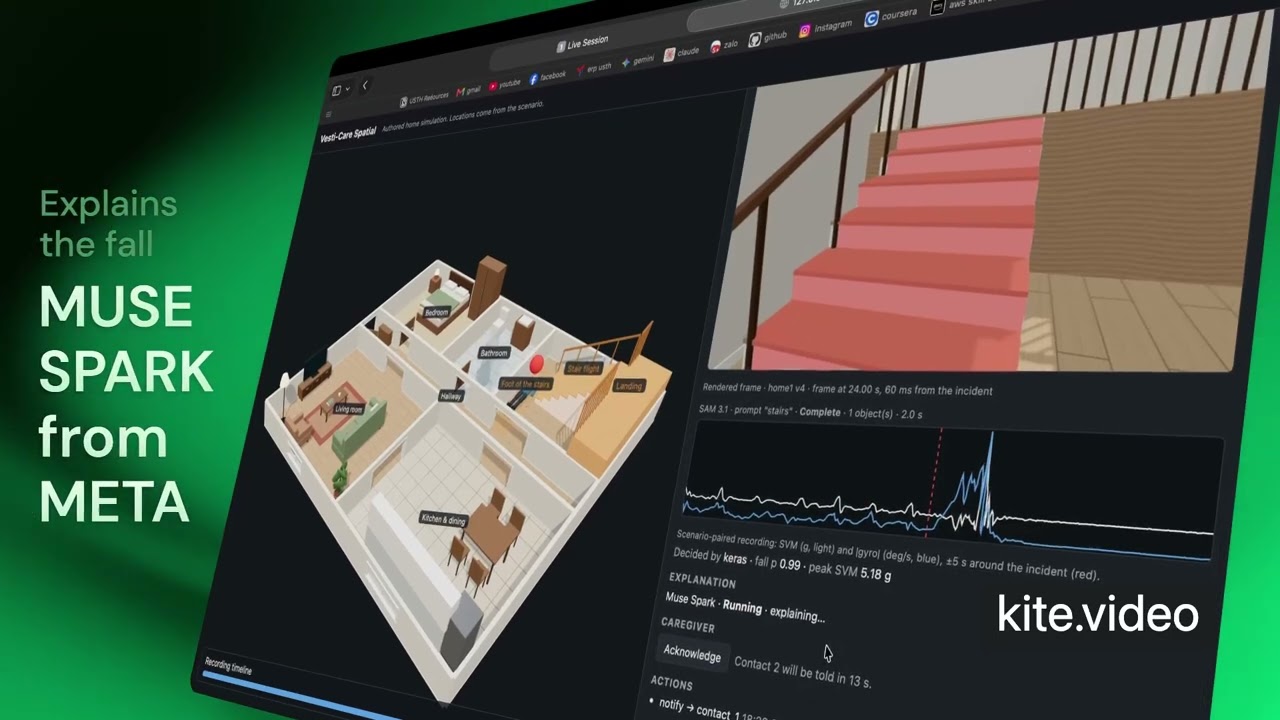
Vesti-Care Spatial: a fall-safety assistant that asks first, alerts second, and explains with evidence The problem. People at risk of falling, including patients with vestibular disorders, are often alone when they fall. A bare "fall detected" alert makes caregivers act on a guess: the sensor may have misfired, the person may be fine, or they may need help now. Vesti-Care Spatial keeps a human in the loop and gives the caregiver evidence, not just an alarm. How it works. 1. A waist-worn ESP32 with an MPU-6050 IMU streams motion data over Wi-Fi to a FastAPI backend, which runs a Keras fall classifier and a threshold check. 2. When a fall is detected and the person stays still, a phone worn on the forehead, standing in for smart glasses, asks out loud: "Are you all right? Please respond." 3. The wearer answers by voice. Speech is transcribed on the laptop, and plain code matches the answer against a fixed phrase list. A clear "I'm fine" before the 30-second deadline cancels the alert. "I need help" raises it immediately. Silence or anything unclear alerts the first caregiver on Telegram. 4. The Telegram message has an Acknowledge button. If nobody acknowledges within 20 seconds, the alert escalates to a second caregiver. Where Meta's models fit. - SAM 3.1 checks the camera frame for stairs. The phone says "Stairs visible ahead." at most once every 30 seconds, and never while waiting for an answer. When a fall happens, the frame nearest in time is attached to the incident, with its clock uncertainty stated. If the clocks cannot support the match, the incident says so rather than showing the image as evidence. - Muse Spark is an incident agent. After the first alert is committed, it reads the evidence (IMU, frame, location, wearer response) and writes a cited explanation for the caregiver. It may send one fixed-format evidence update per contact and pick one of four fixed phone sentences. It cannot write the message text, cancel, escalate, or give medical advice, and code re-checks each request when it acts. If the model fails, the alert is unchanged. Design choice. The models see and explain; code decides. Safety-critical actions never depend on a model's free-form output. Replay. A recorded session can be exported as a package (IMU, frames, response events, policy actions). The detector and the policy replay from it twice with the same result, on a virtual clock, with no speech model, agent or Telegram call. What we tested, and what we did not. The backend has 410 automated tests. We ran the ESP32 on a Wi-Fi link to the backend, and ran real SAM 3.1 and Muse Spark calls. We have not published per-person fall counts, voice-accuracy trials or stairs trials, and we will report them with every miss and false alarm once they exist. Nothing here is clinical validation. Limits. Speech recognition is English only. Location is unknown. The camera is a phone, not smart glasses, and we make no claim about any glasses hardware. The earlier IMU classifier for loss of balance could not tell patients from healthy people on stairs, so we do not claim to detect it.