Tracklab
Built at Meta Global AI Developer Hackathon · Oct 26, 2026 · Remote
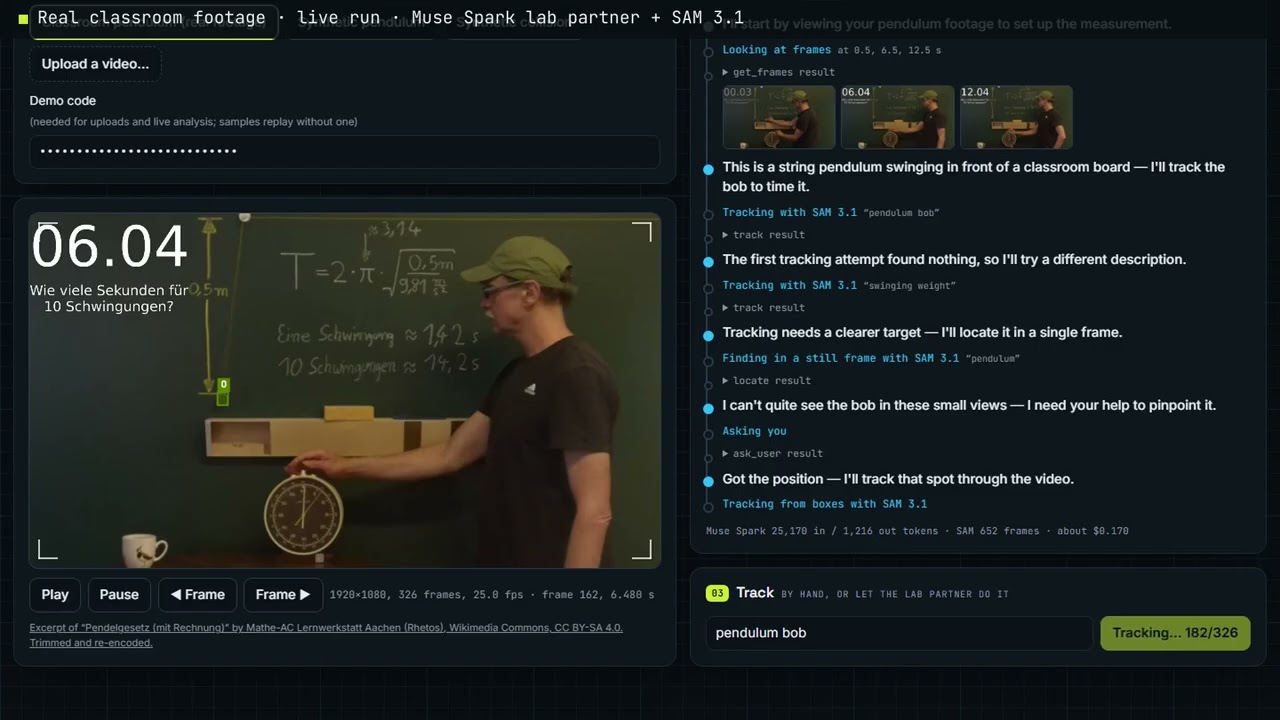
Tracklab turns a phone video of a physics experiment into a real measurement with honest error bars. School pendulums and collisions are usually timed with a stopwatch and eyeballed against a ruler; Tracklab does it frame by frame. SAM 3.1 segments the moving objects in every frame, keeping stable ids even through a collision. Physics fits written for this project (no fitting library) turn those tracks into numbers: a damped-pendulum fit with the finite-amplitude correction, or before/after velocity fits around an automatically found moment of contact. A Muse Spark 1.3 agent runs the whole lab: it looks at frames, chooses what to track, recovers when tracking fails, finds the pivot and a scale reference, asks for a length or the masses only when it must, fits, and writes a report. Every number in the report must come from a tool, and any that doesn’t is flagged. Accuracy: on ten simulated experiments composited onto real classroom footage, g came out within 0.02% of truth with a tape-measured length (0.17% from video alone), and collision momentum ratio and restitution within 1.6σ. On real classroom footage it measured g = 9.48 ± 0.04 m/s², then worked out from its own numbers why it was 3.5% low: the stated 0.5 m was most likely measured to the knot, not the bob’s centre. Live: https://tracklab-olive.vercel.app. Pick a sample and press “Watch a recorded run” (no code needed). Demo code for live analysis and uploads: tl--gKWStQeESXaVOOcTvJuc17B