Video2URDF
Built at Meta Global AI Developer Hackathon · Oct 26, 2026 · Remote
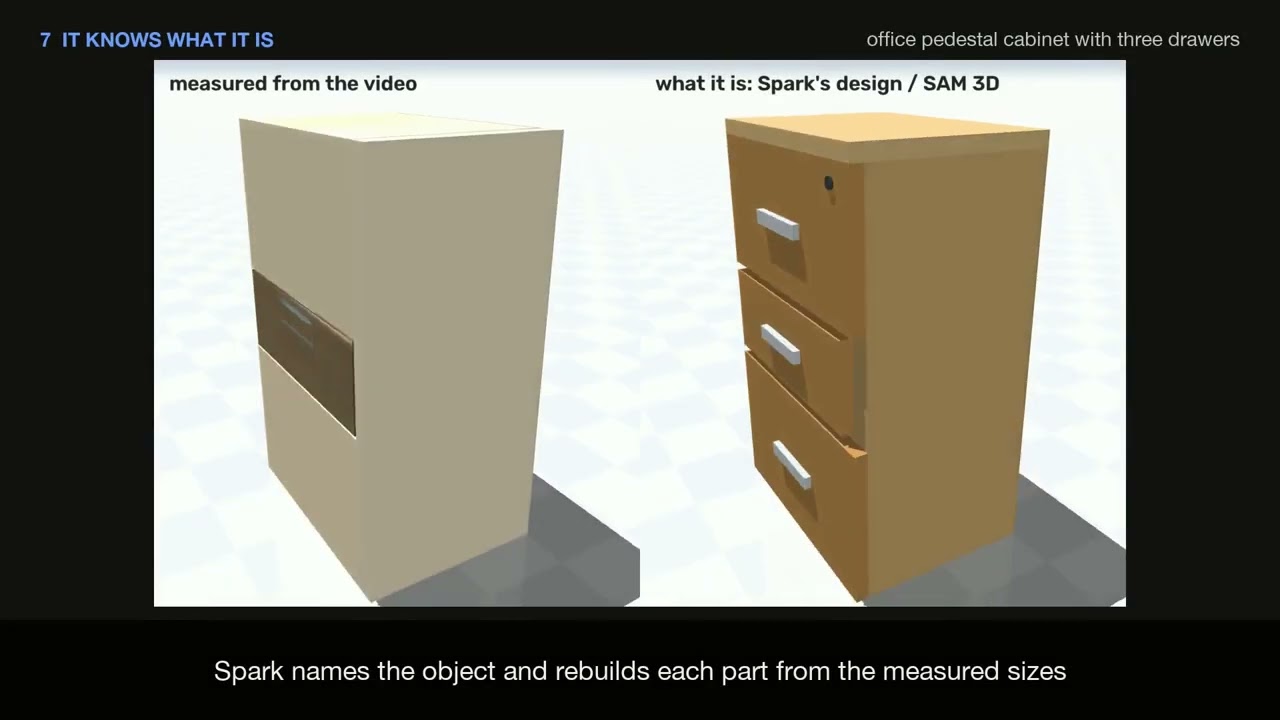
Video2URDF turns one short phone video of a real articulated object (a laptop lid, a drawer, a desk lamp, a microwave door) into a measured URDF/MJCF a robot can use, and checks the model against that same video before it reports. Robotics developers who need a simulation model of a real object usually write the URDF by hand: guess the hinge and the limits, tweak until it looks right. Here you film the object being opened and closed (iPhone LiDAR gives metric depth; a plain video works with a card for scale or, experimentally, MapAnything depth). A Muse Spark agent watches the video, names the parts and prompts SAM 3.1, which tracks each part through every frame. Its tools fit each joint from the parts' relative motion (axis, position, limits), build the links' shapes and write URDF and MJCF. MuJoCo replays the model from the phone's own camera pose on every frame; Spark watches that replay, re-tracks or refits, and cannot finish while its own checks object. Joint friction is measured where a part holds still with no hand on it, and a simulated Franka Panda then uses the measured model. Results: on the RBO motion-capture benchmark, laptops and books come out with a 1.7° hinge-axis and 3.3° angle error (medians, 6 of 7 sequences; box lids fail, and we say so). A 13-inch MacBook Pro lid measures 309 × 205 mm against its spec of 304 × 212; five fresh runs gave 304-306 × 208-212 mm. A Franka Panda in MuJoCo works all 8 published models with grasps planned on the measured geometry (it pulls a drawer 199 mm out by its handle and back, and opens and shuts the microwave door). URDF Doctor checks an existing URDF against a video and finds injected bugs. Anyone can rerun the published laptop's measurement in about 5 minutes with no API keys (scripts/reproduce.py), and the whole pipeline also runs on open weights only. What is new: it measures the real object instead of retrieving or generating a look-alike, checks itself against the video, says what was measured and what was estimated, and runs end to end on open weights. Everything was built solo from scratch during the hackathon.