Even Keel
Built at Meta Global AI Developer Hackathon · Oct 26, 2026 · Remote
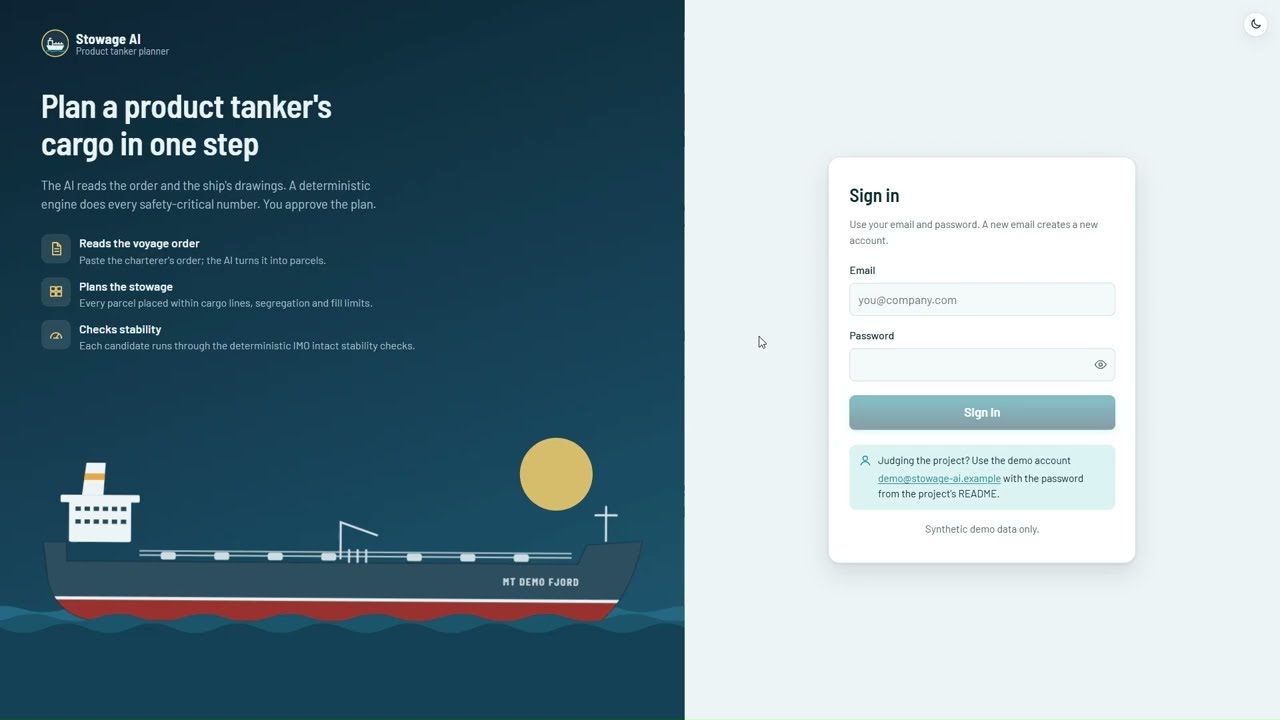
Stowage AI helps cargo planners on product tankers turn a charterer’s order into a safe, ready-to-use loading plan in minutes instead of hours. The planner pastes the order as it was written, for example “Load Rotterdam 20,000 mt diesel, 12,000 mt jet fuel. Discharge diesel at Le Havre, jet fuel at Bilbao.” Stowage AI then: 1. Builds the plan. It decides which fuel goes into which tank and how full each tank should be. Different fuels never share a pipeline, and the cargo for each port can be pumped out when the ship gets there. 2. Checks the ship is safe. It checks the ship stays stable, sits properly in the water and keeps hull stress within limits, both on leaving port and after every stop. 3. Follows the voyage port by port. It warns if fuels would mix in a pipe or if cargo would be stuck behind another fuel, and it suggests which tanks to swap. 4. Shows the ballast to take in. When the ship would tilt too far, it shows how much seawater to put into which ballast tanks, drawn on a picture of the ship. 5. Plans tank cleaning. When a tank switches from one fuel to another, it lists the cleaning needed, with estimated time and cost, as a simple checklist for the port. 6. Explains everything in plain words. Every plan comes with a short summary covering what was decided, why, what to do next, and any values it had to assume. Planners can still change the plan by hand, and each change is checked straight away. Approved voyages are saved so the team can look back at them. Charterers get their own view. They can see the current voyage and its empty tanks, and get suggestions for which cargo could be added at the next port and how much. Only suggestions that pass every check can be added straight into the voyage. The app also remembers the team’s standing rules, such as “always keep tank 3 empty”, and applies them to every plan. The result: faster planning, fewer costly mistakes, and the planner always has the final say.