Allyfix
Built at Meta Global AI Developer Hackathon · Oct 26, 2026 · Remote
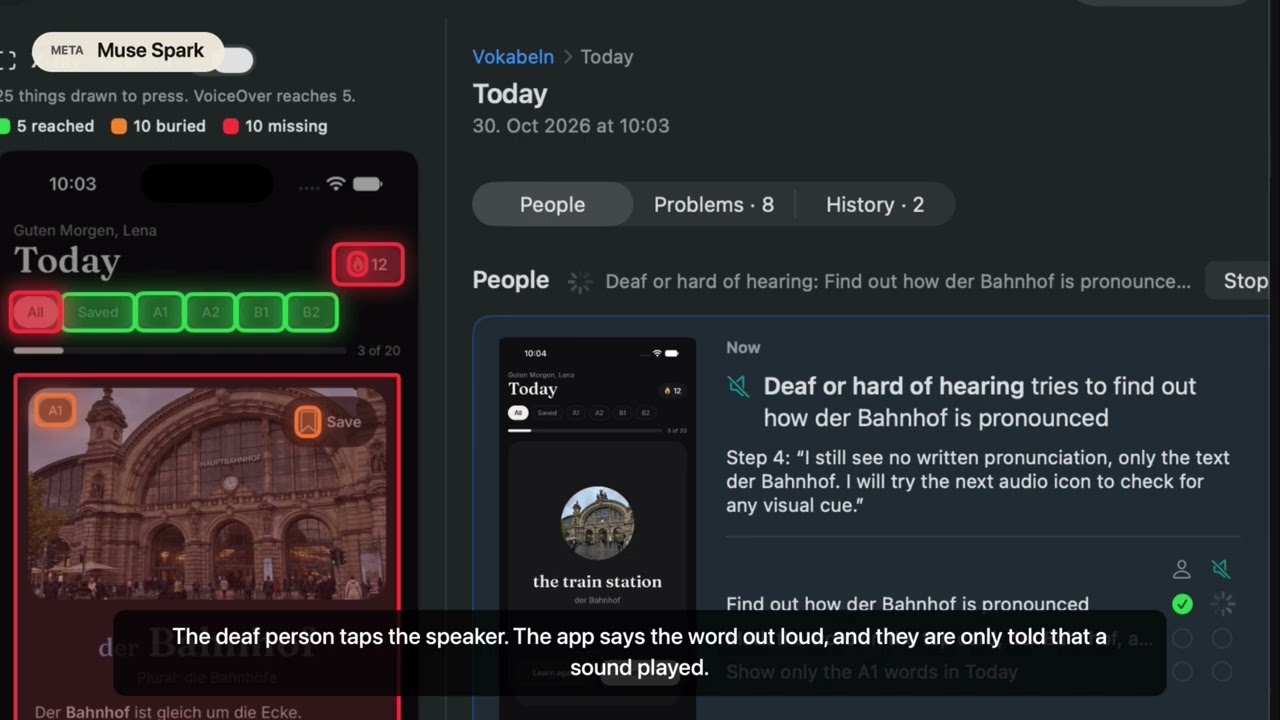
Allyfix checks whether people with disabilities can get things done in an iOS app, fixes what stops them, and checks again. Automated accessibility checkers can tell you a label is missing. They can't tell you that a blind person can't mark a word as known, or that a deaf person never finds out how it's pronounced. Testing with real people finds this, but it's too slow and costly to do on every change, so most small teams don't do it at all. Six synthetic people, chosen after EN 301 549 and named only by access need, try the app in the iOS Simulator. Each gets only what they can perceive: one hears VoiceOver and sees nothing, one sees the screen blurred with text at 235%, one cannot tell red from green, one cannot hear, one taps a few points off, one knows no app conventions. How Meta's models are used: - Muse Spark works out the main tasks of a screen, plays each person step by step, judges every step, and compares each screenshot with what VoiceOver reads. - SAM 3.1 finds everything drawn to be pressed, and an X-ray shows what VoiceOver can reach. - Muse Voice Transcribe writes down what the app says out loud, so a hearing person gets the words and a deaf person only knows that something sounded. - Muse Wonder reads the source and the failures, then commits a fix on a git branch. The same person then tries the same task again. What got them through is saved as a deterministic test that replays with no AI, and must fail on the old code and pass on the new. Allyfix is a fast first pass before testing with real people, not a replacement for it. It is a macOS app, MIT licensed, and includes an example app, Vokabeln, to try it on. Site: https://allyfix.dev