Archivist
Built at Meta Global AI Developer Hackathon · Oct 26, 2026 · Remote
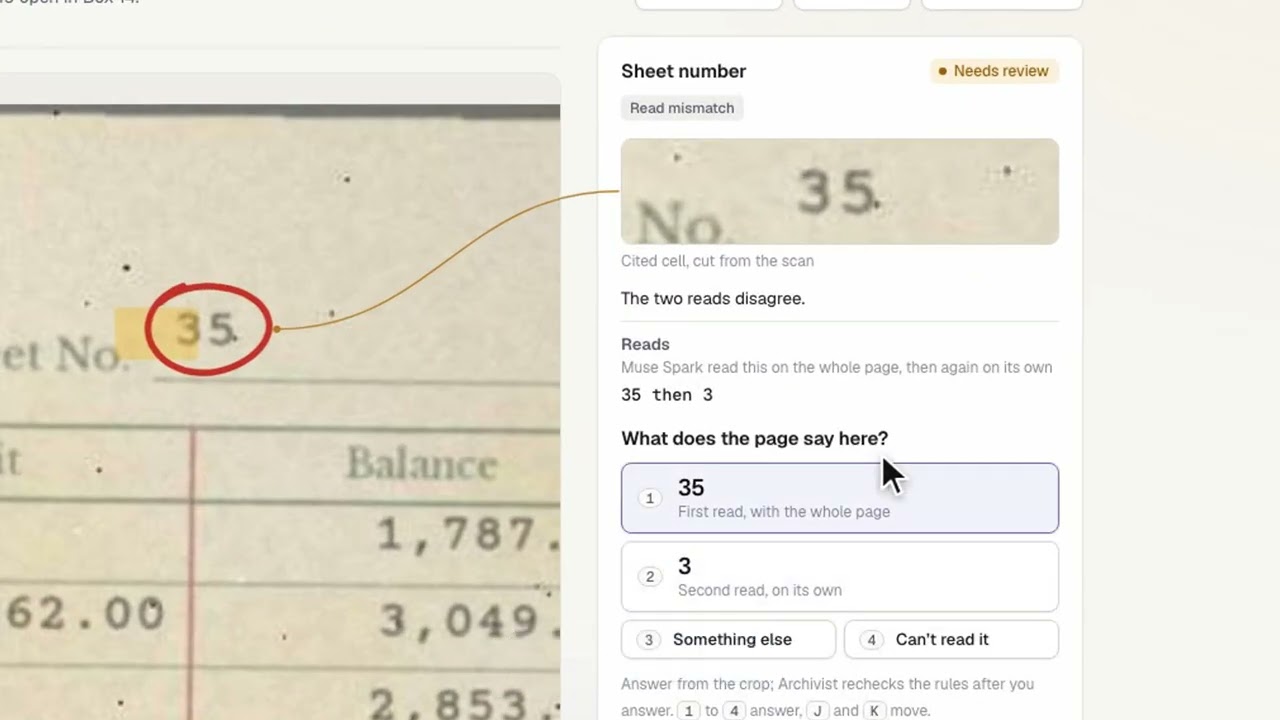
Archivist turns scanned financial archives into a verified database. Every value is cited to its spot on the page, read twice (the second time blind, from a crop of the cell alone), checked by plain-code arithmetic, and sent to a person when anything is in doubt. No model grades its own work, and Archivist never changes a value: it flags source errors and proposes corrections for a person to decide. A new kind of table needs no code: Muse Spark drafts a template from a few pages, plain-code arithmetic tests it, and I approve it. The problem is one I met at a bank internship. I built a parser for about 2,000 legacy memos, then found there was no archive to run it on: the oldest records existed only on paper, and loan applicants brought their earnings in notebooks that staff typed in by hand. A model reading pages like these alone gets some values wrong without saying which. I pre-registered each test with dated commits before running it. On 157 synthetic pages (4,267 values), 0.36% of the values Archivist accepted were wrong, against 4.45% for a single read, and it caught 93.65% of wrong values. It missed two targets: it sent 21.58% of values to a person (target 20%) and flagged 23 of 26 planted source errors (target 90%). On 58 held-out pages of the US Treasury Bulletin, with 400 cells I labelled by hand, the main target was not met: 16.3% of accepted values were wrong against 27.8% for a single read, after a dash correction made by a rule written down first (36.9% against 41.1% as registered). On pages whose layout matches their template, the corrected figure was 0.0%, meeting the target there; the remaining errors are on pages whose layout changed after the templates were drawn. Every result, misses included, is published. Live demo: https://kamil-shirinov.github.io/Archivist/