Bravo
Built at Meta Global AI Developer Hackathon · Oct 26, 2026 · Remote
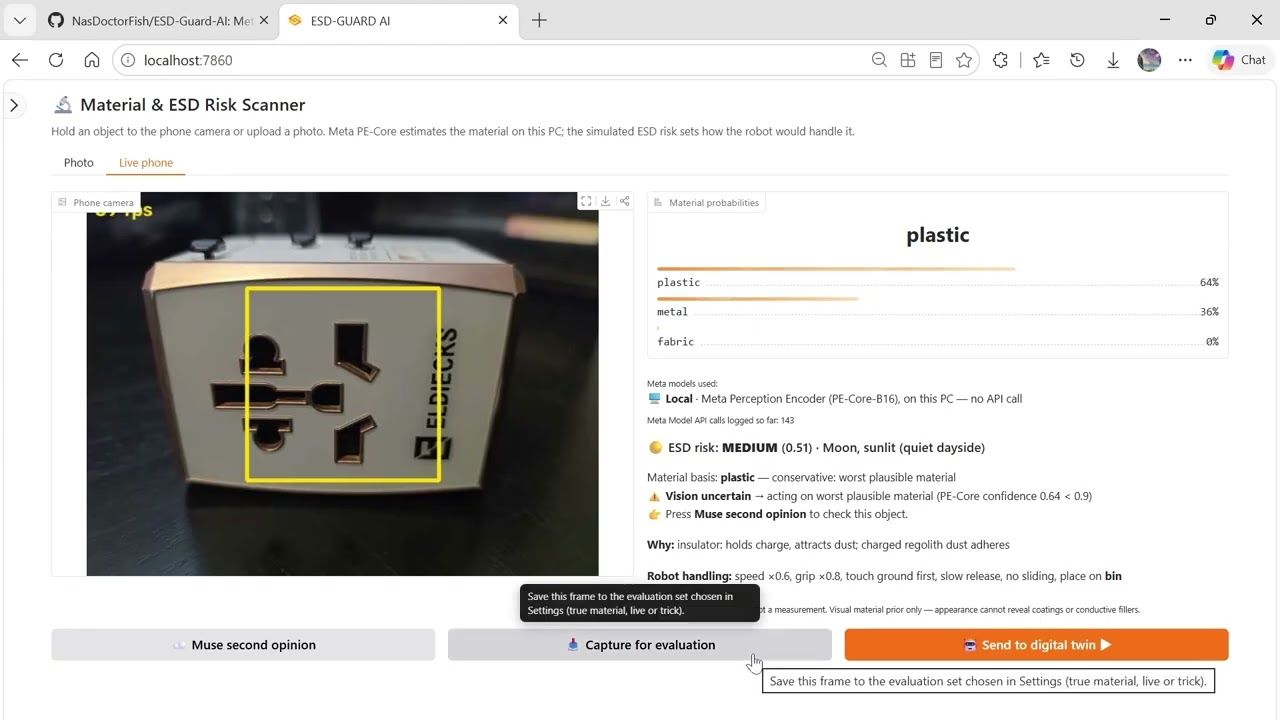
ESD-GUARD AI is a simulated lunar robot arm (Franka Panda in MuJoCo, lunar gravity) that recognises what an object is made of and changes how it handles the object to avoid electrostatic discharge. A camera image goes to Meta's Perception Encoder, which runs locally, and Muse Spark adds a second opinion. That gives a material estimate with an uncertainty flag. A transparent ESD risk model, built from cited NASA and peer-reviewed lunar charging data, turns the estimate plus the environment (sunlit plain, shadow, sun/shadow boundary, solar storm, or an Earth factory) into a handling policy: speed, grip, touching a ground rod first, slow release, and the grounding pad instead of the bin. Muse Spark plans the pick-and-place from the scene image, and a rule-based guardrail enforces the safety policy as a minimum. A web app ties it together. You scan a real object with a phone, see its risk card, and send it to a digital twin, where the arm handles it on the Moon and on Earth side by side. Results: - Simulation benchmark (10 scanned objects × 5 environments): 100% policy compliance, against 0% for a robot that ignores material on the Moon. - Held-out look-alike photos: 0/18 handled unsafely, against 5/18 with the Perception Encoder alone. - Guardrail test: all 112 deliberately bad plans were corrected. All ESD risk is simulated and labelled as such. The approach carries over to any physical AI that must handle unknown materials safely.