Shop-to-World
Built at Meta Global AI Developer Hackathon · Oct 26, 2026 · Remote
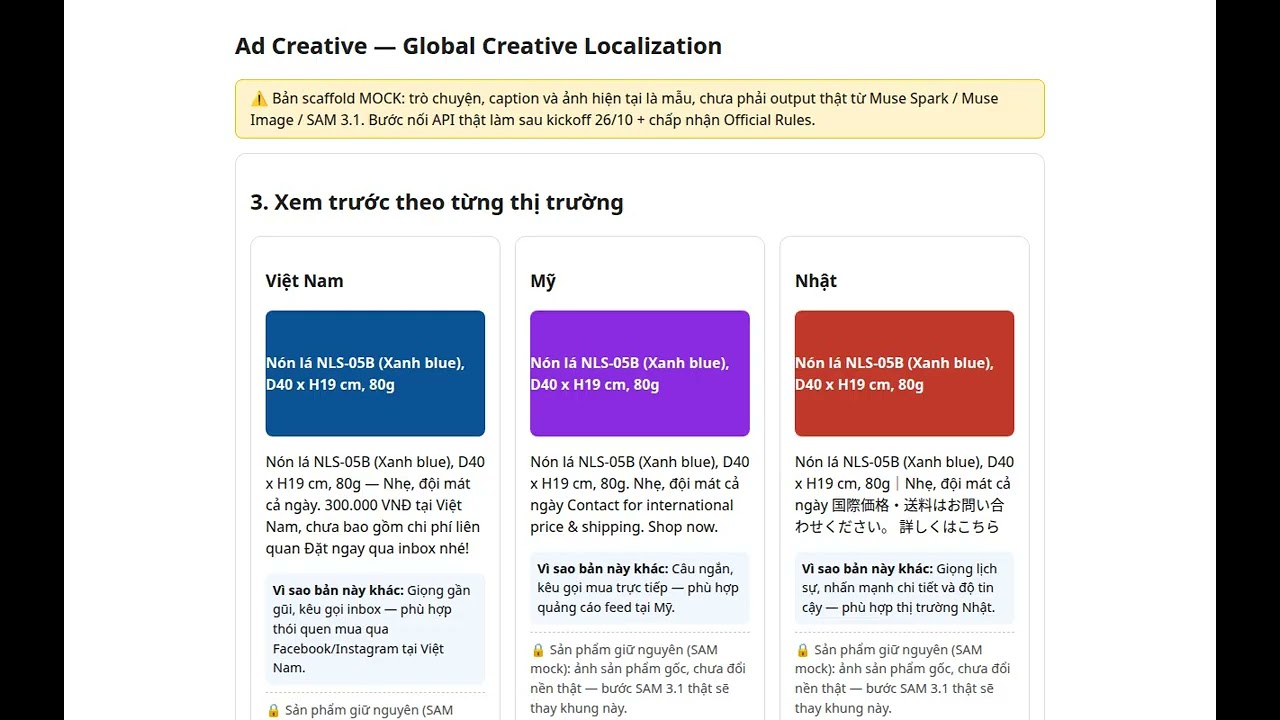
One brief, many markets: help a small shop create its first ad, localized by buying journey, not just by language or image. Short description Small shops with no creative assets cannot use existing ad tools, which assume assets already exist. Shop-to-World starts from a short interview instead: the shop answers three questions (audience, strongest benefit, tone), confirms one brief, and gets a first creative for each market. Localization follows the buying journey of each market: Vietnam closes in the inbox, the US checks out directly, Japan needs detail and trust before buying. The same product stays recognizable across markets, and every market shows why its version reads the way it does. Long description Problem. A small shop's first ad is the hardest one. Existing tools (including Meta's Advantage+ Creative) optimize creatives the shop already has; they do not help a shop that has nothing yet. The shop owner is not a marketer, does not know what a good brief looks like, and cannot judge whether a translated ad will actually sell in another market. What this does. Shop-to-World turns a 3-question interview into a first creative per market: 1. Adaptive Q&A: product and markets are preset; the shop answers only audience, strongest benefit, and tone. 2. Brief confirm: one brief is shown for approval before anything is generated. 3. Generate: product identity is locked (in the full build, SAM 3.1), and copy, tone, call-to-action, and price format are localized (in the full build, Muse Spark). 4. Preview: the shop sees each market's creative with a short rationale for why it reads that way. 5. Pick / edit / export: the shop picks a version, edits, and exports. Why buying journey, not just language. A literal translation keeps the words and loses the sale. Vietnam's creative closes in the inbox because that is where the purchase conversation happens. The US creative is short with a direct checkout call-to-action. Japan's creative leads with detail and trust signals. The novelty is the interview-to-brief step for shops with no assets yet, not image generation itself. Price discipline. Only the Vietnam price is stated. The US and Japan versions carry a "contact for international price and shipping" line. No US/Japan price, shipping cost, or tax is invented anywhere. What is actually built (honest scope) Built and demoable today: + A working mock web app (app/: index.html, app.js, styles.css) that runs the full flow: 3-question interview, brief confirm, and per-market preview with rationale for Vietnam, the US, and Japan. + The locked brief (brief.md) and the product test data below. + The QA fix applied 2026-11-04: locked fields are prefilled, questions start at audience, and US/Japan captions never show the Vietnam price (verified by syntax check and a behavior test of the caption logic). NOT built — do not claim these as done: + No live Meta Model API calls in this build. Muse Spark, Muse Image, and SAM 3.1 integration is the designed next step, not a shipped feature of this submission. + No product photo. Image permission was not agreed, so the submission contains no photo, no video frame with the product, and no link to one. + No demo video. + No public demo URL and no public code repository. The demo runs locally (see below). + No Facebook/Instagram crawl and no Ads Manager publishing. Test product (the only product data in this submission) Nón lá NLS-05B (Xanh blue), D40 x H19 cm, 80g. Price: 300,000 VND in Vietnam, not including related costs. US/Japan price, shipping, and tax: not stated anywhere (contact line only, by design). How to run the demo 1. Open app/index.html in a browser (or serve app/ statically). 2. Answer the three questions: audience, strongest benefit, tone. (Product and markets are already filled in.) 3. Confirm the brief. 4. Preview the three market versions and their rationales. 5. Confirm the US and Japan versions show the contact line, not a price.