Hemakhi
Built at Meta Global AI Developer Hackathon · Oct 26, 2026 · Remote
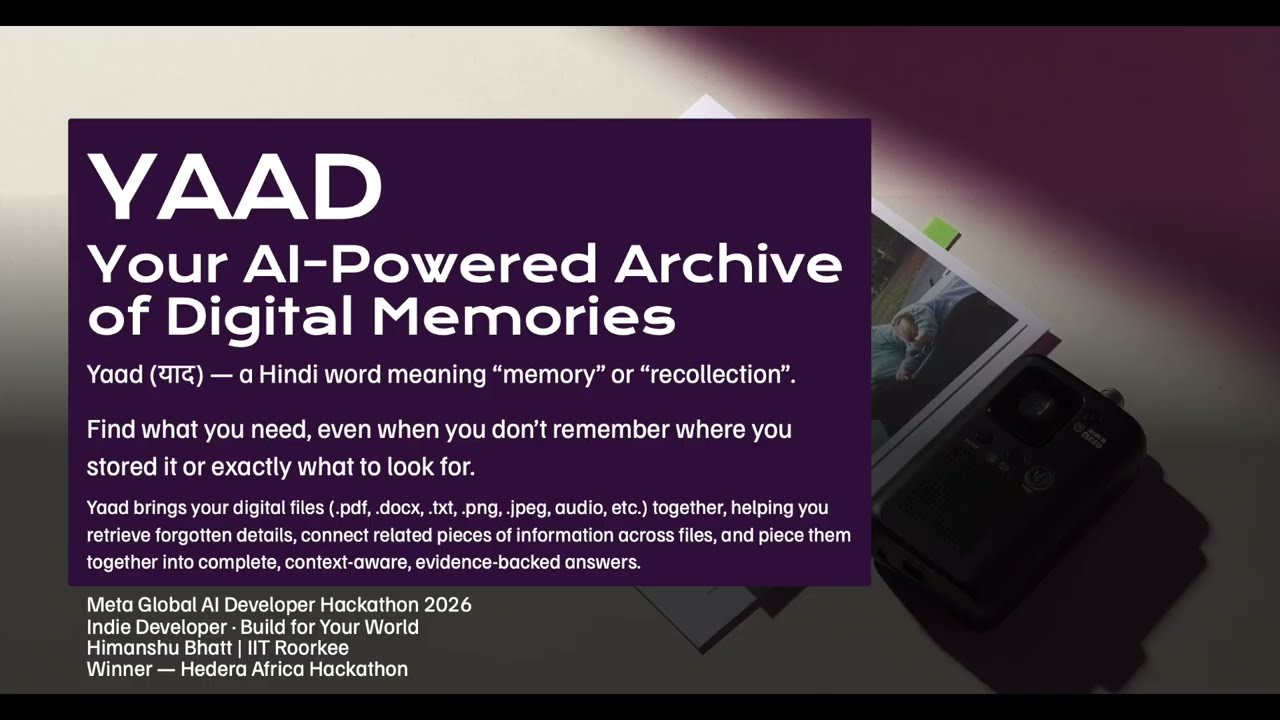
Yaad (याद) turns your scattered files into a memory you can question — and every answer comes with its evidence. The Problem Our decisions, deadlines, and commitments are scattered across PDFs, documents, images, screenshots, and voice memos. Finding one detail means reopening files. Connecting information across sources means holding everything in our heads. And when a deadline changes or two documents disagree, knowing what is still relevant becomes difficult. Traditional chatbots often retrieve information at query time, while basic RAG systems retrieve document chunks without maintaining a persistent understanding of how facts relate or change over time. The Solution Yaad is a local-first personal memory assistant that transforms scattered digital files into a connected, searchable memory. Point it at a folder, and Yaad processes PDFs, text documents, images, and audio into evidence-backed information units. It then builds persistent, structured memory around decisions, deadlines, commitments, and unresolved questions, linking extracted facts to their original source excerpts. Ask questions in natural language, and Yaad retrieves information, connects details across files, tracks changes over time, identifies conflicting claims, and abstains when the available evidence is insufficient. What Makes It Different Models Propose. Evidence Disposes. Unlike systems that rely primarily on generated responses, Yaad places evidence and deterministic verification at the centre of its architecture. Candidate facts are validated against their source text before storage. Relationships between facts are checked using evidence-based rules. Answers undergo verification for citation validity, excerpt support, numerical consistency, and temporal correctness. Unsupported claims can be downgraded or rejected. When information changes, supersession links preserve previous values rather than silently overwriting them. When sources disagree, both claims and their provenance remain available for inspection. Meta AI Integration Yaad integrates Meta AI models where model-based understanding adds value, with explicit consent and spending controls. * Muse Spark 1.3 and Muse Spark: Assist with document and image understanding, visual extraction, structured memory extraction, image comparison, and answer review. * Meta Voice Transcribe 1.0: Converts audio recordings into timestamped transcripts, making spoken information searchable. The surrounding architecture handles parsing, retrieval, relationship validation, conflict management, and final verification through deterministic logic. An optional Ollama integration also supports local model inference, depending on the configured model’s capabilities. Trust and Privacy Yaad follows a local-first architecture. Original files and indexed memory remain on the device. External model processing is governed by per-folder consent, a global cloud switch, and spending limits. Cloud-bound content is redacted to minimize identifiers. Files are treated as untrusted data rather than instructions, with suspicious content quarantined to help prevent prompt injection. External model interactions are recorded with their purpose, cost, and outcome. Yaad is memory you can audit: structured, connected, and honest about what it doesn’t know.