FORGE-0
Built at Meta Global AI Developer Hackathon · Oct 26, 2026 · Remote
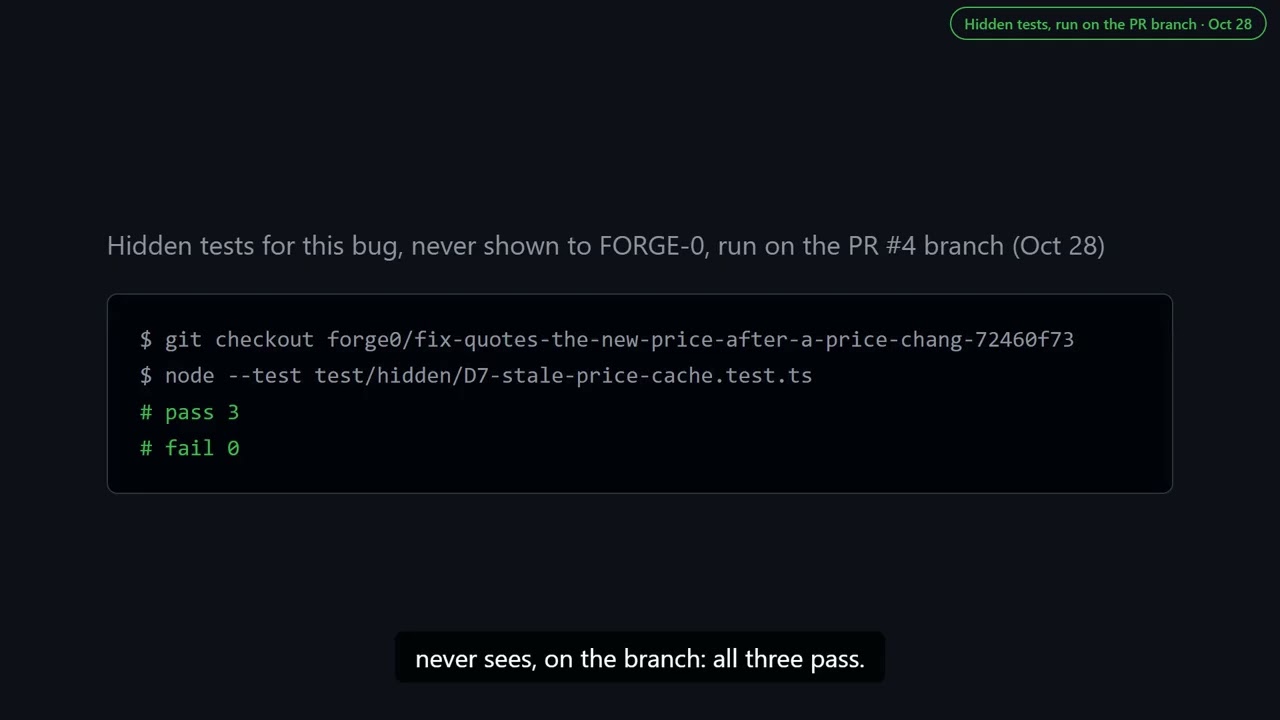
FORGE-0 is the verification layer for machine-written code. AI models now write fixes faster than maintainers can check them; FORGE-0 makes the model prove a fix before a maintainer ever sees it, and never opens a pull request for a patch it hasn't verified. What a maintainer sees: on Oct 28 an issue in our demo repo said quotes kept showing the old price after a price change. It was labelled "forge0", and nine minutes later a pull request was waiting. It named the root cause (a pricing cache that price updates never invalidate), listed two other explanations along with the sandbox experiments that refuted them, and showed the verification: the failing test passes, with no regressions among the 31 tests that already passed. The fix was 7 lines. The review question becomes "do I agree with this evidence?" instead of "is the AI right?" When a test fails, AI coding assistants usually pick the first plausible explanation and write a patch. If the explanation is wrong, the patch can look right and still be wrong, so developers end up checking the AI instead of the code. FORGE-0 works like a careful engineer instead: Muse Spark proposes several competing explanations of the bug, each with predictions about how the code should behave, and FORGE-0 runs experiments in an isolated, offline sandbox to rule the wrong ones out. Only when one explanation survives does it write a fix, and an independent verifier then re-runs the whole test suite on a fresh copy. A GitHub pull request is opened only for a verified fix, and its description is the evidence: the explanations considered, the experiments run, and what the verifier checked. Built this week, on top of a pre-existing core (the pipeline, sandbox, verifier and dashboard, which had never run on a real model): - GitHub integration: label an issue "forge0" and FORGE-0 investigates in GitHub Actions and opens a verified pull request. Three live runs on Muse Spark 1.3 are public (forge-0-demo PRs #4, #5, #6), each passing hidden tests FORGE-0 never saw. - Flaky-test triage: re-runs a failing test first and classifies it as deterministic, intermittent or order-dependent before looking for a cause. - A real open-source bug as a benchmark (issue #162 of the Python "parse" library), checked against the project's own regression test. - Harder benchmark defects, a fair edit-and-test baseline, pre-registered predictions, and the first real runs on Muse Spark 1.3 and Muse Spark Open. - Robust experiment design on open weights: when Muse Spark Open spends its whole output budget reasoning, FORGE-0 asks again for a compact plan at low reasoning effort. In a pre-registered re-run, FORGE-0 on Muse Spark Open went from 30 to 38 of 39 fixed, with no false claims. Results: scored by hidden tests no system had seen, FORGE-0 made 0 false fix claims in 30 runs on Muse Spark 1.3, where a one-shot AI fixer made 2. Across all 117 benchmark runs on both Muse models it still made none. A wrong AI patch costs reviewer hours, risks a bad merge and erodes trust in the next one. FORGE-0 opens a pull request only for a fix that passed independent verification, with the evidence attached, for about $0.07 per investigation. (It doesn't fix more bugs than an edit-and-test loop; docs/EVALUATION.md has the full comparison.) Try it: the repo has a Codespaces button that builds FORGE-0 and opens the dashboard, where you can start a sample investigation and watch it reject a patch that breaks another test, then verify a revised one (a labelled mock model by default, with the real sandbox and verifier; add a META_API_KEY secret for live Muse Spark). The pre-existing core is in a separate, labelled repo, and NEW_WORK.md lists exactly which files and lines were written during the event.