AutoSolar Researcher
Built at Meta Global AI Developer Hackathon · Oct 26, 2026 · Remote
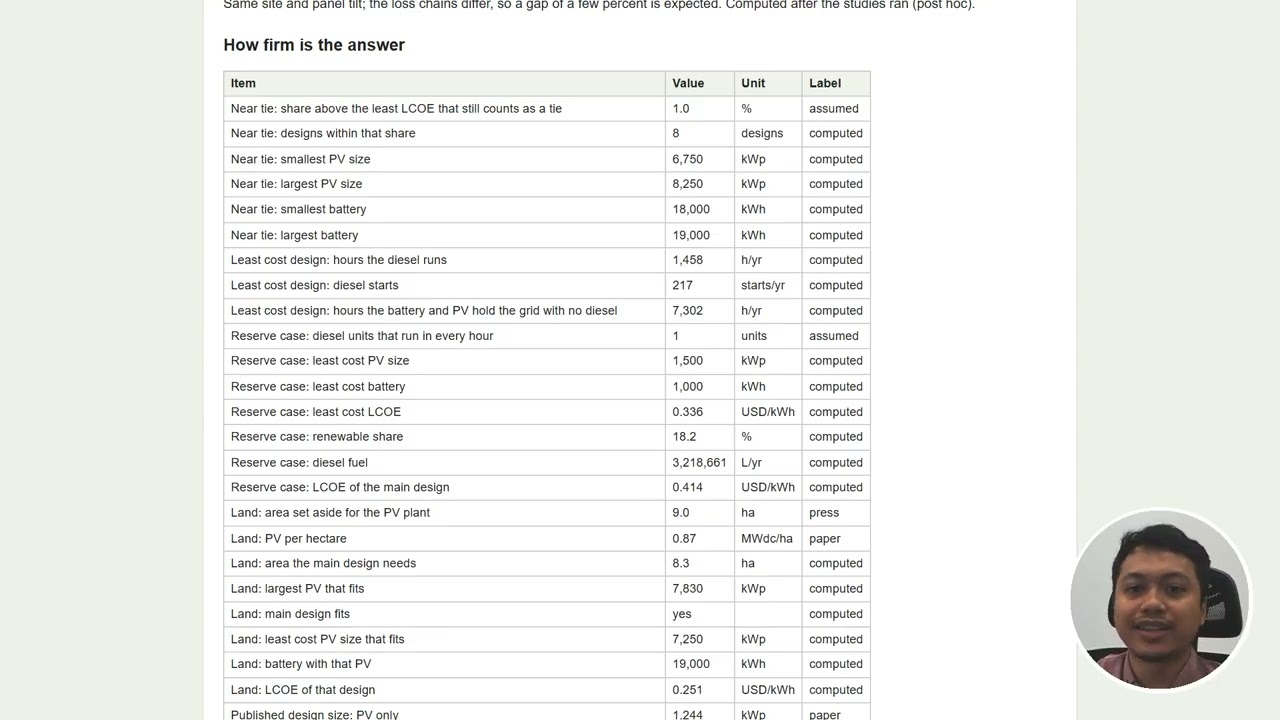
Ask one question about a diesel island and get a checked solar plus battery pre-feasibility study. Today it can cost one island, Karimunjawa in Indonesia's Java Sea. Live study pages: https://havidaqoma.github.io/autosolar-researcher/site/ Indonesia's state utility PLN plans to replace 2,396 diesel generators at 741 sites with solar and batteries (press). Each site needs a first study before anyone pays for a detailed one. For Karimunjawa the answer is: solar plus battery cuts the cost of electricity from 0.354 to 0.251 USD/kWh, 29.1% less (computed). Every input was fixed before the run and many are assumed, among them all battery prices and the discount rate; each is labelled on the page. The plant size stays provisional until the island's load is metered: of the 9 main inputs, each moved 20% down or up, only the load moves our design more than 1% above the cheapest one (8.8% with 20% less load). If one diesel unit must always run, the main design costs more than diesel only, though a smaller one is still 5.1% cheaper (computed). It is a first screen, not a replacement for a detailed design. A senior engineer at PLN (Perusahaan Listrik Negara, Indonesia's state-owned electricity company), speaking for himself, not for PLN: "Planning PV plus battery for a site usually takes one to six months, with PVsyst and other tools, so that nothing fails. An AI study in minutes is impressive, but every number must be double checked against references or field data, and the report must be easy to read and the data trustworthy." Dr. Andy Tirta, Head of Corporate Affairs, ASEAN Centre for Energy, speaking for himself: "Screening every resource for a site ... is harder for a person, so that is where a tool like this adds most." (Wording approved by each.) How it works: sunshine from four weather sources, PV modelled with pvlib, every hour of a year simulated for 925 PV and battery designs, and the cost of electricity computed two independent ways. Meta models find and cite the cost inputs, judge each citation, read the island's published power study (Hiron 2021) and its load chart, and review the finished study; the two Meta fields below say which model does what and how scripts check it. Every number carries a label (measured, computed, paper, docs, press, assumed; post hoc means added after the first study's results, still during the event). For the engineer who picks it up, the page ranks what to confirm first, and hourly files (plus a HOMER load file) let them redo the case in their own tool; we have not run HOMER or PVsyst ourselves. The chart check puts the study's load about 30% above the paper's December 2018 curve, and the page says so. Only Karimunjawa has an hourly load, so the tool refuses sites more than 30 km away (asked about Bawean, it says no and why); a site inside that radius gets Karimunjawa's load, so its answer is only as good as that guess. Built during the event, from Tuesday 27 Oct to the submission: all code in autosolar/, tools/ and tests/, every spec, every study and the static site. Prepared before kickoff and listed with commit times in PRE_EVENT.md in the public repo: planning, a literature sweep, a hand audit of the source paper, the 15 paper check rules (as text), the choice of a second test paper, a weather cross check, two satellite test images and a Muse Glimmer speed test. Those prep notes stay in a separate private repo because it holds copies of papers that may not be shared. The only commit in the public repo before kickoff is the 2-line .gitattributes file (no code).