Fair Wear
Built at Meta Global AI Developer Hackathon · Oct 26, 2026 · Remote
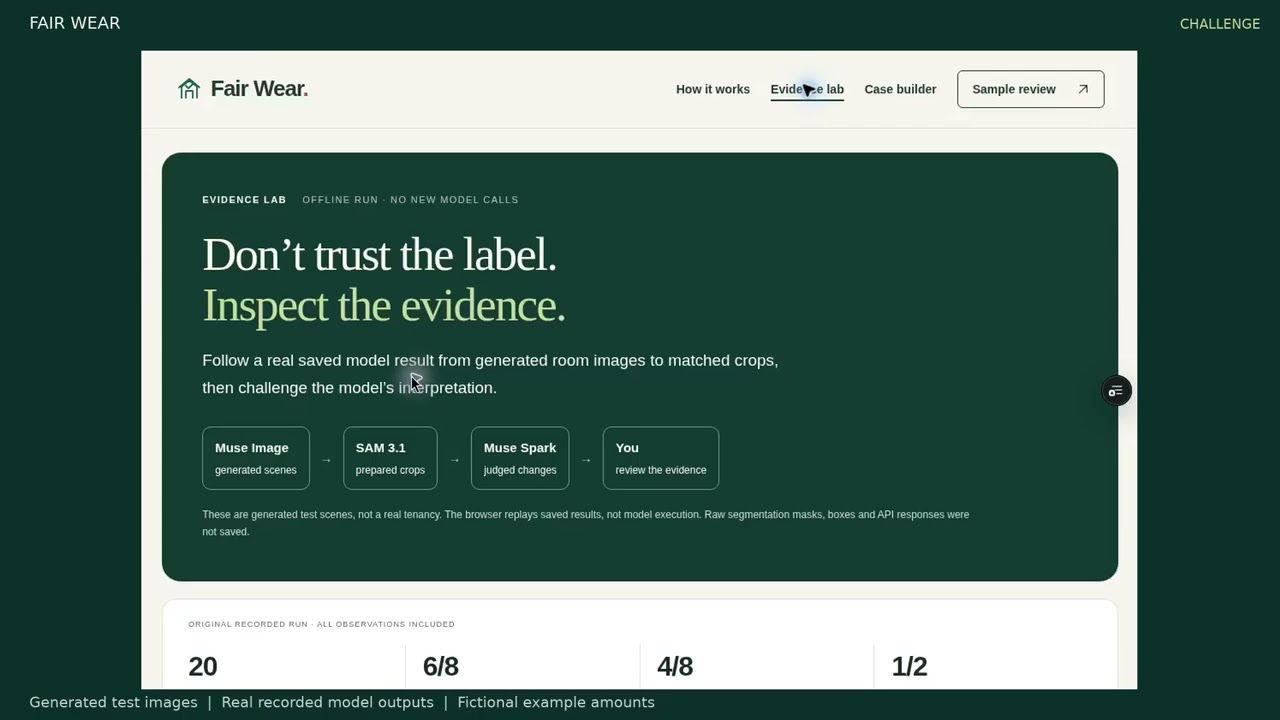
Fair Wear helps UK renters inspect proposed deposit deductions, challenge model findings and export an evidence-backed response for human review. Live app: https://fair-wear.vercel.app Sample review: https://fair-wear.vercel.app/demo Evidence Lab: https://fair-wear.vercel.app/inspect Case Builder: https://fair-wear.vercel.app/case-builder Recorded pipeline: Muse Image generated four test rooms; SAM 3.1 segmented rental-relevant objects; deterministic code matched and cropped them; Muse Spark proposed condition labels. The app serves these saved model results without new model calls. Three tools make the evidence useful and open to challenge: • Sample review: Explore 20 crop-pair findings with a draggable or keyboard-controlled image divider. Choose Discuss after evidence, Dispute or Not claimed, then download a draft. Known model errors remain visible. The divider is a visual comparison, not an aligned measurement. • Evidence Lab: Trace room images to crop pairs and recorded claims, inspect missing observations and adjust confidence filtering. Download a report separating human review from model output. SHA-256 checks compare 51 files with the published manifest, establishing byte consistency, not correctness or authenticity. • Case Builder: Organise deductions, notes, photos and responses, then export a self-contained HTML evidence bundle with embedded images. Transfer and edit sample-review choices for three fictional claims, or use your own photos locally without uploading them or applying AI. Private cases can include supporting-record references as unverified descriptions, without attaching those files. Optional replacement-value calculations require explicit assumptions and never change the claimed amount or accept liability. Nothing is sent automatically. Reviewers can record available evidence and generate tailored requests for gaps. For future runs, ambiguous object matches are withheld for human review; the recorded demo and its evaluation are unchanged. Original small generated-scene test, unchanged by the new tools: • Planted changes detected: 6/8; expected label: 4/8. • Planted damage labelled damage: 3/4. • Fair-wear decoys wrongly labelled damage: 1/2. • Unplanted crop observations flagged as changed: 1/9. Generated scenes and planted labels are not real-home validation or independent pixel-level ground truth. A reproducible fixed-label baseline compares the saved results with labelling every observed crop damage; it is not a model ablation. Planning documents and a mock scaffold predate the event, from 15 October. Working model integrations, evaluation, evidence review, exports and new tools were built during the hackathon. Fair Wear supports human review, not legal advice or decisions about responsibility. Source: https://github.com/OlsOls4/fair-wear/commit/6b1edf925fdaddf9a0cffdc87f4ba78d8bd79b04 Checks: https://github.com/OlsOls4/fair-wear/actions/runs/41920546840