Reality Compiler
Built at Meta Global AI Developer Hackathon · Oct 26, 2026 · Remote
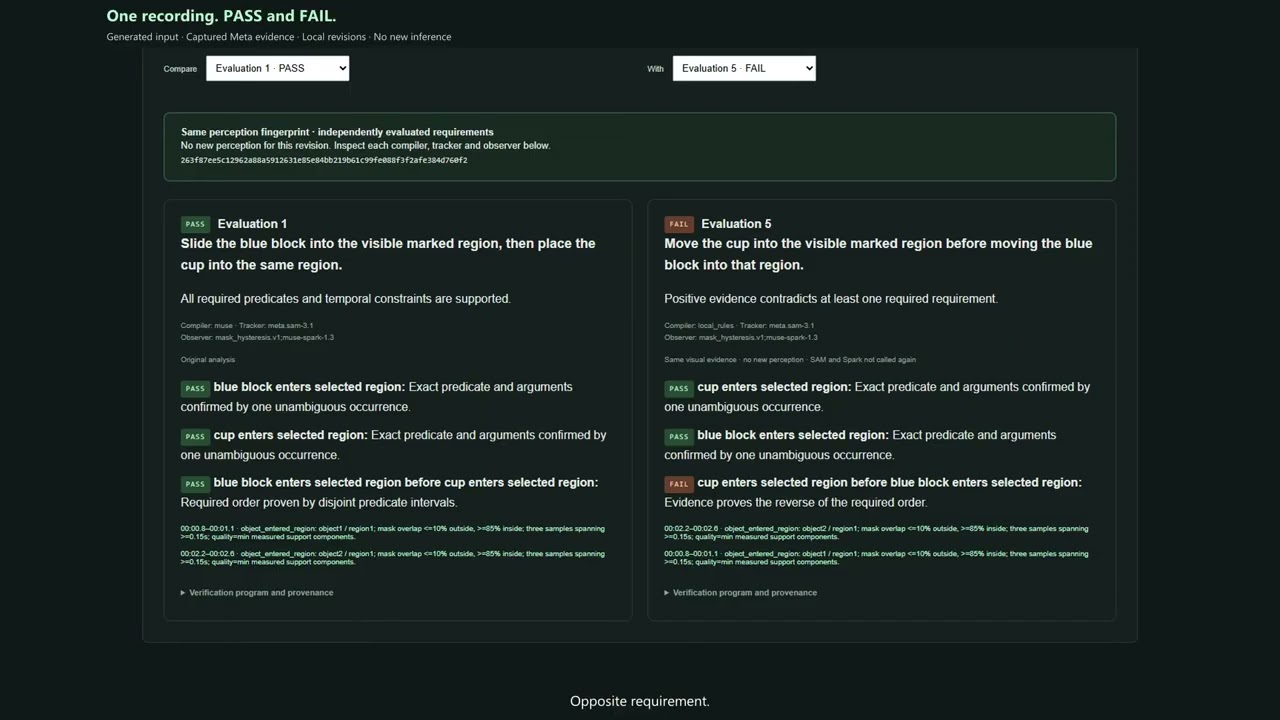
Ordinary video AI describes what appears to happen. Reality Compiler asks a different question: does the evidence establish what the procedure requires? Written physical instructions become an inspectable verification program: identified objects, typed actions, visible regions, explicit ordering and unsupported conditions. Video observations link each decisive check to evidence IDs, time intervals and supporting frames. A deterministic evaluator returns PASS, FAIL or UNKNOWN with reasons. Our working demonstration shows a blue block entering a marked region before a cup. The original requirement passes. Enter a new requirement—cup before block—and it fails against the same preserved evidence. Add “ensure the cup is sterile” and the result becomes UNKNOWN: the visible order holds, but the evidence cannot establish sterility. Each revision compiles independently and must pass a semantic compatibility check before reusing perception. Matching fingerprints make that reuse inspectable; the original evaluation is preserved. Muse Wonder compiled the original requirements, with independent source-grounding and semantic validation. SAM 3.1 supplied actual captured masks and tracks. Deterministic geometry produced region-entry observations; deterministic logic judged their order. Muse Spark supports bounded visible final-state interpretation in separate captured runs, not this order comparison. New demo revisions compile with explicitly labeled local rules. Offline capture review needs no Meta credentials and makes no new inference requests. The initial opportunity is evidence review for robotics experiments, simple workstation procedures and training demonstrations: reviewers can inspect a requirement, its proof and what remains unknown. Compatible revisions avoid repeating expensive visual analysis. These are potential applications, not claims of validated customer demand, production accuracy or cost savings. The public demonstration uses generated input and actual previously captured Meta evidence. It is not physical-camera acceptance. Historical camera findings establish only narrow final visibility or uncertainty; three controlled camera cases remain pending. Image-region entry does not prove physical insertion or containment, and hidden conditions remain unsupported. The prototype runs locally with explicit provenance, immutable audit history, source-frame inspection for new uploads, expiry and conservative uncertainty handling. As supplementary reproducibility evidence, three separate 15-second generated videos also passed through the actual upload/initialization API and local OpenCV pipeline: correct order PASS, observed cup-first order FAIL, and occlusion UNKNOWN. Their results, timestamps, source frames and new revisions were inspected in Chrome. End-to-end native UI uploads remain unverified because of browser-control limitations. The occluder triggers a coarse scene-motion guard that invalidates both identities; this is conservative uncertainty handling, not proof of camera movement or a robust occlusion classifier. These runs use no SAM or new Meta inference. Reality Compiler turns a video summary into an independently inspectable argument about whether evidence matches a procedure.