WilmerAngel
Built at Meta Global AI Developer Hackathon · Oct 26, 2026 · Remote
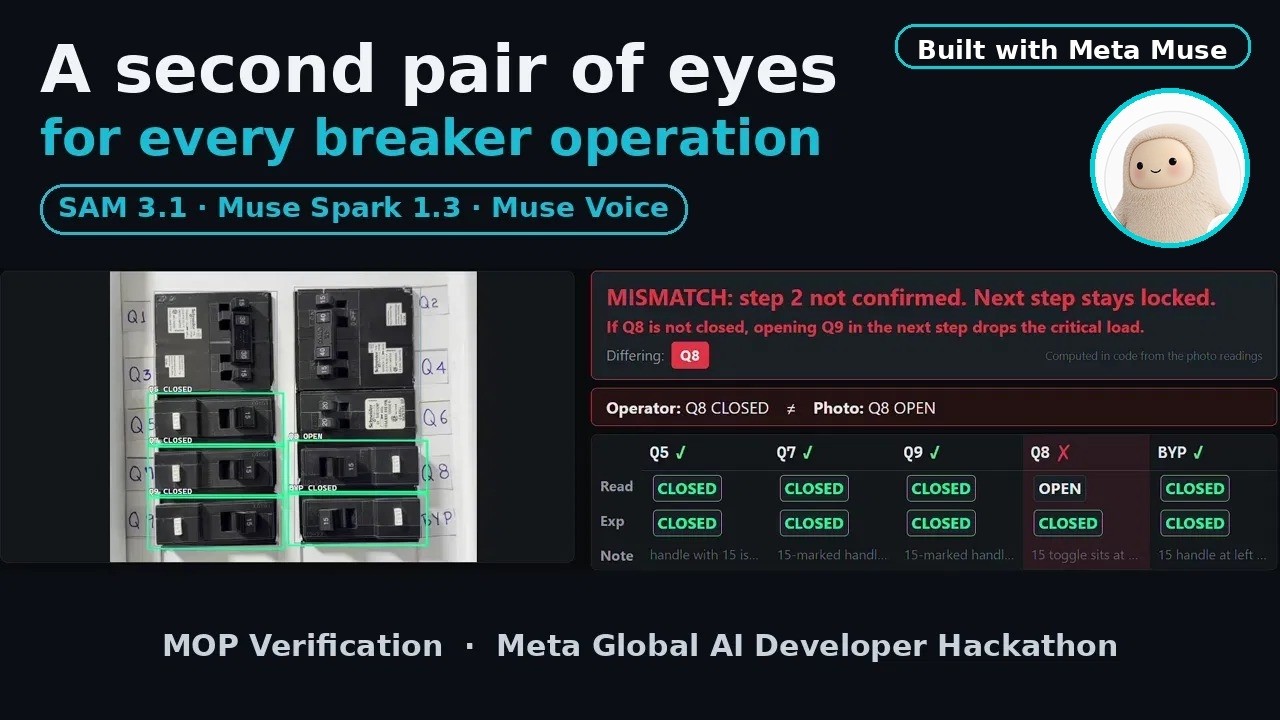
In a data center, transferring a UPS to maintenance bypass is a sequence of breaker operations written in a Method of Procedure (MOP). One breaker operated out of order can drop the critical load or parallel two sources that must never meet. Today the only check is a second person reading the panel and the paper MOP. MOP Verification is a second pair of eyes for every breaker operation. At each MOP step the technician photographs the panel. SAM 3.1 locates the breakers, code splits each column into one crop per breaker using the panel's measured geometry, and Muse Spark 1.3 reads each handle. Then plain code compares every reading with the expected state of that step. The models only read; the code decides. If anything does not match, the next step stays locked and the app shows the hazard written for that step, such as "If Q8 is not closed, opening Q9 in the next step drops the critical load." The technician can also read the step back by voice. Muse Voice Transcribe turns the readback into a claim, and Verify flags it when the claim and the photo disagree. I also built an agentic investigator, exposed as an API: Muse Spark first writes an investigation checklist that includes a counter-evidence item, then investigates with four tools, and the code caps its confidence when the counter-evidence stays unresolved. The demo runs a five-step UPS bypass procedure on a residential training panel, not a live UPS.