Precept Ledger
Built at Meta Global AI Developer Hackathon · Oct 26, 2026 · Remote
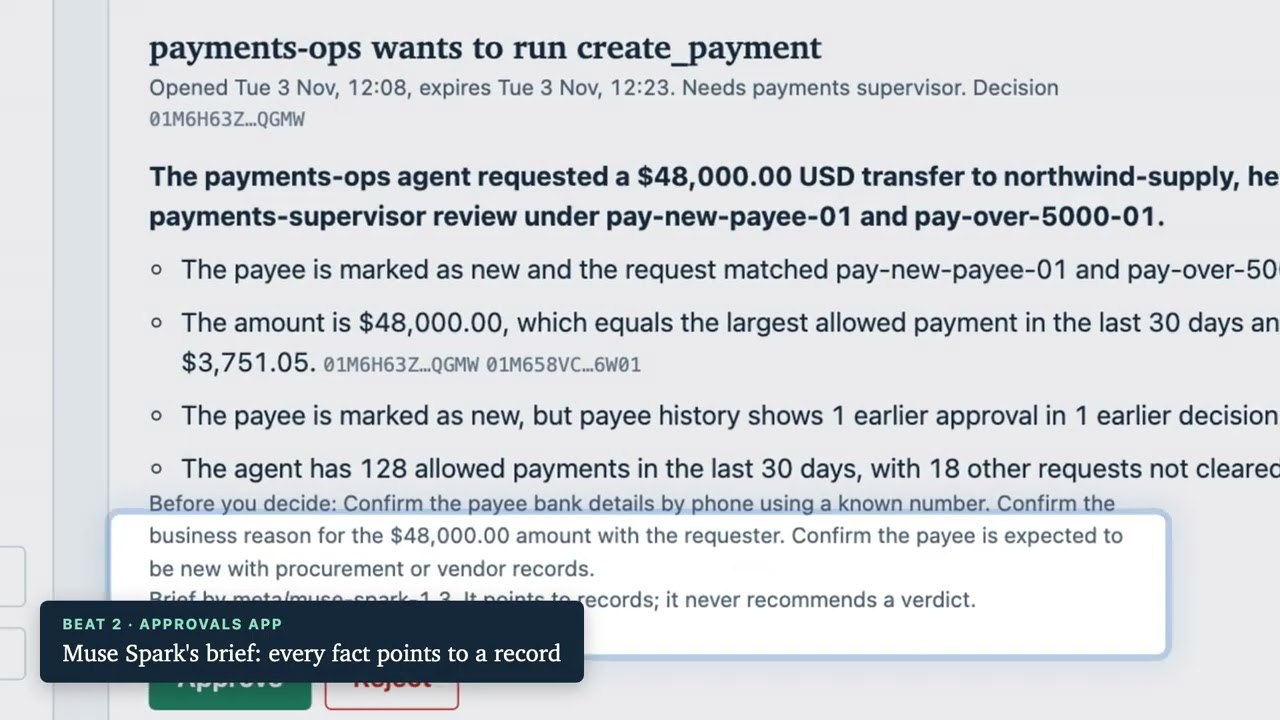
anks want AI agents to move money, but an examiner will ask two questions no agent framework answers: was this action allowed before it ran, and can you prove the record was never changed? Logs in a database the operator controls prove neither, and a model's summary of those logs can be wrong. Precept Ledger is a gate and a tamper-evident ledger for AI agent actions: Gate decides first. It sits in front of every agent tool call and decides in code with Cedar rules: allow, deny or hold for a person. It signs the decision, and the tool runs only after the ledger returns a signed receipt. If the ledger is down, nothing runs. The ledger is a transparency log. It uses canonical JSON records, producer signatures, a hash chain and an RFC 9162 Merkle log. Checkpoints every 10 seconds are cosigned by three independent witnesses, and two of three make a checkpoint final. RFC 3161 and Bitcoin time anchors seal the time. Even the operator holding the log key can't rewrite history unseen. The verifier works offline. It has no network code and names the first broken record. Meta models do the language work, and code checks everything they say: Muse Wonder turns the bank's policy PDF into rules. Muse Spark drives the payments agent, writes approval briefs and answers examiners in claims. Each claim is proven against Merkle proofs or rejected on screen. A Policy Learner proposes rule changes from the ledger's own history. A replay blocks any loosening that would have allowed a past rejection. People sign in to two web apps, and each role sees only its own screens. Everything is open source (Apache-2.0) and was built during the hackathon.