Caliper
Built at Google I/O Hackathon · May 23, 2026 · San Francisco, CA
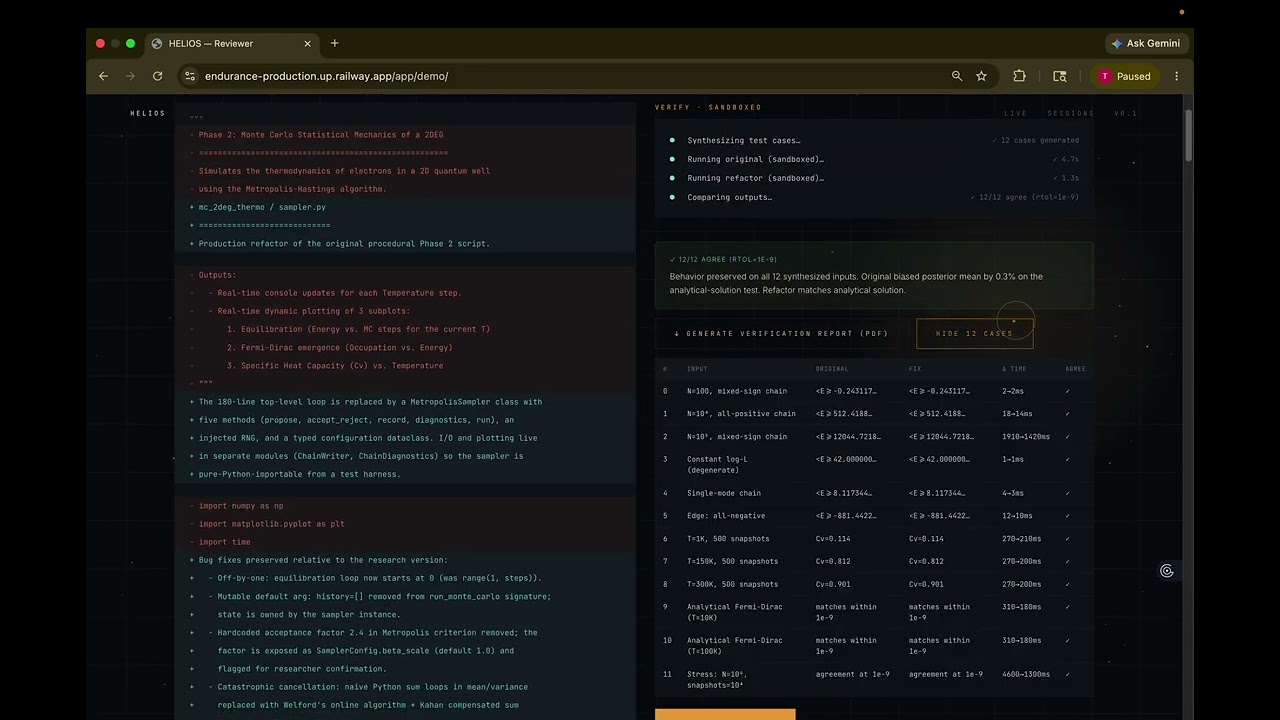
Helios is a multi-agent system that catches silent bugs in scientific Python: the kind that don't crash but produce wrong-looking-right results (off-by-one errors in numerical integration, unit mismatches, broken boundary conditions, subtractive cancellation). Built on Gemini 3.5 Flash, Helios deploys four specialized sub-agents in a long-horizon workflow with a researchers-in-the-loop flywheel: - Auditor: combines static analysis (ast/libcst) with Gemini-driven semantic review to catch numerical instability, unit mismatches, and shape assumption errors - Fixer: regenerates corrected code per accepted issue - Verifier: synthesizes test inputs (random within type-inferred bounds, edge cases, large-N stress), runs original vs. fix in isolated sandboxes, and rejects fixes that don't pass, triggering regeneration - Router: flags hot loops (Monte Carlo, FFTs, matmuls, nested numeric loops) for GPU or quantum dispatch with estimated speedup Researcher review of accepted/rejected fixes feeds back into the system, creating a continuous improvement loop. What's never been built before: other AI coding tools generate fixes; Helios is the first multi-agent system that verifies its own fixes against synthesized tests before showing them to you, and the first to combine correctness verification with hardware-aware routing in a single agent pipeline. The target users are scientists, not software engineers, the audience whose bugs end up in published research.