Autonomous Infrastructure Auditor
Built at Google I/O Hackathon · May 23, 2026 · San Francisco, CA
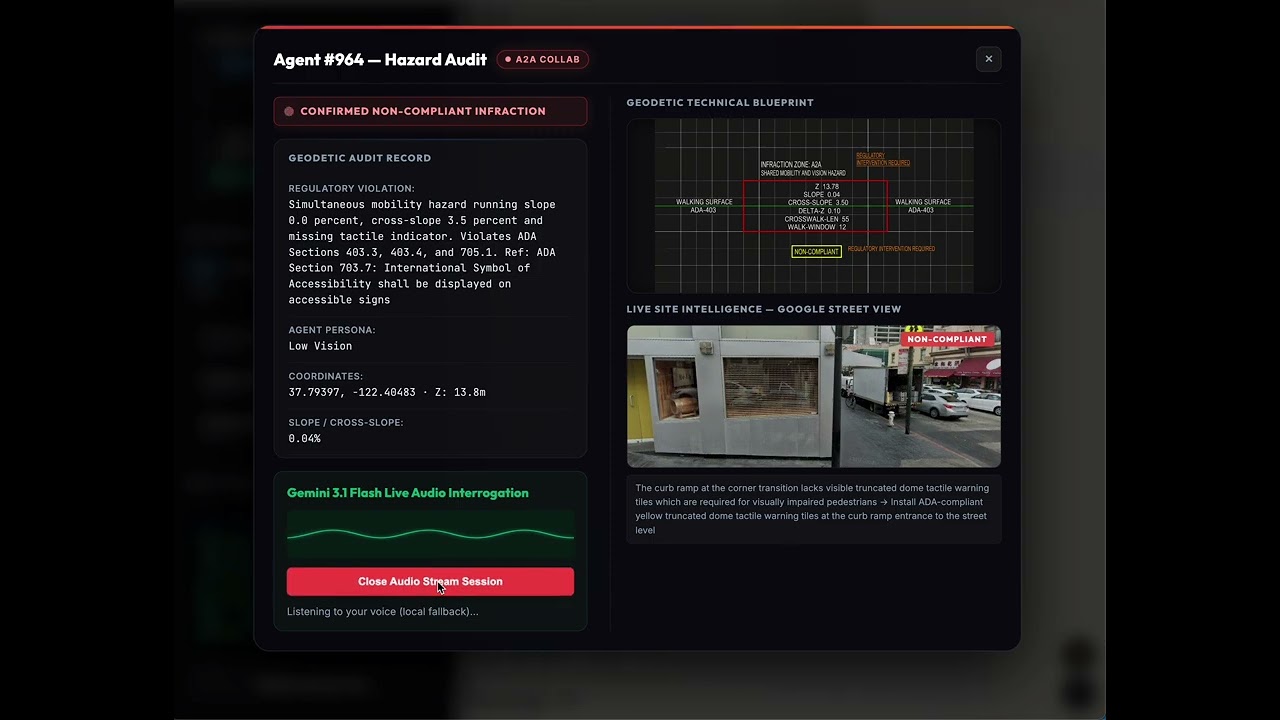
1 in 4 Americans lives with a disability, yet most cities have no systematic way to audit pedestrian infrastructure for ADA compliance at scale. Manual inspections are slow, expensive, and cover only a fraction of the street network. The Autonomous Infrastructure Auditor solves this by deploying a fleet of AI specialist agents across any urban district to autonomously detect accessibility violations such as steep ramps, missing tactile indicators, insufficient crosswalk timing. These are things that prevent wheelchair users, visually impaired pedestrians, and ambulatory individuals from navigating the city safely. A District Orchestrator dispatches three specialist agent types concurrently, each walking real geodetic terrain and applying persona-specific ADA thresholds to measured physics. What makes the system distinctive is how it grounds every finding in multiple modalities simultaneously: real terrain elevation data drives the slope physics, live Street View imagery is analyzed by Gemini's vision capability to visually confirm hazards at the exact coordinate, and the agents' regulatory reasoning is anchored to specific ADA code sections rather than generalized descriptions. When a location fails multiple criteria at once, two specialist agents negotiate a unified fix through bidirectional context passing, producing a single remediation that resolves compound hazards together. The result gives city planners actionable, location-specific violations at a scale and speed no human audit team could match.
