Argus
Built at Gemini 4 Argon SF Hackathon · Oct 25, 2026 · San Francisco, CA
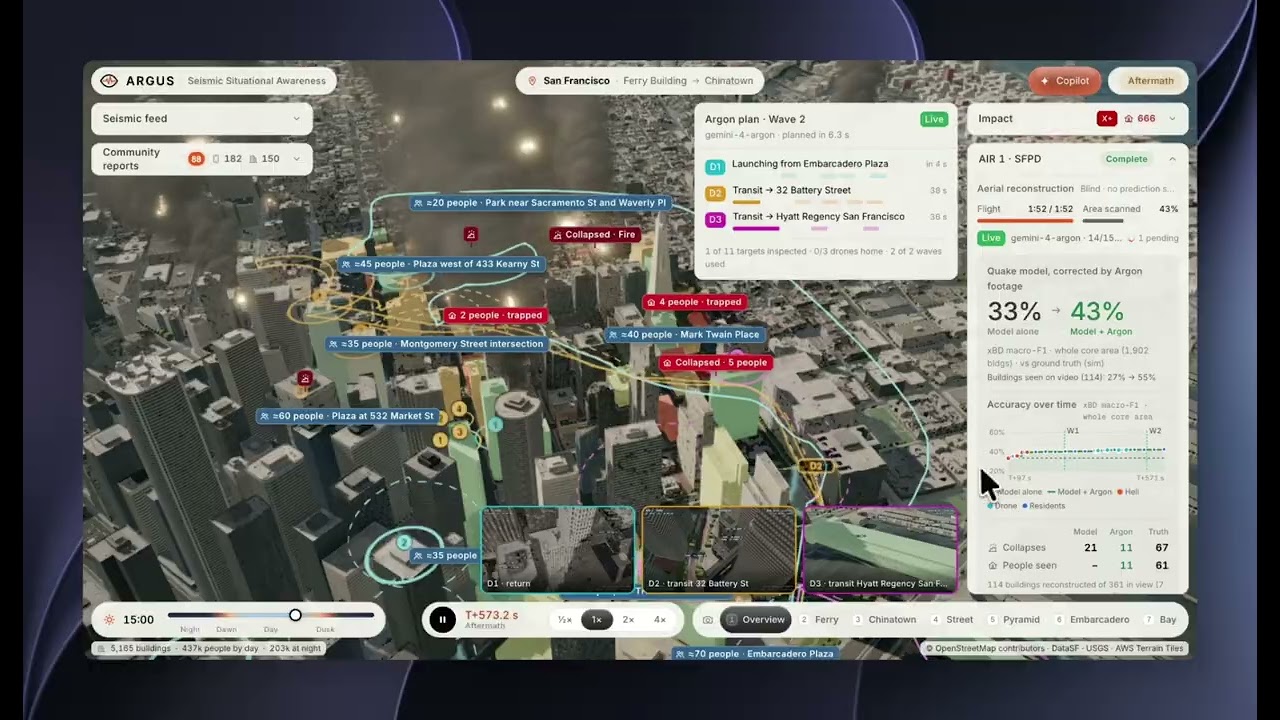
Argus doesn't just simulate an earthquake. It watches the city afterwards, uses Gemini 4 Argon to keep correcting its own physics model against what it sees, and turns the most accurate picture of the damage into rescue decisions that save more people. The problem: in the first hour after a major quake, physics-based damage models (USGS PAGER, FEMA HAZUS) can say roughly how bad a district is, but not which building fell or who is trapped inside, and nobody corrects them as evidence comes in. Police helicopters and drones stream hours of footage that no operations centre can watch. In the 1976 Tangshan earthquake more than 240,000 people died, many of them survivors trapped under rubble while rescuers searched blind. What Argus does, over a real-data 3D San Francisco (5,689 buildings from OpenStreetMap, DataSF LiDAR and Assessor records, real streets, terrain and bay) and a physics-grounded replay of the 1906 M7.8 San Andreas earthquake: Simulate, then keep correcting the physics. Gemini 4 Argon watches the aftermath: AR-tagged police helicopter video, drone close-ups and resident reports. Working blind (it never sees the model's prediction), it reconstructs each building's damage, people on rubble and rooftops, signs of trapped survivors, fires and blocked streets, each tied to the video second as evidence. Every observation tells Argus how hard the ground really shook at that spot, and the correction propagates to nearby buildings no camera has reached yet. The physics model is updated continuously against evidence instead of standing as a one-time guess. Build the best damage picture, then save more people. Argon decides where drones should look next to reduce uncertainty fastest and writes the mission plan in about 6 seconds; the commander approves, three drones fly close orbits, and their video goes back to Argon. Then the commander asks in plain language, "I have 10 fire engines, 20 police officers, 2 helicopters and 6 ambulances, where do they go?", and Argon returns ranked priorities, unit assignments and routes around blocked roads, drawn live on the 3D city. Nothing moves until the commander clicks Dispatch. Results, scored against the simulator's hidden ground truth on the xBD damage scale (Argon never sees the truth): Buildings Argon saw: 24% -> 46% macro-F1, nearly double the damage model's accuracy. Whole downtown core (1,902 buildings, most never on camera): 33% -> 43%, from seeing only 7% of the city. Resident reports: Argon linked 77% of 198 noisy, multilingual reports to the right building and read the damage correctly on 96% of those.