celestial2
Built at Gemini 4 Argon SF Hackathon · Oct 25, 2026 · San Francisco, CA
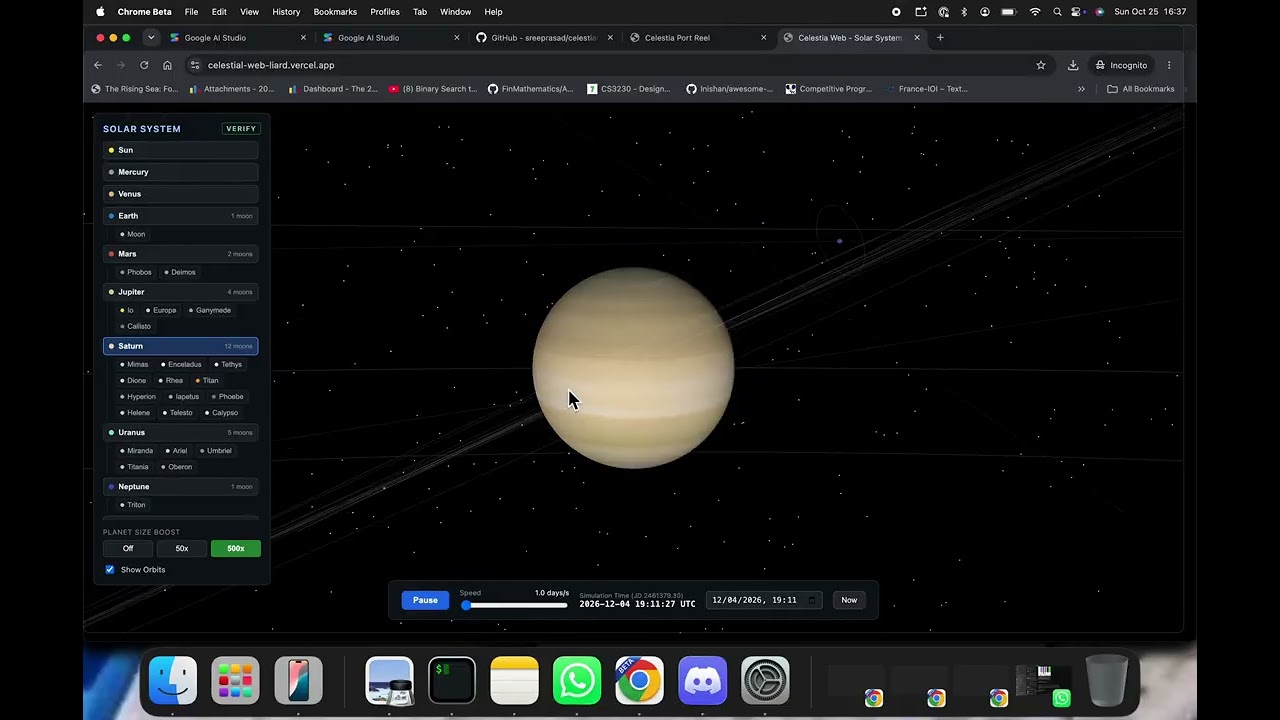
Live: https://celestial-web-liard.vercel.app Anyone can now open Celestia’s solar system in a web browser, with no install. Celestia is a well-loved open-source space simulator written in C++ with legacy OpenGL. We ported its orbit engine to TypeScript, Next.js and Three.js using Gemini 4 Argon. We did not just make it look right. We proved it is right. We compiled the original C++ as an answer key. Then we compared every body at 1,003 dates from 1900 to 2100. All 35 bodies match: the Sun, eight planets, Pluto and 25 moons. Most agree to within centimeters. The largest difference is 34 meters, for Phoebe, on an orbit 13 million km wide. This was tedious work. The planets alone use 10,203 coefficients. Saturn’s moons come from the TASS17 theory, with over 1,100 rows of numbers for Iapetus alone. Argon copied every one of them into TypeScript. The check also caught real mistakes. Argon dropped 5 identical rows from a 583-row table. Our row-by-row diff found the exact spot. Argon fixed it, and every date matched again. You can pick any planet or moon and fly to it. You can run time forward or jump to any date. The Verify page shows the accuracy for every body. Live: https://celestial-web-liard.vercel.app Code: https://github.com/sreeprasad/celestial-web Original: https://github.com/CelestiaProject/Celestia Orbit code ported from Celestia (GPL-2.0-or-later). Planet textures from Solar System Scope (CC BY 4.0).