Virtual Lab
Built at Gemini 4 Argon SF Hackathon · Oct 25, 2026 · San Francisco, CA
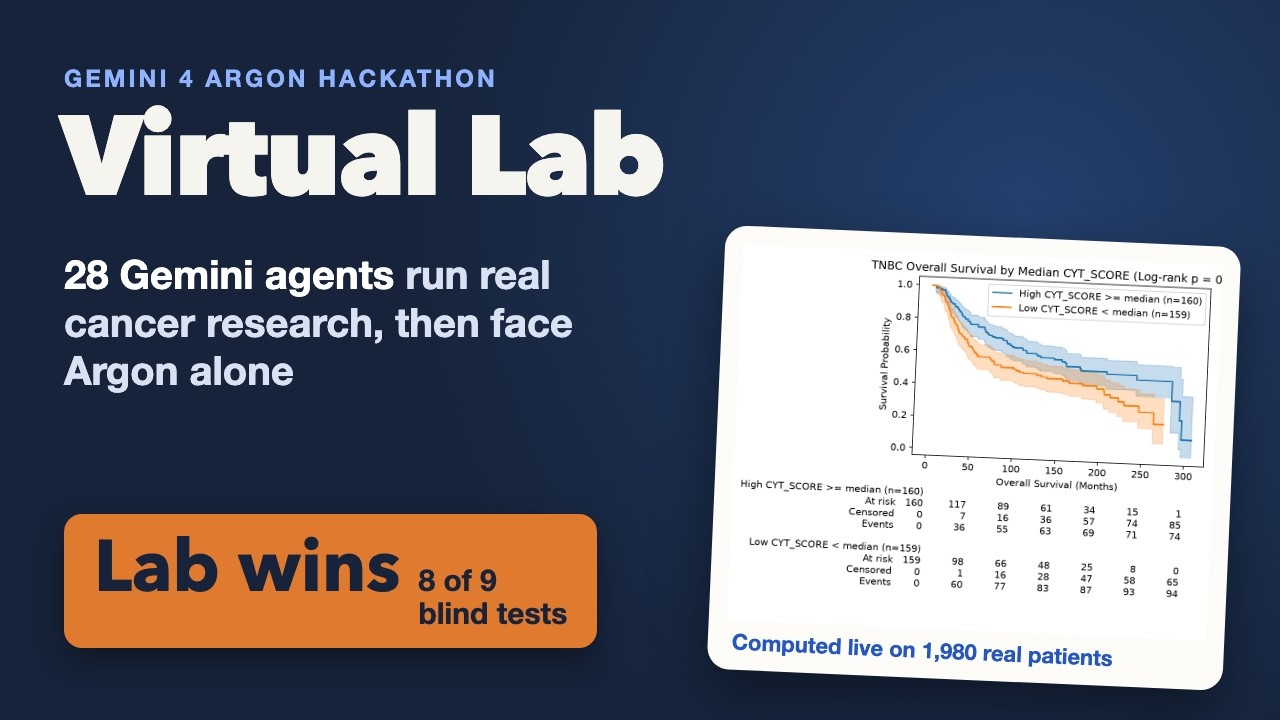
Cancer researchers have public datasets and hypotheses, but getting from a question to a tested, cited answer takes days: someone has to read the literature, design the analysis, poke holes in it, then write and run the code. An AI chatbot answers in seconds, but it never touches the data, so its numbers are educated guesses. Virtual Lab works like a real lab, built from 28 Gemini agents with one job each. They study the topic and write cited notes. Three planning meetings run in parallel: in each, a lead scientist asks an immunologist, a statistician and a data expert for ideas, and a critic attacks the plan until it holds up. A lead scientist merges the plans and code checks that the data has every variable needed. Then a person approves the budget, which becomes a hard spending cap. Gemini 4 Argon writes the analysis code, and a Gemini managed agent runs it on 1,980 real breast cancer patients (METABRIC) in a Google-hosted sandbox. The lab writes an answer that separates what its data shows from what published research says, with references. Finally a blind judge compares it with Gemini 4 Argon answering alone, twice, with the order swapped; the lab must win both. On our demo question (is more cytotoxic immune activity in triple-negative breast cancer linked to longer survival, after accounting for age, stage and grade?), the lab won 8 of 9 blind tests. It found about a 20% lower risk of death per standard deviation of the immune score (hazard ratio 0.76–0.80 in every run), consistent with the literature. A run takes about 2.5 minutes and costs about $0.35. It is a research tool, not medical advice: questions about an individual patient are turned into research questions about patients in general, and it uses public data only.
