chroma-code
Built at Built with Claude: Life Sciences · Jul 7, 2026 · Remote
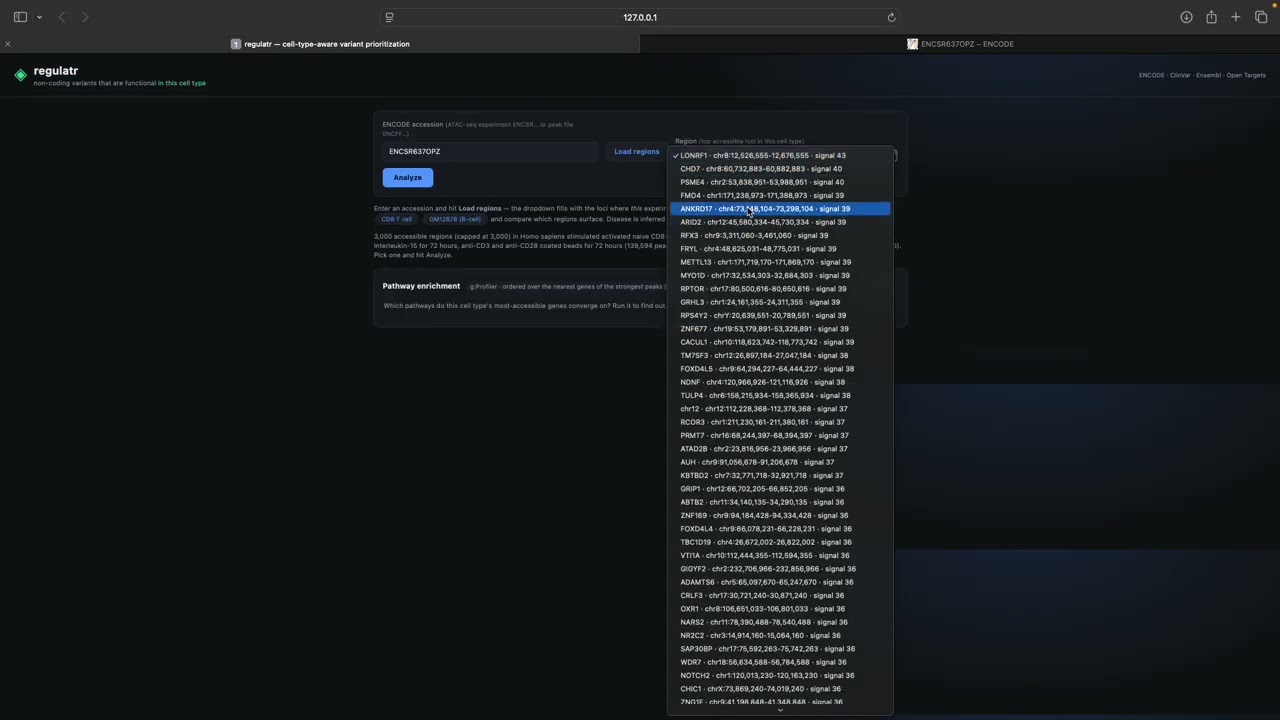
regulatr — cell-type-aware non-coding variant prioritization What we built. regulatr is a web tool that answers a question standard variant annotation can't: is this non-coding variant sitting in active regulatory DNA in the cell type that actually matters — and which gene does it likely control? Most disease-associated genetic variation lies outside protein-coding genes, where its effect is regulatory: it changes whether and where a gene is switched on. But regulatory DNA is cell-type-specific — an enhancer variant only matters in a cell type where that enhancer is open. So "is this variant functional?" is the wrong question; "is it functional in this cell type?" is the right one. regulatr operationalizes exactly that. You give it a single ENCODE chromatin-accessibility experiment (ATAC-seq), which fixes the cell type. It scans that experiment's peak file genome-wide to find where regulatory DNA is open, pulls every ClinVar variant in a chosen locus, flags which variants fall inside open chromatin, maps each to its nearest gene via Ensembl, infers the gene's strongest disease association from Open Targets, and ranks the variants by a transparent composite score (accessibility strength, clinical significance, and gene–disease score, equally weighted, in-peak variants first). It adds ordered pathway enrichment over the most-accessible genes (g:Profiler), an embedded igv.js genome browser, and JSON/CSV export. The entire backend is Python standard library only — zero third-party dependencies — and pulls all data live from ENCODE, ClinVar, Ensembl, Open Targets, and g:Profiler. What we found. The tool makes the cell-type dependence of non-coding variation visible. Loading the same locus under two different experiments — say a CD8 T-cell line — surfaces different accessible regions and a different set of variants landing in open chromatin. The same variant can be "in open regulatory DNA" in one cell type and inert in another, which is precisely the biological signal that a cell-type-agnostic annotation would erase. Building it also surfaced real data-integration subtleties worth handling correctly: ENCODE peak BEDs use inconsistent schemas, so the signal column must be resolved per file rather than assumed; gnomAD genome frequencies (not exome) are the right subset for non-coding variants; and gnomAD's own region API can't serve wide windows, so ClinVar's embedded frequencies are the reliable source. Why it matters. Interpreting non-coding variants is one of the central bottlenecks in human genetics. regulatr turns a genome-browser hunch into a ranked, exportable, provenance-tracked list of cell-type-specific mechanistic hypotheses — the candidates worth testing at the bench first. It is deliberately honest about scope: accessibility locates open regulatory DNA but never calls variants; nearest-gene mapping is a first approximation, not chromatin-contact evidence; and an in-peak variant is a hypothesis, not proof. Every result is coordinate-checked to hg38 and traceable back to its ENCODE source file and lab. By combining public accessibility, clinical, and target-disease data behind one accession-driven query, regulatr lowers the barrier to asking the right, cell-type-aware question — for any of the hundreds of biosamples ENCODE already provides.
