DeepPro-v2 is a multi-view, multi-backbone deep learning model for prokaryotic promoter prediction across 23 species. It aggregates five complementary genomic foundation model experts through a learnable anchor–prototype fusion module with a soft-MoE aggregator, together with a differentiable motif-grammar side branch. Training follows a three-stage pipeline: task-adaptive pretraining of each backbone on the pooled 23-species corpus, followed by per-species two-stage 5-fold training, and finally ensemble voting. Findings: DeepPro-v2 attains a mean test MCC of approximately 0.81 across the 23 species, exceeding strong genomic foundation model baselines (GROVER, HyenaDNA, DNABERT2-CAMP, msBERT) retrained under a faithful, paper-matched reproduction protocol. Beyond headline accuracy, we subject the model to an end-to-end analysis and interpretability campaign spanning statistical significance testing (Friedman–Nemenyi and pairwise Wilcoxon), probabilistic calibration (ROC/PR and reliability curves), per-view contribution analysis, representation-space separability (UMAP), motif discovery, error stratification, and a full 23×23 cross-species transfer matrix. This campaign also yields honest negative results: the soft-MoE gate does not aggressively prune experts—itself evidence that the five views are non-redundant—and an anchor-prototype probe revealed no latent class structure, which we report as a negative finding. Most strikingly, the standalone differentiable motif-grammar branch spontaneously recovered the sigma-70 −10 box (TATAAT; best per-expert correlation r = 0.67) from binary promoter/non-promoter labels alone, without any motif-level supervision. Why it matters: Accurate and interpretable promoter identification underpins genome annotation and synthetic biology circuit design. By pairing fair, paper-matched benchmarking with a comprehensive, reproducible analysis and interpretability suite—rather than reporting a single accuracy number—we provide a rigorous reference for this task and make transparent both where the model succeeds and where it does not. All of the work presented here was built during a one-week hackathon: "v2" denotes an in-week iteration of our own model rather than an extension of any pre-existing project.
More from Built with Claude: Life Sciences
What I built. Lazarus is an agent that takes a dead research repository that is open, cited, and no longer runnable, and turns it back into a callable…
Diffuse midline glioma is a paediatric brainstem cancer that is almost uniformly fatal: about ninety percent of children die within two years, and the first…

Hippocampus AI is the memory and reasoning engine for scientific discovery. Every experiment generates valuable knowledge, but that knowledge becomes…


I used Claude to train a protein language model that can generate an extremophilic version of any enzyme, maintaining its function, while allowing it to…


Many primates are sexually dichromatic — males and females are different colors. I wanted to know how that trait is built genetically, and how it evolved…

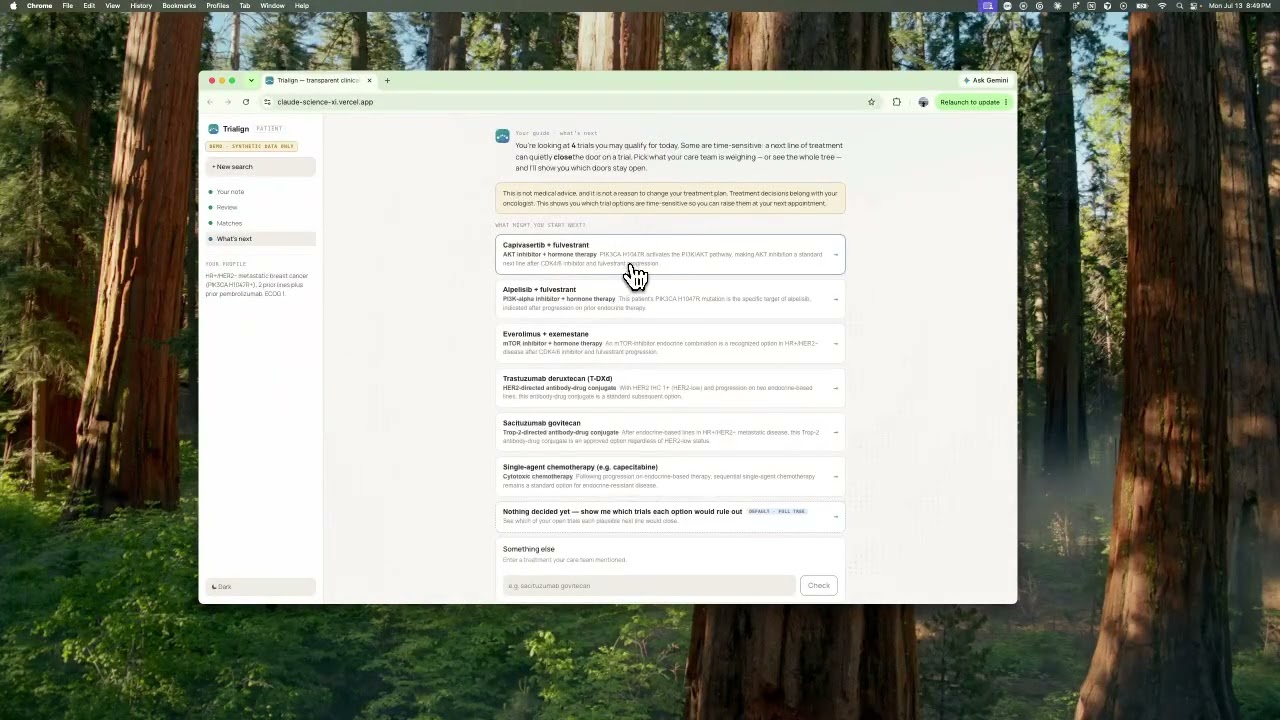
About Trialign is a patient-facing clinical trial matcher for oncology. A patient pastes a clinical note, uploads a record, or connects their EHR via SMART on…