Discoverybytes
Built at Built with Claude: Life Sciences · Jul 7, 2026 · Remote
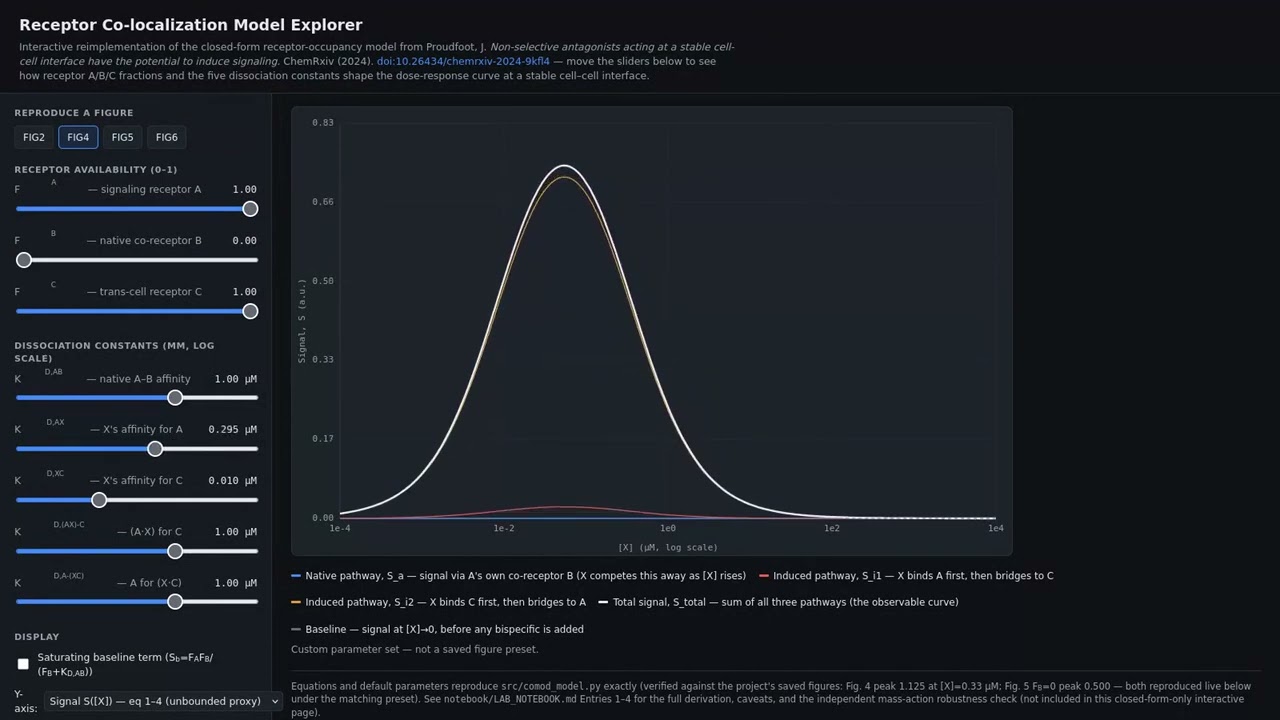
Co-localization of signaling molecules to a stable cell-cell interface is a key prerequisite for signaling in systems such T cell activation. We had previously built a model that indicated bifunctional antagonists, such as bispecific antibodies, might have unexpected activating function in such systems. We revisited the concept to do the following. 1. Confirm the math behind the model and build a user-friendly interface to visualize activation / inhibition 2. Generate a table of receptor proteins that span the cell membrane once, and are involved in signaling. These are candidate targets for modulation via this co-localization mechanism of action. 3. Expand the candidate target data to include data for interaction partners, disease associations (including rare/orphan), therapeutic objective (i.e. activate/inhibit), highest drug clinical stage for any targeting the receptor. We ranked pairs by a composite Opportunity Score, then narrowed to three rare/orphan diseases with clean ligand-replacement logic: CD70-CD27 (severe combined immunodeficiency), DLL4-NOTCH1 (Adams-Oliver syndrome), and EDA-EDAR (hypohidrotic ectodermal dysplasia). DLL4-NOTCH1 lacks a disease-modifying option, making it our lead despite highest mechanistic risk: Notch activation requires active endocytic force, not proximity alone. Molecular design concept would tether a nanobody against EFNB2, an endothelial protein coupled to Notch signaling, to one against NOTCH1.
