Paul Gueguen
Built at Built with Claude: Life Sciences · Jul 7, 2026 · Remote
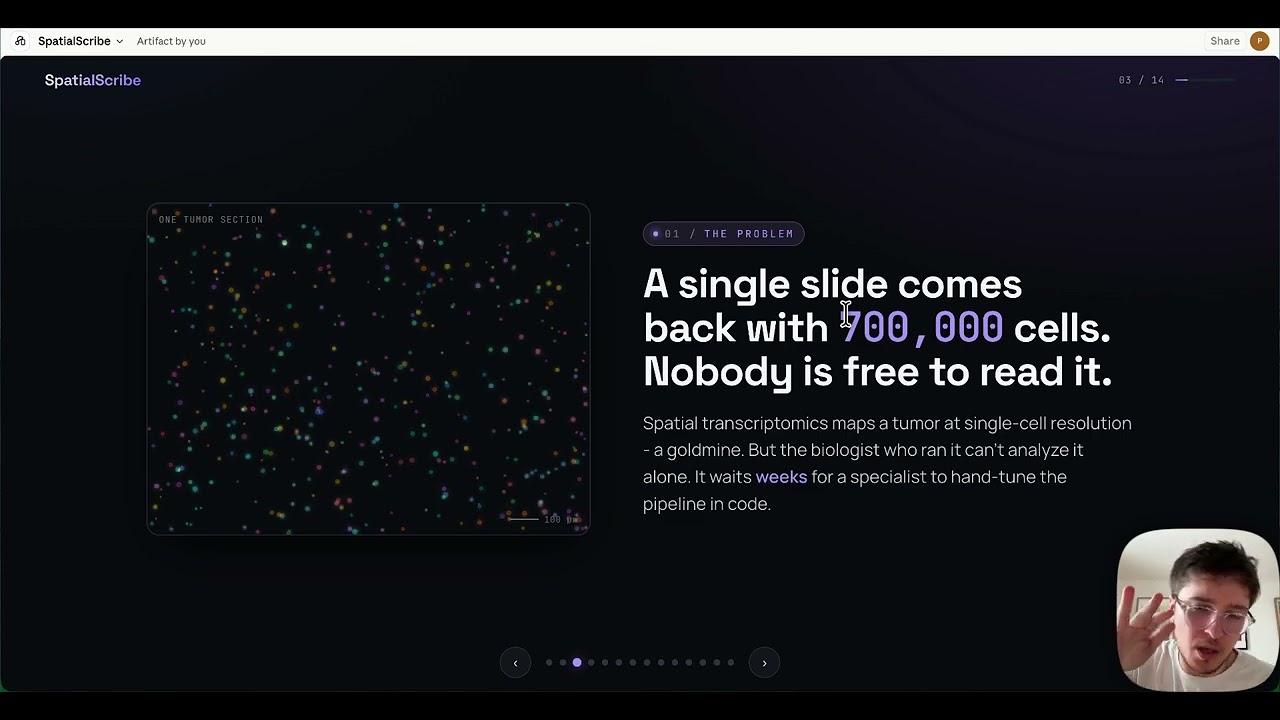
SpatialScribe is a self-serve copilot for imaging-based spatial transcriptomics (Xenium, CosMx, MERSCOPE, and whole-transcriptome Atera). A wet-lab scientist points it at a raw run folder and gets back a QC'd, annotated, spatially-explored tissue map plus a re-runnable report - in plain language, with no terminal, no R, and no waiting for a bioinformatician. It's a React + FastAPI + deck.gl app over a single shared analysis engine of 40 capabilities, drivable four ways: guided rails, one click ("Run full analysis"), one headless command, or a grounded Claude copilot that runs the real analysis and can recolour the map, subcluster a population, or load a whole new section from plain English. The thesis is honesty. Most tools label every cell. SpatialScribe refuses to: it abstains when the evidence isn't there, tells you up front which cell types your panel can and cannot resolve, and reports one 0-1 Annotation Quality Index. Three findings I didn't expect: A low "confidently typable" score is usually a DEPTH verdict, not a panel defect. On the bundled 5K-panel section, restricting to the panel's genes costs 1 of 10 cell types; thinning to the section's real ~50 counts/cell costs 5. Buying a bigger panel would not have helped. Reference agreement is not annotation quality. Transferring a lab's own 28-type skin reference lifted agreement with their existing RCTD from 0.23 to 0.70 while the quality index collapsed from 0.22 to 0.01 - those fine types simply aren't separable on a 495-gene panel. Coarsening the reference first buys both (agreement 0.65-0.75, AQI 0.28). Per-cell confidence heuristics barely rank correct cells (within-type AUC ~0.54, near a coin flip). Only cross-method ensemble agreement does (~0.77). So the app declares which regime it's in instead of pretending its greying is trustworthy. Why it matters: spatial runs are piling up far faster than bioinformaticians can read them, and the failure mode that actually hurts a biologist is a confident wrong label. The quality index is validated against expert ground truth (Spearman ~0.78, 95% CI 0.66-0.86, across 11 sections and 5 tissues) - and it is an index, explicitly not a probability of being correct.