Xiao
Built at Built with Claude: Life Sciences · Jul 7, 2026 · Remote
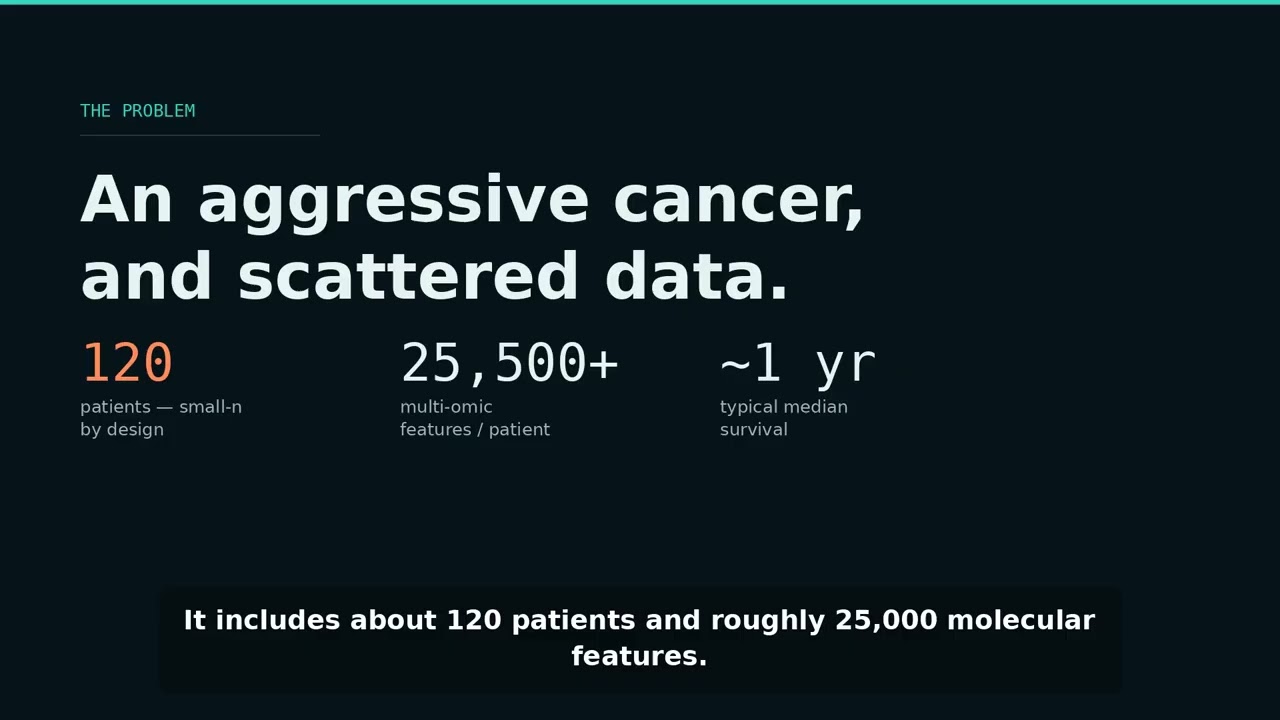
Background & motivation Mesothelioma is an aggressive, asbestos-linked cancer of the pleura with poor prognosis and few effective therapies. It is particularly important to study in Australia, which has one of the highest incidences of the disease in the world, driven by its historical use of asbestos, while only hundreds of public omics datasets now profile it across modalities and this information is scattered and rarely integrated. The goal is to use Claude to automate retrieval and integration of public multi-omics datasets (genomics, transcriptomics, epigenetics), then systematically identify survival-associated features that are reproducible across cohorts, biologically meaningful, and have potential for clinical translation — such as cancer-vaccine target discovery. Project description I developed a new feature-selection workflow. A reliability-first method for high-dimensional, small-sample omics survival data: repeated event-stratified split screening + epistasis-hub detection + bootstrap stability LASSO-Cox, combined so that only features reproducing across resamples survive (released as the reusable omicsfs library). It was applied to mesothelioma on the MESOMICS cohort (120 patients × ~25,000 multi-omic features: expression, DNA methylation, LOH, CNV, driver alterations. I benchmarked it against commonly used methods. Head-to-head against SIS, LASSO-Cox, Random Survival Forest and XGBoost, and DeepSurv under one common evaluation: cross-cohort survival transfer to external cohorts, KEGG pathway enrichment, single-cell cell-type expression, and a curated-literature check. Panels of prognostic features for mesothelioma were selected to take forward. The workflow yields reproducible, cross-cohort-validated biomarker panels — a shortlist of candidate features for further experimental validation. What found. The in-house consensus panel generalizes best across cohorts (expression-surrogate C-index ~0.67; native multi-omics transfer to TCGA ~0.72), edging established methods — though at n=120 the bootstrap confidence intervals overlap, so this is competitive and best-generalizing. A key methodological result: internal cross-validation is optimistic. Biologically, the prognostic signal sits largely outside canonical driver pathways, and several top targets are immune-compartment genes (T-cell, mast, neutrophil, dendritic). Why it matters. Methodologically, this is a template for a defensible biomarker benchmark — verified comparators only, honest confidence intervals, generalization prized over internal fit. Translationally, it delivers a short, druggable, immuno-oncology-relevant target shortlist for Mesothelioma, an asbestos-linked cancer with few effective therapies and growing use of immunotherapy. Methodologically, it can be used to select features for other cancers.