PHANTOM
Built at Built with Claude: Life Sciences · Jul 7, 2026 · Remote
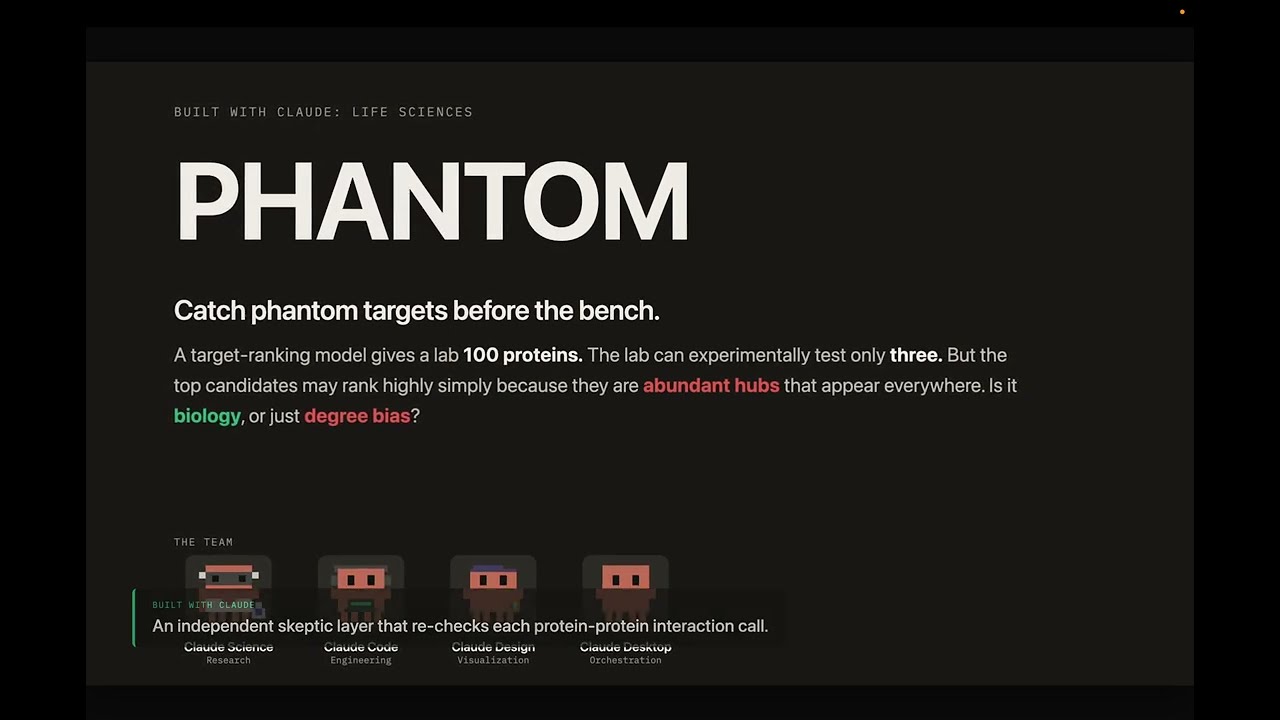
What I built / investigated A degree-bias assessment for protein–protein interaction (PPI) ranking. The central question: when a PPI method ranks candidate partners for a protein complex, how much of that ranking reflects genuine, specific binding versus a confound — the fact that well-studied, highly-connected “hub” proteins tend to score high for everything? I attacked this on two levels: A controlled complex example — a 29-protein network spanning three complexes (Arp2/3, CCT/TRiC, MCM), with a naive network score and a degree-corrected re-ranking, to show the mechanism cleanly. Real data vs. a published model — the same degree assessment applied to two experimental interactomes (BioPlex 3.0, 293T and HCT116; score = CompPASS-Plus pInt) and to a sequence-only deep predictor (D-SCRIPT human_v1, run from the published model over its own benchmark pairs; score = interaction probability). The one label-free, directly comparable statistic across all of them is the Spearman correlation between score and node degree. What I found The direction of the degree relationship flips between experimental and computational scores. BioPlex top scores are negatively correlated with degree (−0.097 / −0.110) — they favor specific, low-degree pairs. D-SCRIPT is strongly positive (+0.659, far beyond a degree-preserving null, p ≈ 0.001) — its top scores are enriched for hubs. Most of the predictor’s apparent skill on its benchmark is a sampling artifact. Benchmark positives have higher endpoint degree (6.6) than the randomly-sampled negatives (2.8), so a biology-free degree-only baseline recovers the labels at AUROC 0.905. D-SCRIPT reaches 0.944 — a biology premium of only +0.039 AUROC over degree alone. In the controlled example, ranking inverts biology: the hub ACTB (degree 23) ranks #1 while the specific true member MCM6 (degree 6) is buried at #29. Degree correction promotes the seven Arp2/3 members and the seven CCT/TRiC members to the top as confirmed targets and demotes the frequent-flyer hubs to “hypothesis only.” Why it matters A low-degree, top-ranked pair in experimental data is plausibly a true, specific interaction. The identical position in a computational predictor evaluated on a standard random-negative benchmark instead tends to reward high-degree hubs — so top-ranked computational predictions cannot be read as “specific” the way experimental ones can. For anyone using PPI predictors to nominate targets, a large fraction of the ranking signal can be study/sampling bias rather than binding, and a degree control is a cheap, label-free way to see how much. The framing is deliberately conservative: the assessment measures what survives a degree control, not ground-truth correctness — it reports a provable “% artifact” and a small non-zero “survives-assessment” premium, and does not claim “% real.” Scope caveat: D-SCRIPT was assessed on a seed-42 subset of 858 pairs (612 proteins), not the full 52,725-pair test set (~8 h of GPU embedding); the subset preserves the degree structure, so extending it is a compute question, not a method change.
