futurelarry
Built at Built with Claude: Life Sciences · Jul 7, 2026 · Remote
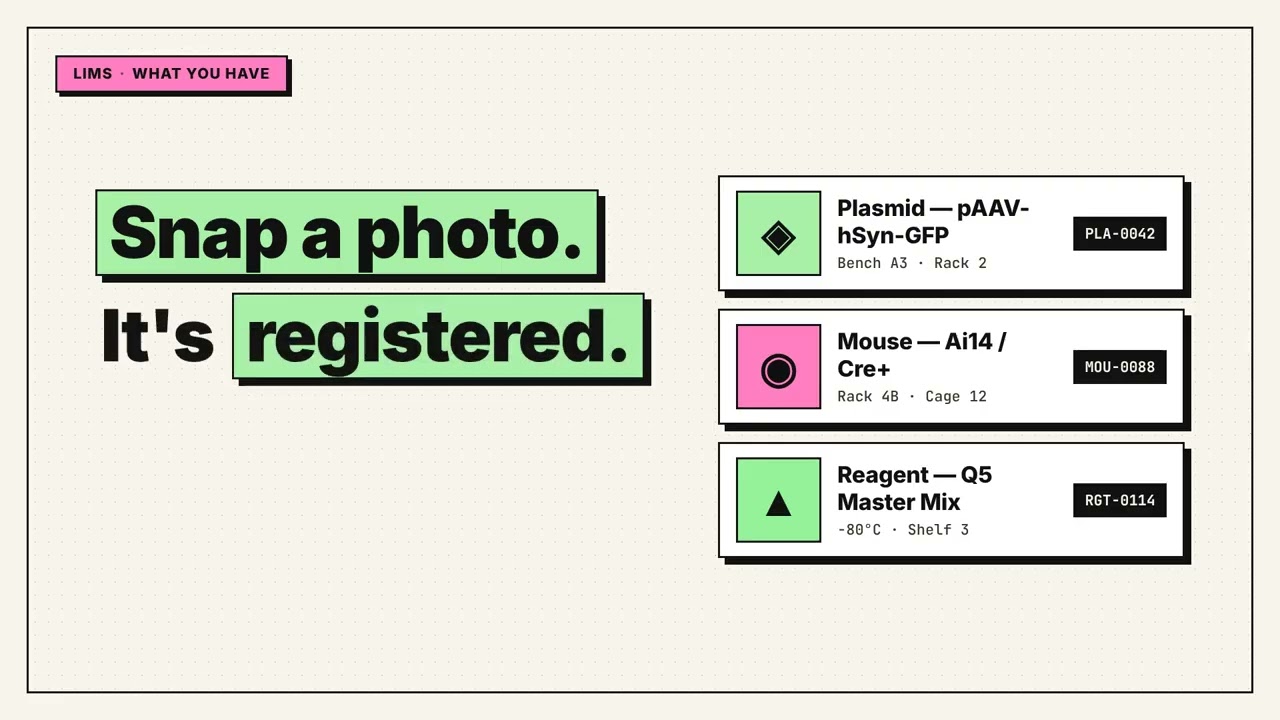
## Project description — agent-eln ### What I built **agent-eln** is an AI-native lab operating system: a single git repo that unifies an Electronic Lab Notebook (ELN), a Laboratory Information Management System (LIMS), a methods library, and a knowledge wiki into plain Markdown files plus a small Python toolkit. No database engine, no server — just files, `git`, and ~4,300 lines of stdlib Python under `tools/`. The system is organized around four modules that share one registry, one provenance graph, and one CLI: - **ELN** logs *what happened* — experiments, meetings, ideas, projects, literature, reports. - **LIMS** lists *what you have* — plasmids, oligos, mice, cell lines, reagents, instruments (16 inventory types). - **methods** describes *how you do things* — SOPs, analysis pipelines, scripts, skills. - **wiki** captures *what you learned from others* — llm-wiki-style paper summaries, concepts, entities. Every record is a Markdown file with a stable ID (`PLA-0042`, `EXP-2026-07-12-01`, `LIT-0060`) whose YAML frontmatter declares one-way provenance links (`used_resources`, `produced_resources`, `derived_from`, `protocols`). A single registry (`tools/registry.py`) is the schema — adding a new record type is two edits: one registry entry + one template. Backlinks, provenance edges, per-type CSV tables, an interactive HTML dashboard, and a DuckDB view are all auto-generated from the files; git hooks enforce validation on every commit. ### What I found Two design choices did most of the work: 1. **Filesystem = database, YAML frontmatter = queryable schema, body = free text.** Both the AI and the human read the same files. `git log` becomes the audit trail; `git blame` becomes attribution; every commit is a snapshot of the entire lab you can time-travel to. 2. **Only write one-way links; derive backlinks and the provenance graph.** A single field on the experiment card (`produced_resources: [PLA-0042]`) causes `produced_in: EXP-…` to be auto-backfilled on the plasmid card, edges to appear in `graph.json`, and the resource to show up in `plasmids.csv` — with no duplicated bookkeeping. The system now runs an active UCSD lab: 134 records across 26 types, 56/56 DOIs deduplicated, 30/30 tests green, structural validation at zero errors. A 2026-07-13 external audit scored it 8/10 as a research ELN and 8/10 for literature/knowledge management. It handles Novogene/BGI vendor deliveries with MD5 verification, GenBank plasmid auto-annotation, DOI → LIT card ingest, and a bidirectional LIT ↔ wiki bridge. ### Why it matters Legacy ELNs (OneNote, Benchling, LabArchives) were built for humans clicking forms — they can't hand context to an AI. The notebook is flat: no link from the experiment to the plasmid, no link from the plasmid to the paper it came from, so every trace is a search bar and every audit is a guess. When a postdoc leaves, the lab loses its memory. agent-eln flips the model. The AI is the primary user; the human reads the same files. Every experiment auto-declares which mouse, which plasmid, which SOP it used; every new sample, gel, and dataset gets a unique ID and an automatic edge back to its ancestors. Nothing orphans. The next breakthrough will be co-authored by an AI — that AI needs a lab it can read, and this is one built for that from day one. It's MIT-licensed, runs on a laptop, and any AI agent that clones the repo can operate it end-to-end.
