Cell Dna
Built at Built with Claude: Life Sciences · Jul 7, 2026 · Remote
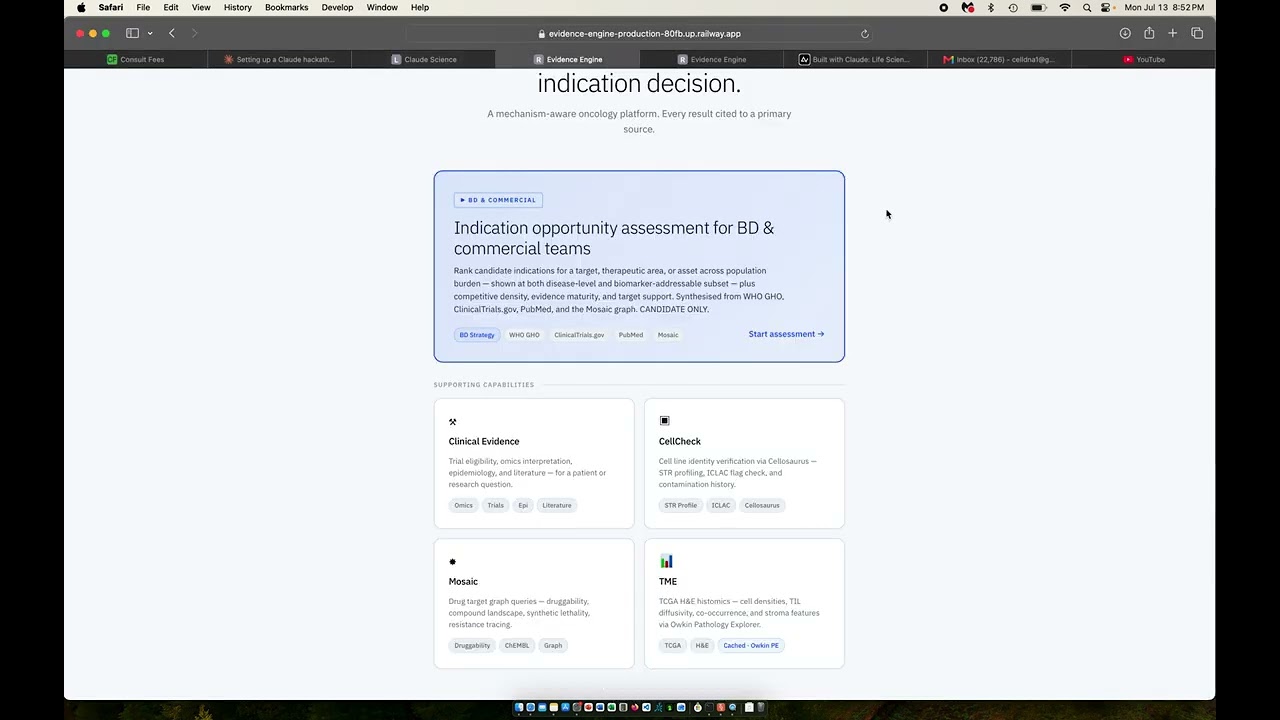
Evidence Engine is a mechanism-aware oncology evidence platform that answers the recurring BD/commercial question — "which indication should we pursue for this asset?" — in minutes instead of weeks, with every number traceable to a named primary source. Enter a drug target and it scores candidate indications on population burden (biomarker-addressable, not just disease-level), competitive density, evidence maturity, and target support — synthesized from WHO GHO, ClinicalTrials.gov, PubMed, and a provenance-stamped knowledge graph. Five modes span the workflow: Opportunity Assessment (BD prioritization), Clinical Evidence (patient/trial matching with per-criterion eligibility reasoning), CellCheck (cell-line authentication via Cellosaurus + CLASTR STR matching), Mosaic (drug-target graph), and TME (tumor-microenvironment histomics). The differentiator is an enforced epistemic contract: three-state verdicts (MET / NOT MET / NOT EVALUABLE), everything labeled CANDIDATE ONLY, and the LLM strictly downstream of deterministic data — the system physically cannot cite a source the retrieval lanes didn't produce. The MSI prediction model was trained and validated in Claude Science (AUC 0.929, cross-validated) with the circular MSI assay column deliberately excluded to keep predictions non-circular, then deployed into the product with its full reproducibility package attached as provenance. Why it matters: high-stakes oncology BD and clinical decisions are made on evidence that's slow to assemble and impossible to audit. This makes the answer fast AND auditable — trust you can check, not trust me.
