MotorSmiths
Built at Built with Claude: Life Sciences · Jul 7, 2026 · Remote
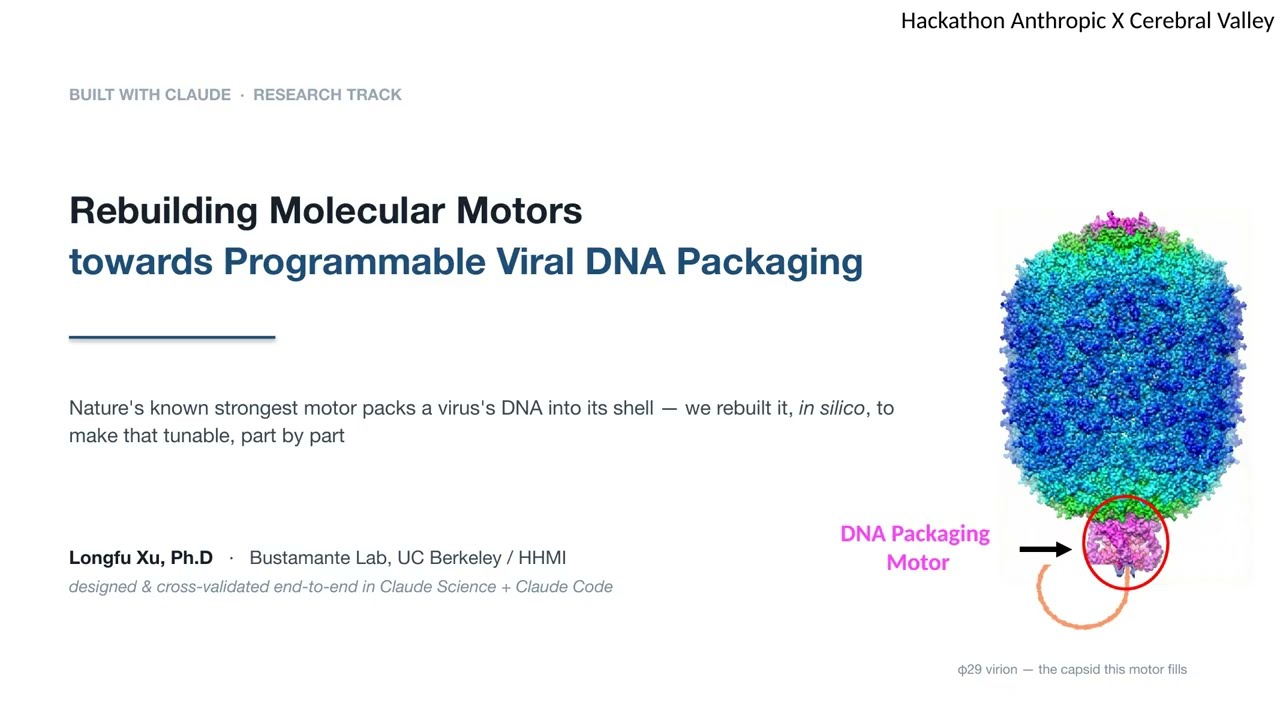
I rebuilt nature's strongest molecular motor — the phi29 gp16 DNA-packaging ATPase — as a single programmable protein, entirely in silico. The motor is a ring of five identical subunits. That sameness is a wall: you cannot tune one subunit, read the firing order, or even model the oligomer. I fused the five subunits into one covalent chain (cp233, 1,750 aa) using circular permutation, so every seat becomes individually addressable and the ring becomes computable. I then evaluated it. Structurally it is indistinguishable from native: three independent predictors agree 5/5, subunit RMSD 1.80 A / TM 0.94, and it threads dsDNA at the native contacts — designs that merely close the ring cannot. Driven molecular dynamics plus a mechanochemical-ratchet model predict a hand-over-hand mechanism with a falsifiable 3D-MINFLUX signature. The design method generalizes across 13 ring motors and passes a blind retrospective test on ClpX (6/6 working, 0/6 dead mutants). Why it matters: this turns the strongest packaging machine in biology into one that is both readable — mechanism resolvable one seat at a time — and tunable, a concrete step toward programmable viral DNA packaging (phage engineering, viral-vector production, DNA nanotechnology). Everything is computational, cross-checked, and honestly bounded; it hands the wet lab a concrete, testable to-do list.