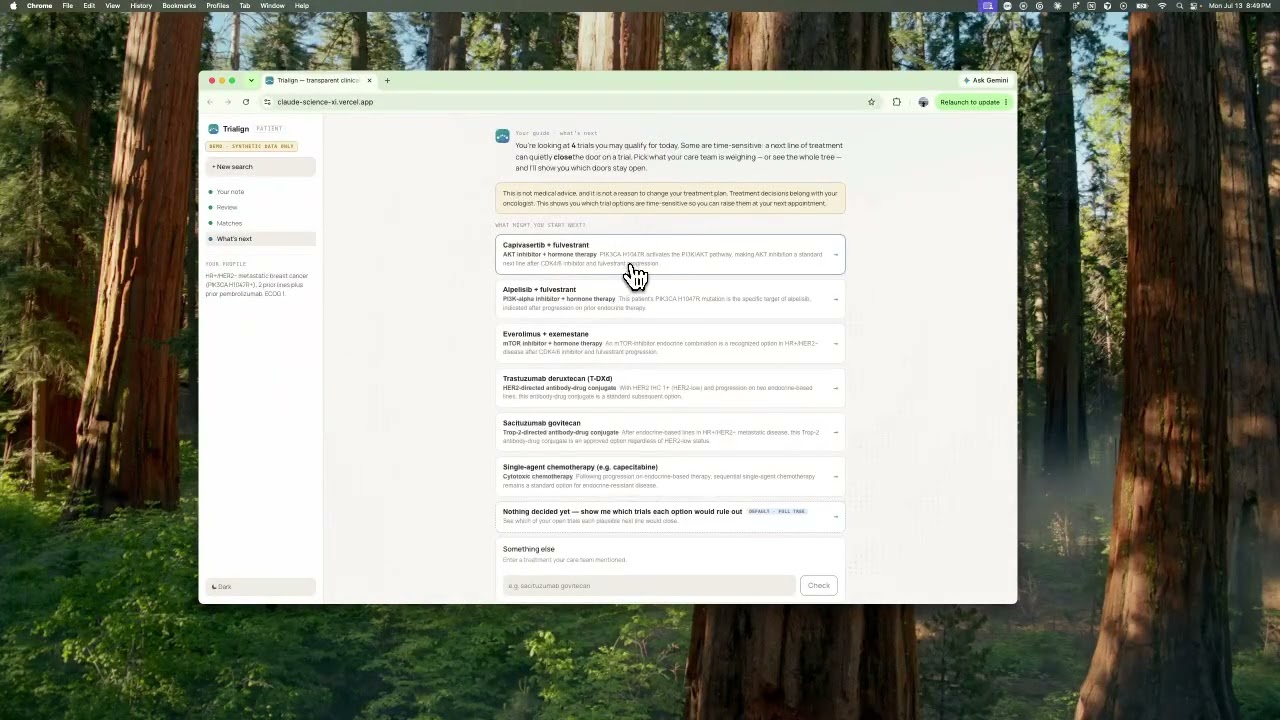
Aquiles — auditable, host-directed antiviral target triage for Aedes arboviruses What we built. Dengue, Zika and chikungunya have no approved antiviral — and because they mutate fast, drugs that hit the virus directly lose to resistance. Aquiles takes the opposite route: it looks for the human proteins the virus hijacks to replicate — the machinery it can't live without — and ranks which of those host factors are both essential to the virus and druggable. A drug that targets your own protein is far harder for the virus to escape, and can potentially work across all three arboviruses at once. For each host-factor gene, three Claude agents work in sequence: a specialist (Haiku 4.5) gathers cited evidence from public biomedical databases (Open Targets, DGIdb, Europe PMC) plus the Krogan host–pathogen interactome and published CRISPR host-dependency screens, and makes concrete, checkable claims. An independent verifier (Sonnet) then re-reads every claim in an isolated context, against the raw database record — marking each one confirmed, corrected, or unsupported. Only verified evidence flows into a final synthesis agent that writes a go / watch / no-go dossier and, where an approved drug already exists, a repurposing hypothesis. Druggability and evidence-strength scores are computed in code from verified claims — never written by the model. The whole pipeline is exposed as an MCP server, and a web app lets a scientist ask in plain language and watch the verification happen live. What we found. The independent verifier caught [52 of 79 — 66%] of the specialist's own claims as unsupported or wrong — mistakes a self-checking AI would have delivered as fact. That is the core result: in biomedical AI, the reviewer is usually the same model with the same blind spots, and separating the verifier into its own agent with its own context measurably changes the output. Why it matters. The bottleneck for trusting AI in the life sciences isn't generating hypotheses — it's knowing which ones to believe. Aquiles turns an antiviral discovery question into an auditable one: every number traces back to a public source that survived independent verification, and a human stays in the loop on every dossier. It's a template for AI-assisted drug discovery you can actually check — applied to a disease burden that hit 6M+ cases in Brazil alone in 2024, with no cure on the shelf.
Team

Placement
Participant