dbCAN-coder
Built at Built with Claude: Life Sciences · Jul 7, 2026 · Remote
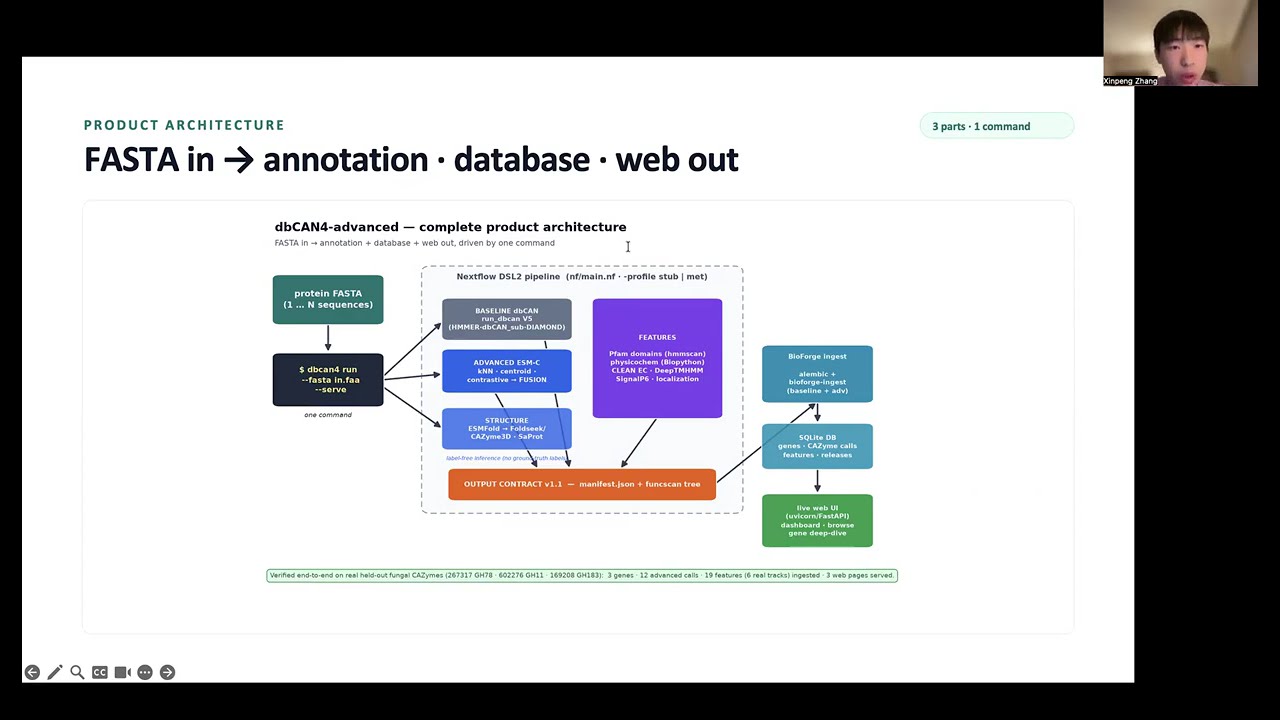
We built dbCAN4-advanced, an end-to-end research and software platform for annotating fungal carbohydrate-active enzymes, or CAZymes. Existing dbCAN methods primarily identify CAZyme families through sequence similarity using HMMER, dbCAN-sub, and DIAMOND. These methods are reliable when a close reference sequence exists, but can miss remote homologs whose sequences have diverged while their structures, catalytic mechanisms, and biological functions remain conserved. dbCAN4-advanced adds two complementary evidence layers: protein-language-model representations generated with ESM-C and structure-based evidence generated through ESMFold, Foldseek, and CAZyme3D. It combines multiple predictions through a confidence-aware fusion layer that can abstain when the available evidence is insufficient or contradictory. Rather than returning only a CAZy family label, the platform performs a comprehensive functional workup for each protein, including Pfam domains, EC-number prediction, signal peptides, transmembrane topology, subcellular localization, physicochemical properties, structural models, and structural-homology evidence. We turned these research components into a usable product. A single command can take a fungal protein FASTA file through baseline and advanced annotation, publish a standardized and versioned output manifest, ingest the results into a database, and launch a browsable web application. Each protein receives an evidence-rich page where users can compare baseline and advanced predictions, inspect domain architecture and membrane topology, and interact with an ESMFold structure in a 3D viewer. The system includes a Python package and CLI, a modular Nextflow pipeline, database migrations, a FastAPI interface, reproducible examples, tests, and detailed documentation. We also investigated whether protein language models and structural methods actually improve CAZyme annotation under a realistic temporal evaluation. We constructed a leakage-controlled 2024-to-2025 fungal holdout containing 337,759 reference proteins and 4,726 evaluation proteins. ESM-C was competitive with, but not universally superior to, sequence-based methods: the contrastive ESM-C approach achieved 0.973 family-level overlap compared with 0.981 for DIAMOND, and improved exact subfamily assignment over dbCAN-sub, although it remained below a custom temporal DIAMOND baseline. This result is important because it shows that protein language models provide useful orthogonal evidence, but should not automatically replace strong sequence baselines. The most consequential finding concerned benchmark design. Of the proteins initially classified as belonging to “novel fungal families,” 95.9% belonged to families already present in other kingdoms in the 2024 CAZy database. They were new to fungi, not genuinely new to CAZy. We also found severe database-vintage leakage: using the current database increased apparent novel-to-fungi subfamily recall from 0.001 with a fair 2024 reference to 0.992 because many evaluation sequences had already entered the newer database. Domain-level retrieval additionally improved exact-set performance for multidomain proteins from 0.006 to 0.412. These observations demonstrate that database versioning, taxonomic context, multidomain architecture, and abstention are as important as model selection when evaluating biological annotation systems. Finally, we developed standalone visualization and reasoning-assistance prototypes. These include interactive embedding exploration, training and calibration dashboards, evidence-grounded protein reports, conformal prediction sets, disagreement-based review triage, and an improved novelty score. The novelty prototype reached an AUROC of 0.786 compared with 0.655 for the current baseline, although we clearly identify it as a prototype that still requires integration and broader validation. This matters because CAZyme annotation supports research into fungal biology, biomass degradation, microbiomes, carbon cycling, and enzyme discovery. More broadly, the project presents a model for trustworthy AI-assisted bioinformatics: combine complementary models, preserve provenance, control data leakage, expose disagreements, and give scientists enough evidence to verify rather than simply accept a prediction. We also aim to explore AI applications in bioinformatics by leveraging current AI technologies to validate, update, and upgrade classic tools on a large scale. Our goal is to make these tools more user-friendly—enabling a wider audience to utilize them more effectively and efficiently—while ensuring the preservation of their original biological accuracy.
