Let's fight cancer!
Built at Built with Claude: Life Sciences · Jul 7, 2026 · Remote
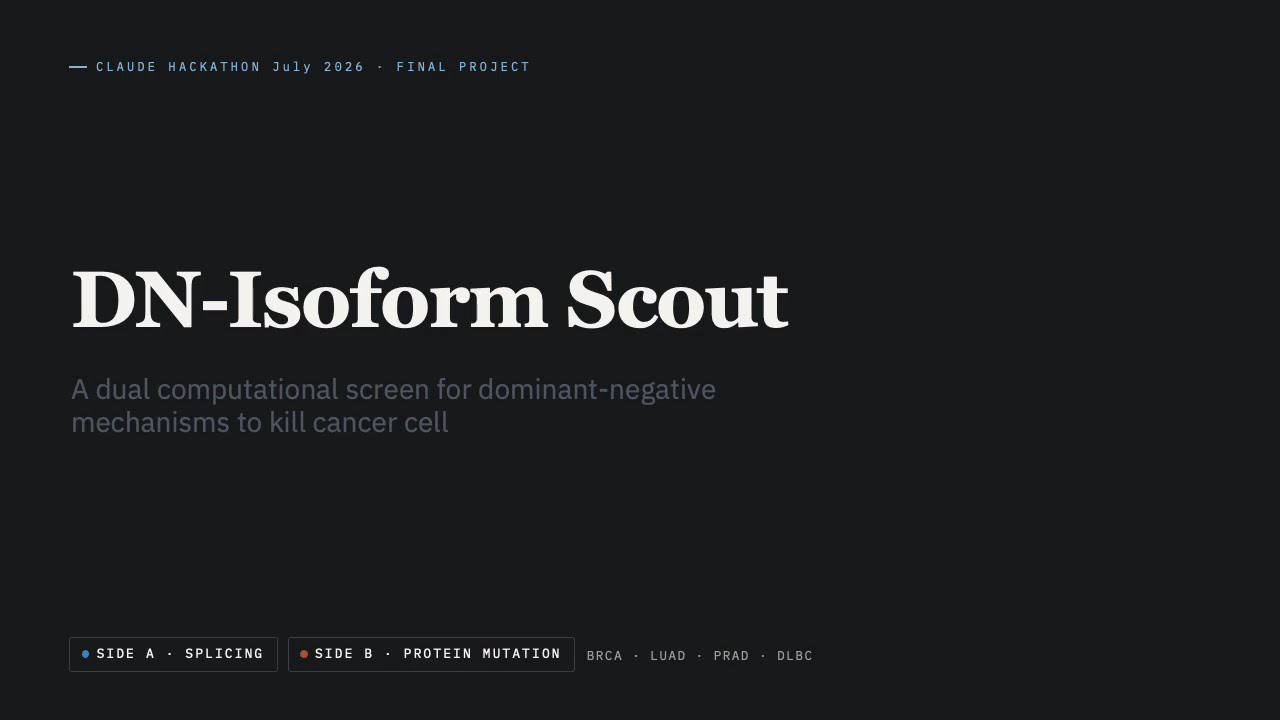
I built DN-Isoform Scout, an end-to-end computational proof of concept for discovering an underexplored class of cancer mechanisms: dominant-negative proteins that lose their normal function but retain the ability to assemble with—and poison—the wild-type protein complex. The long-term goal is a cancer-selective strategy that targets molecular alterations enriched in tumour cells while sparing healthy cells. In the splicing arm, I directly measured tumour-versus-normal differences to identify candidate therapeutic windows; in the mutation arm, I established the computational framework needed to prioritize potentially tumour-specific protein variants. These selectivity hypotheses must now be confirmed experimentally. Unlike conventional CRISPR screens that reduce each gene to a simple knockout, DN-Isoform Scout investigates cancer below the gene level from two complementary directions. The first arm identifies tumour-associated splice events across breast, lung, prostate and diffuse large B-cell lymphoma. The second screens point mutations, truncations and deletions in TP53, STAT3 and IKZF1. I integrated cancer transcriptomics, protein-domain annotation, protein language models and structural AI—including ESMC-6B, ESMFold2 and Boltz-2—to search for the defining signature of a dominant negative: function lost × interaction interface retained × protein still folded. I then converted the predictions into concrete experimental starting points: a 521-guide dCas13d library designed for reversible splice redirection without permanent genome editing, plus protein candidates annotated with potential covalent reactivation, interface-disruption and selective-degradation strategies. The proof-of-concept results were highly encouraging. From 42,529 quantified event–cancer combinations, I identified 1,806 significant tumour-associated splicing hits across 315 genes and narrowed them to 365 ranked dominant-negative hypotheses across 118 genes. I constructed and structurally evaluated 186 candidate isoforms, identified seven particularly strong complex-supported hypotheses, and designed 416 candidate dCas13d guides alongside 105 carefully chosen controls. In parallel, I screened 1,238 protein variants, modeled 160 monomers and 64 mutant–wild-type complexes, and selected 30 high-priority candidates spanning TP53, STAT3 and IKZF1. Importantly, the pipeline successfully recovered the known dominant-negative controls Δ133p53, STAT3β and Ik6 using the same scoring framework as the other candidates, without assigning them an artificial scoring bonus. In an internal TP53 sanity-check benchmark based on 33 literature-curated labels, the DN score separated dominant-negative variants from ordinary loss-of-function variants with an AUC of 0.90 and from benign variants with an AUC of 1.00. These results demonstrate internal consistency and support the central mechanism, although they are not yet a substitute for independent biological validation. One of my most important findings was that monomer structure alone cannot reliably distinguish a dominant negative from an ordinary loss-of-function protein: the crucial question is whether the altered protein can still assemble with wild type. DN-Isoform Scout therefore turns a major blind spot in cancer screening into an auditable experimental roadmap containing ranked mechanisms, designed perturbations, structural hypotheses and clear validation gates. This hackathon project establishes the proof of concept. The next phase is laboratory validation: confirming transcript identity and protein production, testing mutant–wild-type assembly, demonstrating genuine poisoning of wild-type function, and measuring cancer-versus-normal selectivity. Instead of merely asking which genes matter, I built a platform that asks which precise molecular alteration poisons the cell, how it does so, and how we might selectively stop it.