Sriram
Built at Built with Claude: Life Sciences · Jul 7, 2026 · Remote
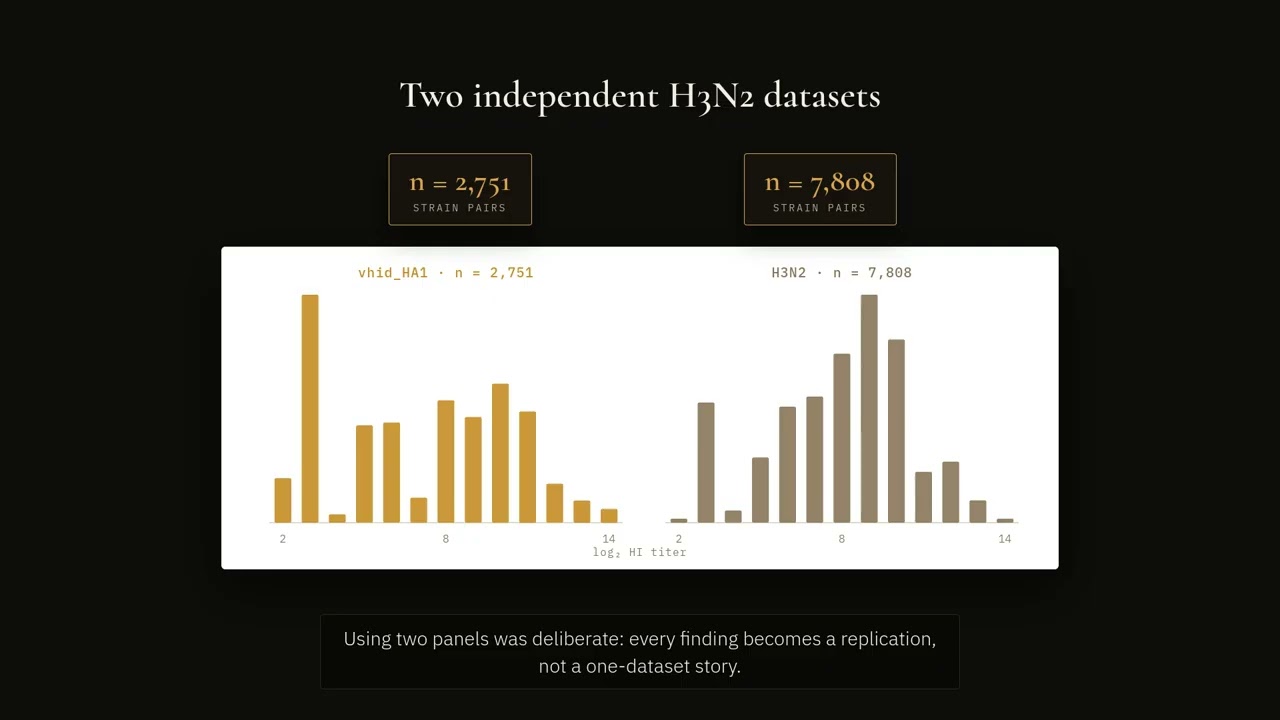
This project presents a causal-structure-oriented, interpretable pipeline for modeling influenza (H3N2) antigenic distance from hemagglutination-inhibition (HI) data and HA sequence alignments. Its central problem is that dense viral phylogenies tightly link true antibody-escape drivers with passenger mutations, so accurate sequence-based prediction does not establish which HA positions physically disrupt antibody binding. In this study, we analyzed two public H3N2 HI datasets by collapsing co-evolving positions into linkage blocks, then applying target-oriented causal discovery ranked by 200-resample bootstrap stability, alongside an interpretable B-spline Kolmogorov–Arnold Network whose per-position response curves are inspectable and which extends to second order to probe epistasis. The first-order KAN trails gradient boosting by a small but robust margin; a second-order KAN closes most of the gap only under a different protocol. Our pipeline demonstrates cross-method convergence by isolating a highly stable set of key drivers at mature HA positions 133, 156/158, and 189, mapping precisely to classical antigenic sites A and B. Finally, adjusted partial-regression effect sizes systematically shrink relative to marginal associations, confirming successful control over phylogenetic confounding.
