CellVerdict
Built at Built with Claude: Life Sciences · Jul 7, 2026 · Remote
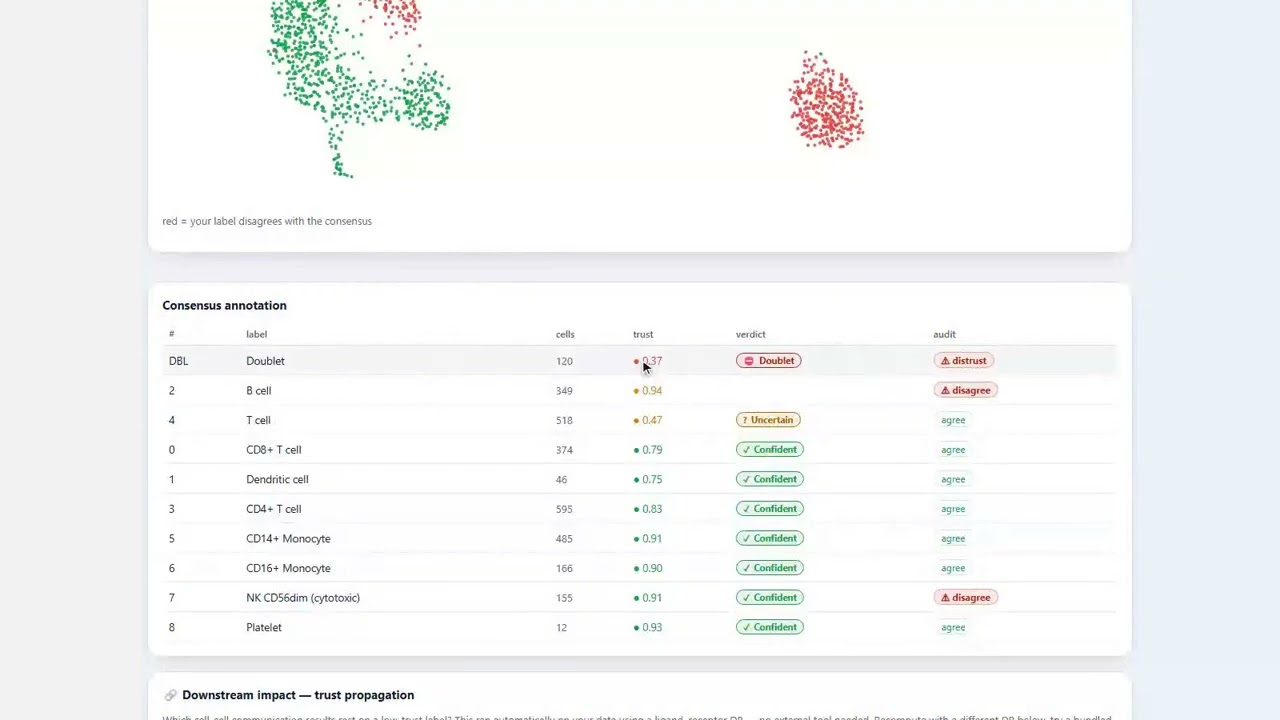
CellVerdict is a multi-method consensus annotator and trust layer for single-cell RNA-seq data. Cell-type annotation is the linchpin of every single-cell analysis — a wrong cluster label silently poisons downstream differential expression, cell-cell communication, and trajectory results while the UMAP still looks clean. Existing annotators each give an answer, often with unearned confidence, and they disagree with one another; a non-expert can't tell which to trust. Instead of adding one more annotator, we built a council. Every cluster is annotated independently by five voices — a marker-database matcher (multiple curated reference DBs), a CellTypist ML classifier, a prior-studies voter that web-searches primary literature for the specific tissue and votes with clickable, citation-ranked PMIDs, and a grounded Claude annotator — on top of a deterministic evidence engine that computes doublet, stress, ambient-contamination, and marker-specificity signals. A separate Claude adjudicator then reconciles all the votes against the computed evidence into one final label, a green/yellow/red trust score, and natural-language reasoning that names which DBs, which model, and which papers drove the decision. What we found: the fusion catches failures a single tool confidently mislabels — planted doublets and dying-cell states get flagged red instead of forced into a clean label — and that bad-label risk propagates downstream, so CellVerdict lists exactly which cell-cell communication interactions rest on a low-trust annotation. Give it an unlabeled dataset and it annotates; give it a labeled one and it audits. Every verdict is glassbox: click any node in the flow canvas to see the votes and the raw numbers behind them. Why it matters: it turns a two-day, subjective, cluster-by-cluster eyeballing task into a two-minute, reproducible, citable trust report — and makes the risk in an annotation visible instead of hidden.
