What it is. A trust-first interpreter for non-coding, regulatory DNA variants — the frontier where variant-of-uncertain-significance (VUS) calls mostly fail. Coding-variant tools are mature; a variant in regulatory DNA usually gets no principled call at all*, because its effect isn't "changes a protein," it's "changes how much a gene is expressed." I fine-tune a DNA language model on the Deng et al. 2024 cortical MPRA (*Science*, adh0559), score a single-base change's effect via in-silico saturation mutagenesis, annotate the mechanism via transcription-factor motif gain/loss, and — the core contribution — ground every prediction in independent evidence (held-out MPRA, GTEx eQTLs, an independent organoid-context model, TSS proximity) to return a calibrated confidence with an auditable evidence chain**. When the model and evidence agree, confidence is high; when they conflict, the tool surfaces it instead of hiding it behind a number. What I found. 1. Optimizing the allelic-difference directly — a shared-weight "siamese" model trained on measured skew — beats the standard subtract-endpoints proxy by **+47%** on a bidirectional Caduceus backbone (variant-effect Δ-Pearson 0.19 → 0.28**, emVar AUC → 0.67**), the project's biggest gain. 2. A stacking meta-learner that fuses the primary model with an independent organoid model beats a single-feature calibrator (emVar AUC 0.623 vs 0.610**), the independent model being the lever. 3. I reproduce Deng's headline emVar set end-to-end (**163 ≈ 164**), and I report honest negatives — reverse-complement averaging, lower calibration τ, bigger HyenaDNA, and a frozen Enformer feature (tested to full 15k-variant coverage) — each logged with its reason, including one case where I caught our own thin-coverage artifact (a promising feature weight that collapsed to zero under full coverage). Why it matters. The deliverable isn't a bare score — it's a calibrated confidence and an auditable evidence chain for a class of variants curators currently can't call. A confident-but-wrong regulatory call is dangerous; a calibrated "uncertain — here's the conflicting evidence" is usable. The tool works on any variant and outlives the hackathon as a variant-curation aid.
More from Built with Claude: Life Sciences
What I built. Lazarus is an agent that takes a dead research repository that is open, cited, and no longer runnable, and turns it back into a callable…
Diffuse midline glioma is a paediatric brainstem cancer that is almost uniformly fatal: about ninety percent of children die within two years, and the first…

Hippocampus AI is the memory and reasoning engine for scientific discovery. Every experiment generates valuable knowledge, but that knowledge becomes…


I used Claude to train a protein language model that can generate an extremophilic version of any enzyme, maintaining its function, while allowing it to…


Many primates are sexually dichromatic — males and females are different colors. I wanted to know how that trait is built genetically, and how it evolved…

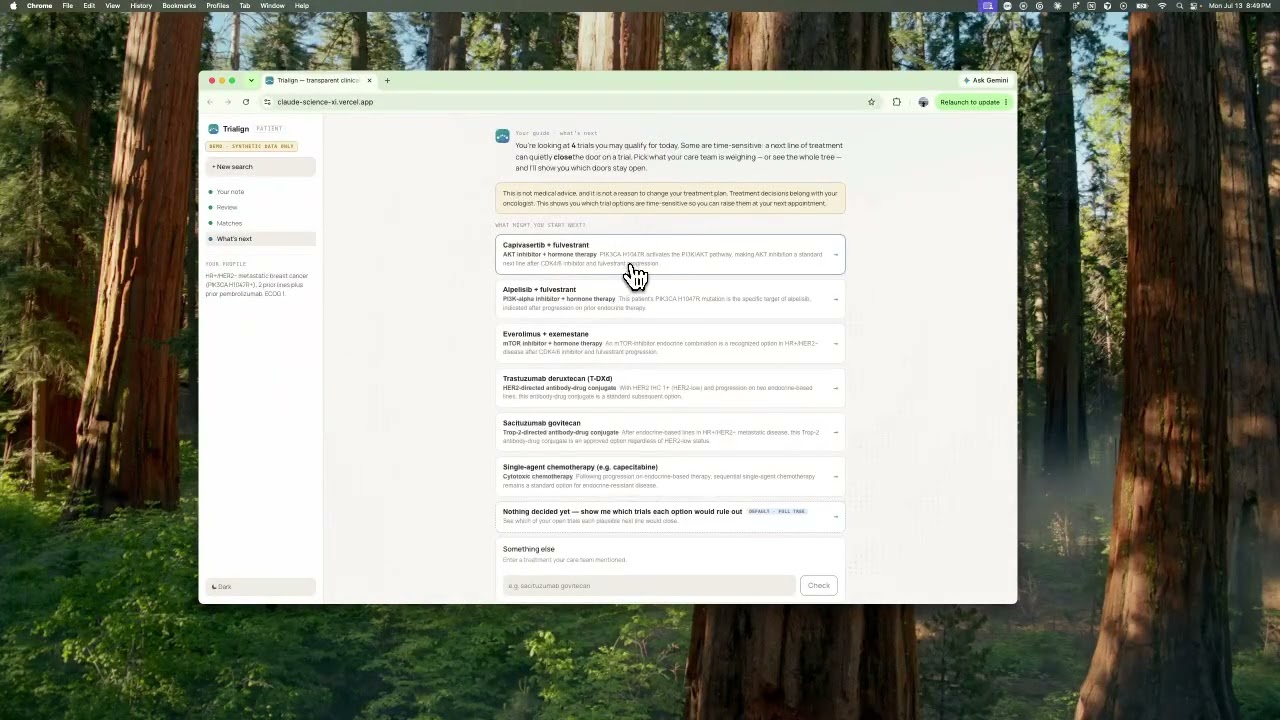
About Trialign is a patient-facing clinical trial matcher for oncology. A patient pastes a clinical note, uploads a record, or connects their EHR via SMART on…