Jimmy Ouellet
Built at Built with Claude: Life Sciences · Jul 7, 2026 · Remote
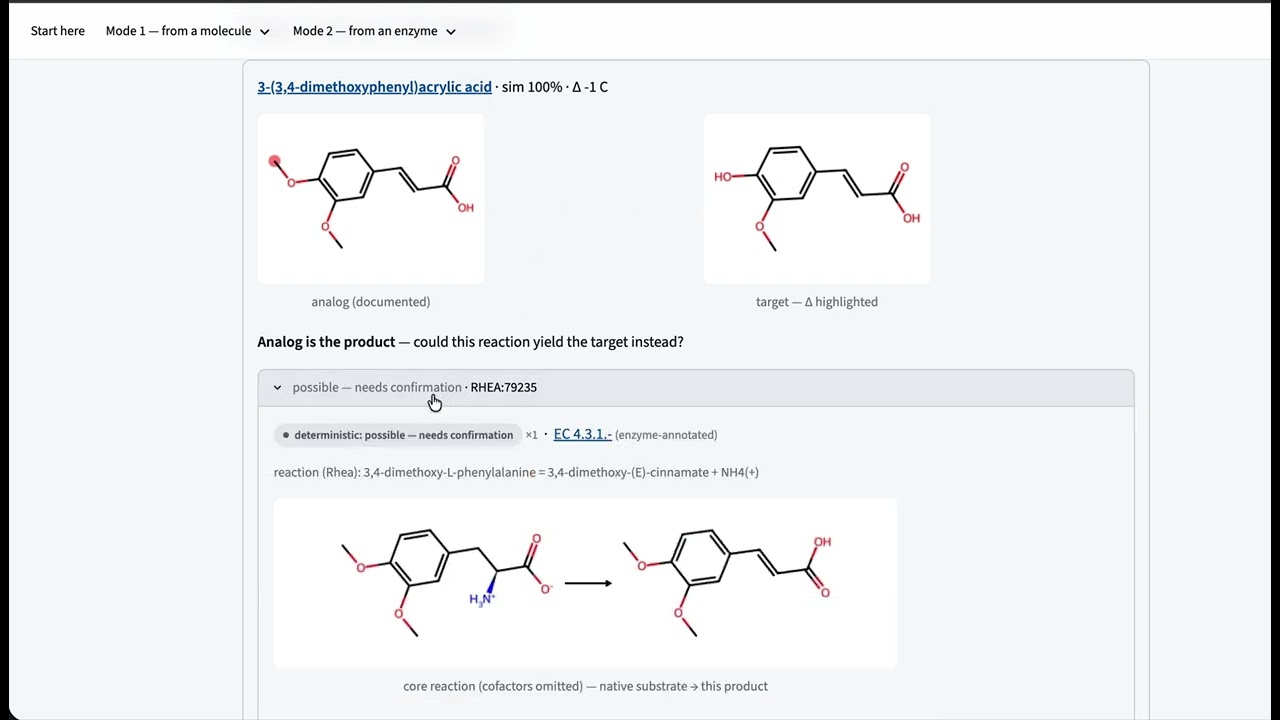
KatalistSeek — a grounded reasoning layer over fragmented enzyme/reaction databases. Curated knowledge databases about a biochemical pathway or enzyme are scattered all over the internet — PubChem, Rhea, UniProt, COCONUT, AlphaFold, ChEBI. The questions a researcher actually cares about are: how do I make this molecule, and which enzyme catalyses the step? and what else might this enzyme accept? Answering either today means hours of manual cross-referencing to ensure grounded structure and honest provenance. KatalistSeek is a tool that will hopefully fill that gap by providing grounded and a provenance-tagged reasoning layer that collapses that work into minutes. Two modes share one core — make a molecule (target → natural-product gate → grounded producing reactions → candidate enzymes → homologue family → binding-pocket fit) and substrate scope of an enzyme (enzyme → its ortholog family, how the substrate drifts across species, its literature, its 3-D pocket, and a discovery step that proposes candidate promiscuous substrates from structurally-similar natural products — separating those already documented in a reaction from purely structural look-alikes). What makes the output trustworthy enough to act on is one non-negotiable rule: no EC number, accession, or catalytic residue is ever emitted unless a live database call returned it in the current session. Every biological claim carries a provenance handle back to the exact record that produced it; when retrieval fails, the tool says so and stops — it never backfills from memory. On naringenin it recovers chalcone isomerase from a live call and ranks the fold family so that catalytically inactive fold-homologues fall below the true isomerases — showing that conservation is not activity — while refusing to invent a precursor for a xenobiotic that has none.
