John Knopf
Built at Built with Opus 4.7: a Claude Code hackathon · Apr 21, 2026 · Remote
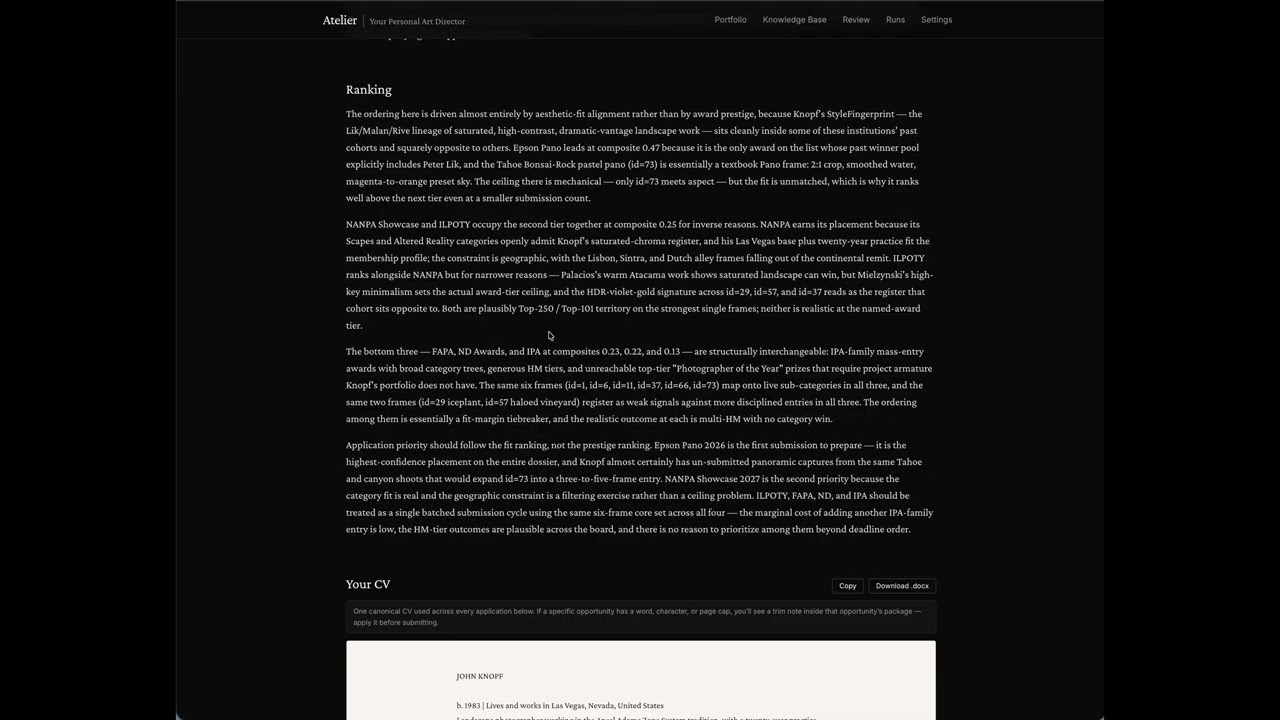
Atelier is an AI art director for working photographers. Upload your portfolio, build an Artist Knowledge Base through a short structured interview, and get a Career Dossier with ranked grant / residency / competition / gallery opportunities and submission-ready application materials. The system runs as a long synchronous pipeline of six specialist agents on Claude Opus 4.7. Two of them run on Anthropic's Managed Agents beta: Opportunity Scout — searches twenty-plus curated photography archetypes (landscape competitions, photo-book prizes, photography-specific foundation grants, photo residencies, museum-acquisition tracks, etc.) using web_search + web_fetch, applies eligibility filters, locates past recipients with portfolio image URLs, and persists each opportunity via a custom tool round-trip. Rubric Matcher — the novel core. For each opportunity, it pulls past recipients' portfolio images, normalizes them through Sharp, uploads to the Anthropic Files API, and sends them as image content blocks inside per-opportunity user.message events alongside the photographer's own work in the same Managed Agents session. The agent reads both cohorts visually and scores aesthetic fit with reasoning that cites specific portfolio images and names individual past recipients (e.g., "Hougaard Malan and Max Rive define this prize's pastel-pano formula; your Tahoe Bonsai Rock frame at 2:1 hits exactly that vantage"). The other four agents are direct SDK calls: Style Analyst (Opus vision chunked over the full portfolio, produces a structured aesthetic fingerprint — composition, palette, formal lineage, museum-acquisition signals), Knowledge Extractor (gap-driven structured interview that walks a priority-tiered AKB field list and only asks for what's missing), Package Drafter (institutional-voice writing — statement, proposal, cover letter — drafted in the voice each specific program expects, with a fact-grounding linter that rejects hallucinated venues / fabricated partnerships / made-up dates before they ship), and Orchestrator (composite scoring, ranking narrative, master CV, "why not" blurbs for filtered-out opportunities). Twenty-one curated skill files codify the photography-domain knowledge — controlled aesthetic vocabulary with twelve named precedents (Adams, Sugimoto, Eggleston, the Bechers, Misrach, Mann, etc.), juror-reading heuristics for institutional cohort analysis, opportunity-source registry, voice rules per material type, fact-grounding patterns. Loaded into the appropriate agent system prompts at runtime. The artifact is a Career Dossier — printable PDF and web view — that names what to apply to, what to skip, and why. Each included opportunity carries a fit rationale citing specific portfolio images, plus pre-drafted statement / proposal / cover letter / work-sample selection (12 images with per-image rationale) in the institutional voice that program expects. Each filtered-out opportunity carries a one-sentence "Why not [program]" — saying no with reasons is the product, not a by-product. The dossier surfaces the harsh-truth output prominently rather than hiding it. Architecture decisions worth flagging: the entire app deploys to Vercel — no Cloud Run, no separate worker tier, no long-lived process. Long-running agentic work survives Vercel's 60-second function timeout via a poll-pull-on-read pattern (state in Turso, browser polls a thin /events route, that route reads new events from Anthropic and persists them on every poll, server-side cron handles browser-tab-closed continuity). Image content blocks at session scale bypass the read-tool degradation that kicks in above ~95 mounted files. Sequential per-opportunity dispatch keeps each Rubric turn under context limits. All custom-tool persistence is idempotent against unique partial indices on event_id. Version one is photography-only and single-tenant. The hosted multi-tenant version (email/password accounts, no bring-your-own database or API key) is roughly a day-and-a-half of work after the hackathon — the auth and persistence seams are pre-wired today. Free for working photographers when it ships.