Foundry
Built at AIE Code Summit 2026 Hackathon · Nov 7, 2026 · San Francisco, CA
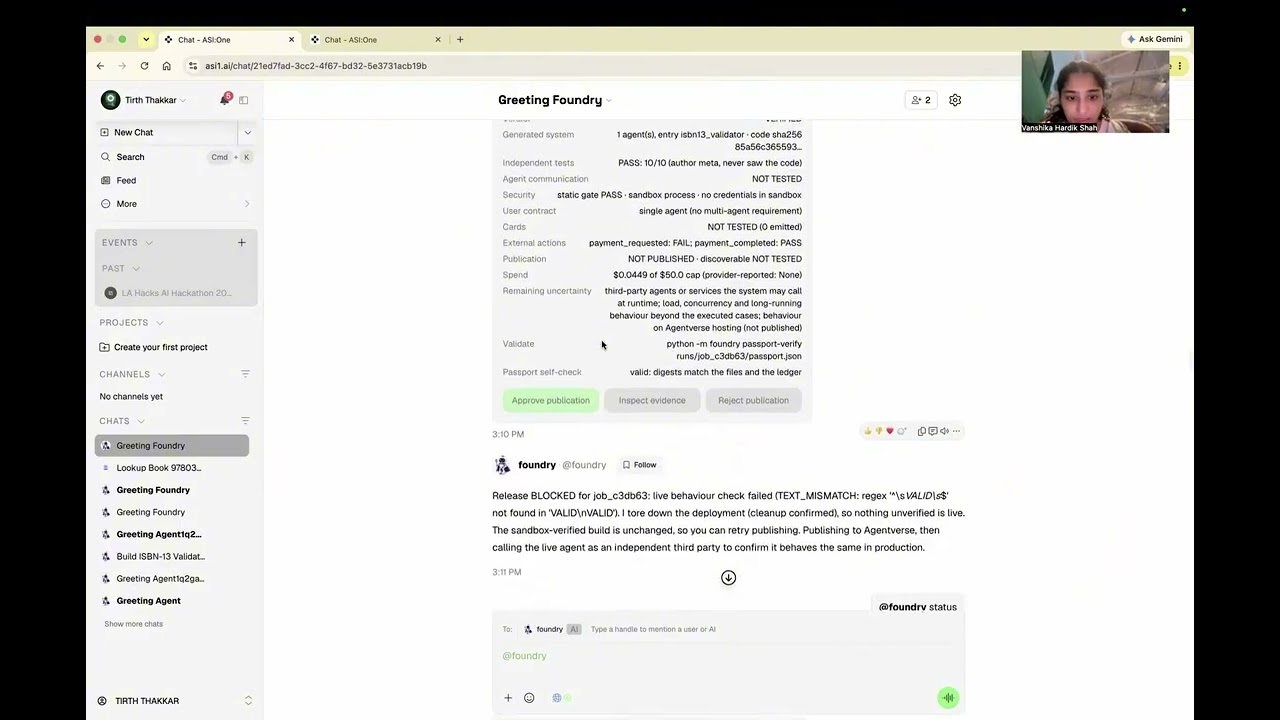
FOUNDRY — Build. Prove. Evolve. AI can build agents in seconds. But who proves they work? And what if the AI engineer could learn from its own failures? FOUNDRY is a self-improving AI engineering system built on Fetch.ai. It creates and deploys autonomous agents, investigates GitHub repositories, proposes software fixes, independently verifies its work, and evolves its own engineering capabilities. THE PROBLEM AI-generated software can look convincing while failing in execution. Agent marketplaces advertise capabilities without independent proof, and AI coding systems repeatedly make the same mistakes. This wastes time, money, and trust. HOW IT WORKS Inside ASI:One, users describe what they need, refine the design conversationally, and approve execution. FOUNDRY searches Agentverse and live-tests existing agents before building another. If none qualifies, eight specialized agents collaborate through Fetch.ai Mailbox and ACP. Meta Muse independently generates hidden tests; GPT-5 builds and repairs code. Other agents handle architecture, adversarial testing, execution, security, and deployment. Generated software runs in restricted environments. Independent tests and safety gates determine what ships. A hash-linked Proof Passport records the evidence, costs, and deployment status. The Payment Protocol integrates Stripe test payments. LIVE RESULTS • 120 Agentverse search results; 79 live chat agents identified, with no tested candidate passing the ISBN requirement. • An ISBN-13 agent passed 10/10 independent tests on its first attempt. • Actual model cost: $0.045 versus $0.095 quoted. • Automatically deployed to Agentverse, independently invoked in 4.4 seconds, and confirmed discoverable. • A 2048 game agent failed 0/11 tests. FOUNDRY blocked publication rather than shipping broken software. THE BREAKTHROUGH: SELF-EVOLUTION FOUNDRY doesn't just repair failed applications. It diagnoses weaknesses in its own engineering process, proposes reusable skill improvements, and tests them on separate tasks before adoption. After discovering an ASI:One card-format defect, FOUNDRY evaluated a new engineering lesson on 10 promotion tasks under equal budgets. Results: 19 → 23 passing test cases, zero observed regressions, 21% lower average build cost, and promotion from v0001 to v0002. Failed improvements are rejected or rolled back. Protected verification rules cannot be weakened through evolution. REAL-WORLD IMPACT FOUNDRY addresses a major barrier to autonomous software: reliability. It reduces duplicate engineering, blocks unverified deployments, makes costs transparent, and transforms failures into reusable knowledge. Built with Fetch.ai uAgents, Agentverse, Mailbox, ACP, ASI:One, Meta Muse, GPT-5, Docker, SQLite, and Stripe. FOUNDRY doesn't just build agents. It proves they work—and learns how to build the next one better.