LessonTrace
Built at Meta Global AI Developer Hackathon · Oct 26, 2026 · Remote
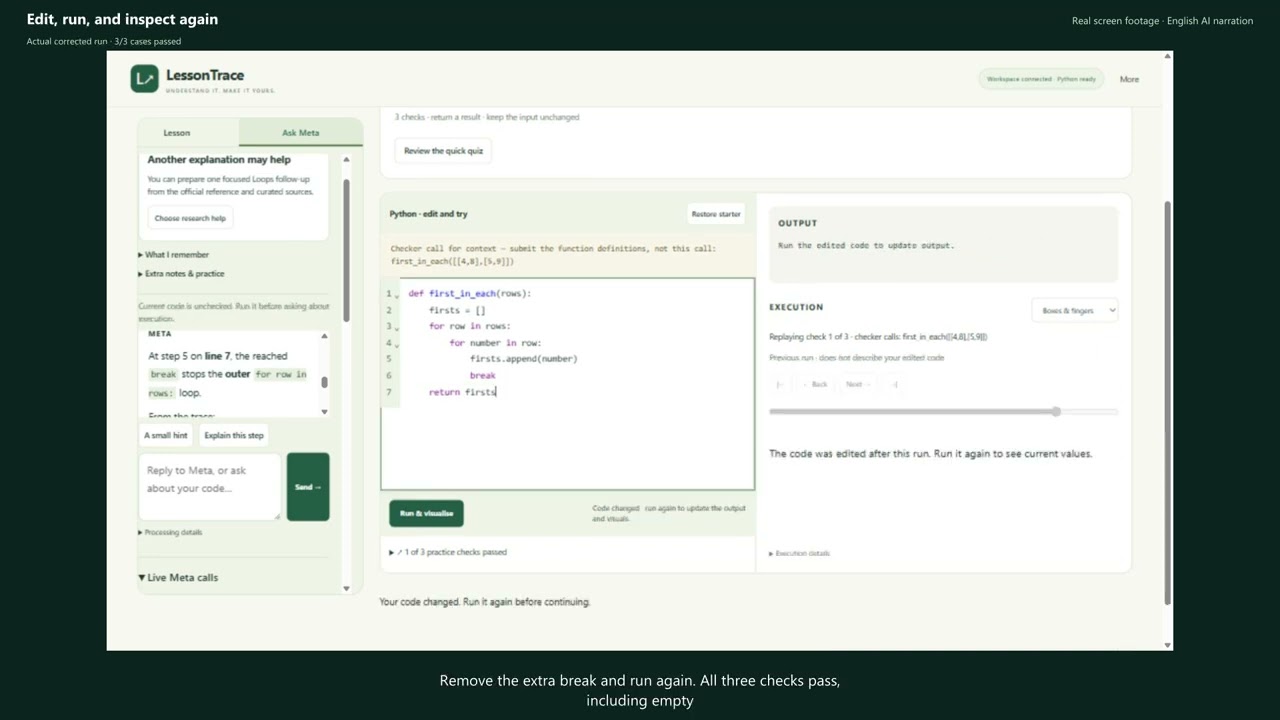
LessonTrace turns passive Python tutorials into a guided learning workspace where students predict, execute, inspect and debug code. I am an independent developer with one year of school teaching experience; the problem comes from seeing learners need different pacing and support before they can solve a problem themselves. The standalone website offers a five-unit Python course with 24 prepared, source-linked lessons, topic and debugging questions, an editable code workspace, and step-by-step visualisation of real Python execution. Concept prerequisites prevent questions from requiring skills the learner has not yet completed. Required topic/debug questions and coding checks unlock the next lesson. A bounded Meta teaching agent uses the learner's question, expectation, recent attempts, retrieved passages and actual trace state to choose an eligible teaching action: ask about their expectation, offer a hint, show a source, or inspect an observed execution step. Lesson Hub adds an optional research workflow that selects approved references, reads relevant passages, can inspect a small Python example, and prepares focused follow-ups. In the lesson-first course, hints support the current task before optional Hub practice becomes available after passing. The agents propose; backend rules decide; Python checks. CPython runs inside a bounded WASI environment. Source IDs and exact quoted anchors are checked, applicable code is executed, and a separate Meta request reviews claim support before anchored teaching is accepted. This is an execution-checked learning workflow, beyond retrieve-and-answer chat. All submitted standalone website code was built during the hackathon, starting October 26, 2026. The public repo includes setup instructions, an original keyless sample, 317 passing release tests, and recorded model receipts and Python traces. The 2:50 English demo shows live Muse Spark tutoring/review, a failing program and its corrected three-case pass, plus a completed live Hub research run. In 94.3 seconds, that run chose sources, inspected Python and generated a lesson, quiz and task with four Meta requests; receipts and outputs are preserved. This prototype does not claim measured student learning gains.