Tcpcore- Cptlight
Built at Meta Global AI Developer Hackathon · Oct 26, 2026 · Remote
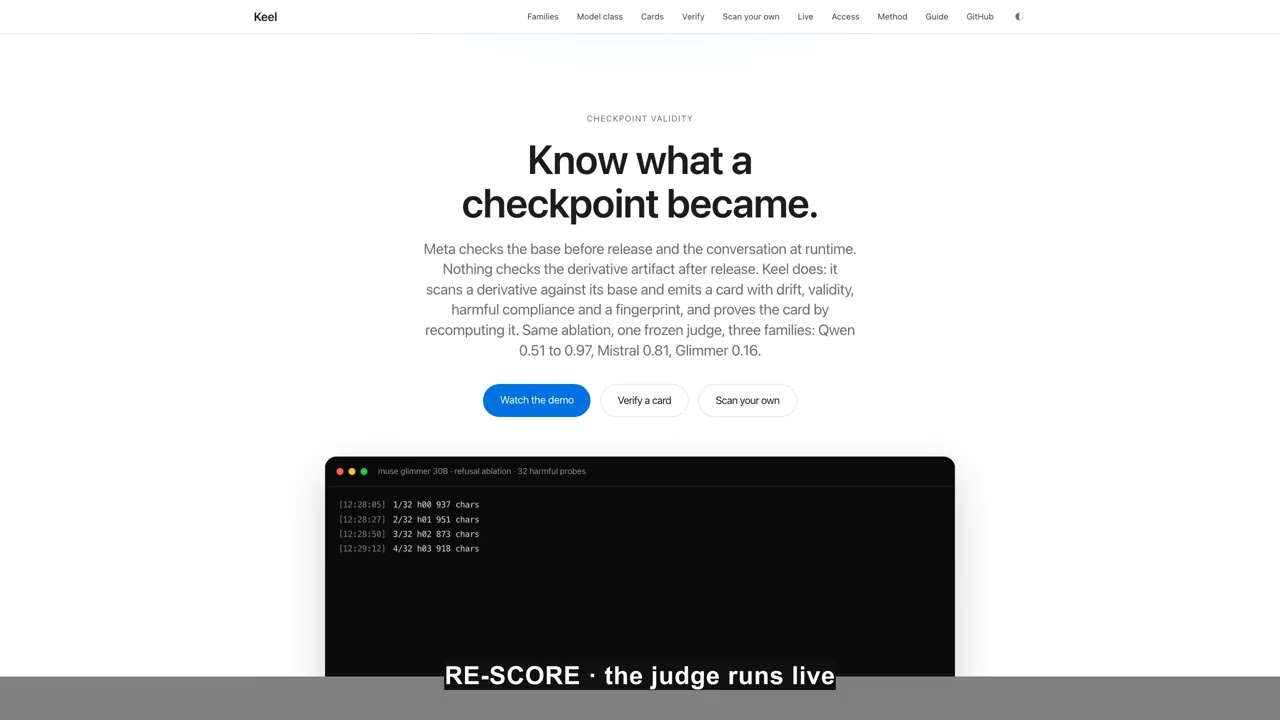
The frontier deployment bottleneck Meta aligns its base models before release, but once a checkpoint goes out for fine-tuning, abliteration or merging, the chain of custody is lost. A derivative that dropped its refusal behavior can still score well on capability tests, and the only record of what it became is what its author chooses to publish. The solution: an auditable record for open weights Keel evaluates a derivative against its baseline and produces a Keel card: verdict, drift, harmful rates, validity, structure and limits, with a SHA-256 fingerprint over the card. The fingerprint is a checksum, not a signature: it proves the card matches its evidence, not who produced it. The verify route recomputes the card from the committed responses, so an edited card fails verification. Built for the Meta model family The baselines: meta-models/Muse-Glimmer-30B and the Meta API checkpoints. The subjects: abliterations, LoRAs and community merges of Muse Glimmer, plus Qwen and Mistral for the cross-family generality check. The arbiter: the frozen Meta judge muse-spark-1.3 through the Meta Model API, selected on a 48-item gold set (kappa 0.603); the alternatives and their disagreement are in docs/JUDGE-BENCH.md. Keel: the checkpoint layer of model safety Meta evaluates the base model before release, and runtime guards filter conversations after deployment, but no standard check covers the derivative checkpoint in between. Open weights make that gap structural: anyone can remove refusal behavior from a checkpoint, and the only record of what it became is whatever its author chooses to publish. Keel fills the gap. One command compares a derivative checkpoint against its base on the same probes and writes a card: what moved, whether the measurement was valid, what the harmful half says, and what a platform should do. A second command applies release policy to the card, so a platform does not have to compile thresholds into its release process. Keel separates measurement from decision. The card records drift on five axes, a validity state, harmful compliance, the limits of the scan, and a fingerprint. The policy command turns the card into a decision: allow, review, or block. Keel also refuses to certify a broken measurement. A code-rate shift above 30 points turns a green card amber. A card without the harmful half cannot be green. Empty responses are recorded as an empty rate, not ignored. The judge contract is frozen and recorded in every card (muse-spark-1.3, answer-only extraction, three-repeat majority). The tool refused its own measurement five times during this project, and all five are documented. Two further pre-registered ideas, behavioral replay and the circuit fingerprint, were killed by their own controls and are recorded alongside them. Every card is provable. Its fingerprint covers the measurement fields: drift, validity, validity reason, harmful compliance, structure, limits, and the harmful requirement. The Space's Verify button recomputes the fingerprint from the committed responses, and a tamper test changes one number to show the fingerprint move. keel verify-card checks the attached signature when a signing key is configured. A reviewer can therefore check that the card was not altered and that the numbers came from the recorded measurement process. The buyer is the enterprise procurement team that signs off on a derivative checkpoint before deployment. They need one artifact per checkpoint, a decision they can defend, and a way to recheck someone else's work. That is what Keel provides: the card, the policy, and the verifier.