Good things for life
Built at Meta Global AI Developer Hackathon · Oct 26, 2026 · Remote
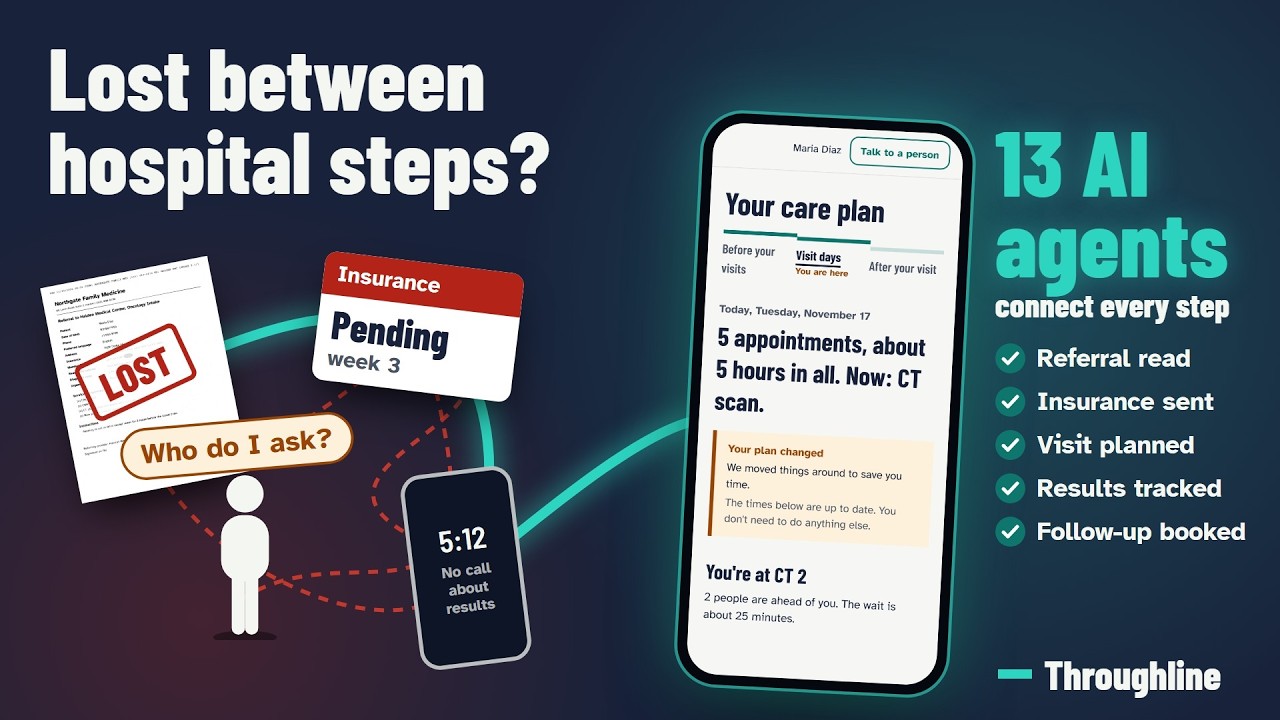
Throughline is an agent platform that connects the steps of a patient's hospital journey, from the first referral to the last follow-up. The problem: a hospital is organized around its departments, not around the patient. A single referral passes through a clinic, an insurer, schedulers, the building itself, a lab and several doctors, each with its own people and its own system. Nobody owns the whole journey, so the handoffs between steps happen by fax, phone and portal, and patients fall through them: in one 2023 study, only 58% of ordered tests and referrals were completed on time. Staff lose hours to the same coordination; doctors' offices spend about 13 hours a week on insurance approvals alone. The people hurt most are those without someone on the inside: older patients, people with limited English, anyone lost in medical terms. My family has lived this. Our solution: one thread through every journey. Throughline gives each step to an AI agent. Agents pass the work, and what they learned, to the next agent through a shared event log, so nothing is retyped and nothing is dropped. A safety gate decides what an agent may do on its own and when a person must decide, and medical questions always go to a nurse. What it covers today, with 13 agents: - Before the visit: reads faxed referrals and insurance cards, checks coverage, drafts prior-authorization requests for staff to approve, books the visits, and confirms with the patient by text or voice note. - On the visit day: tracks waits from waiting-room cameras, gives each patient a live plan with step-free directions, and when an area backs up, tests the possible fixes and applies small ones within policy. Staff can report a problem at any station (a room down, a missing staff member, a surge); the planner forecasts the next 90 minutes and proposes a fix, or asks a manager when none helps. - After the visit: plain-language summaries the doctor signs, a check-in that sends unsure patients to a nurse, results tracked until a doctor acknowledges them, and a report back to the referring doctor. A few examples from the demo: a smudged ID on a faxed referral becomes a question for the coordinator instead of a guess; a patient who mentions a wheelchair in a voice note gets a step-free route on her visit day, without anyone retyping it; and when a CT scanner breaks, the planner moves patients to the second scanner, cutting the simulated wait from 17 to 5 minutes. Models read and write; our Rust engine does the math, so every number on screen is computed, not generated. Built to grow: every agent is a descriptor (what it may do and how risky that is) plus a handler, and it inherits the safety gate, throvals. Next: a voice agent thatcalls patients and takes their calls in their own language, to confirm visits, remind them of prep and check in the day after, so pati not left out; plus agents forrides, interpreters, pharmacy refills and cost estimates. Any hospital can be added as its own workspace. All patients and hospitals are synthetic; the public site replays recorded live model calls.