AITrailblazer
Built at Meta Global AI Developer Hackathon · Oct 26, 2026 · Remote
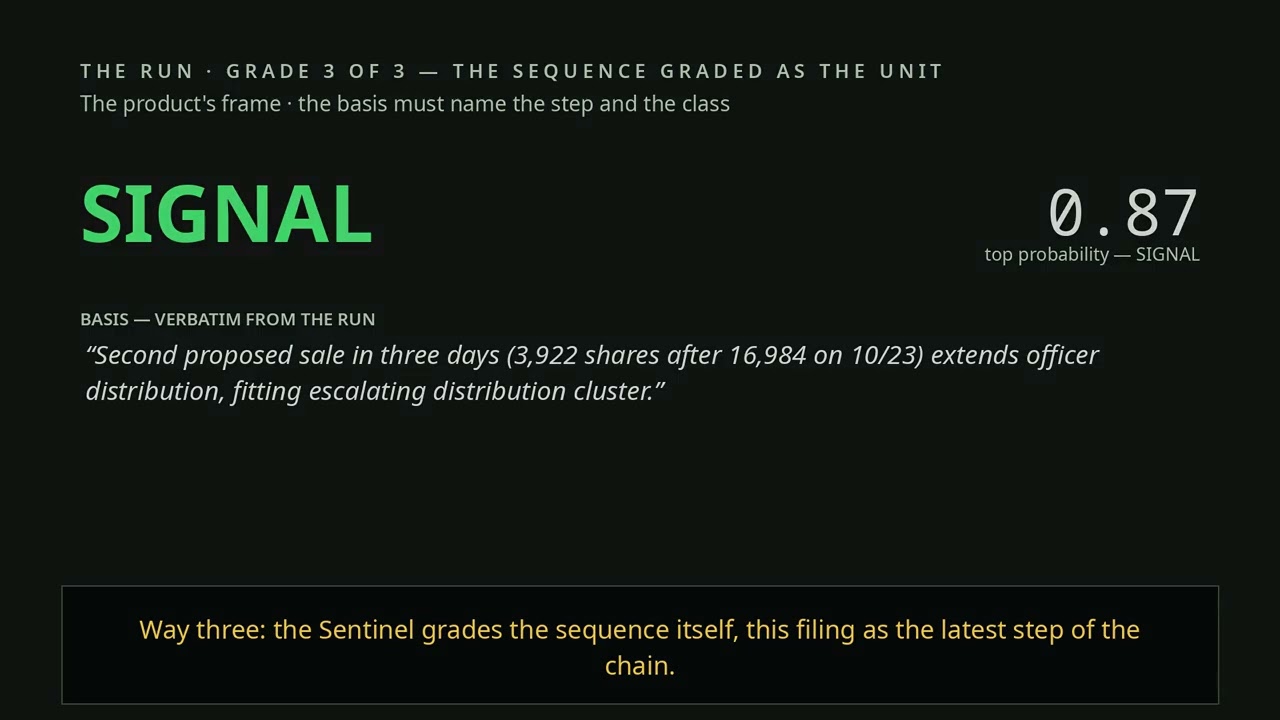
ATLAS-7 Filing Sentinel is a working product, not a prototype. It reads SEC filings and grades each one for material signal: does this filing change what an investor should expect from the company or the insider who filed it? It works for the independent investor, the small desk, and the solo analyst, who cannot read thousands of filings a week while the material ones hide inside routine paper. It is an evaluation system twice over. It evaluates filings against a locked grading standard, and it evaluates the AI models that read them against the same standard. For each filing it returns a verdict, SIGNAL or NO SIGNAL, a probability for each class, and one sentence naming the specific filing content the verdict rests on. A verdict is issued only when the model's confidence reaches 85 percent. Below that line, the sentinel says not sure and issues no grade at all, so thin evidence produces no grade instead of a confident guess. Filings are also read as steps in a sequence, not as isolated documents: a fourth insider sale in four months is a pattern advancing, and the sentinel holds that sequence state, because a model reading one document alone cannot see it. For this hackathon we also graded the graders. Muse Spark 1.3 and Muse Spark Open each took a test of 179 filings whose answers were sealed before the models took it. The answer key was built by two independent Muse grading desks working blind, their disagreements ruled on by a fresh judge who did not know where any label came from, and the result locked by a human before either model ran. Muse Spark 1.3 agreed with the locked key on 87.7 percent of filings; Muse Spark Open agreed on 85.5 percent; the two models gave the same verdict on 96.6 percent of filings. Across all 358 gradings, neither model ever once said not sure, even when it was wrong. Their scores, their misses, and their cost per filing (about $0.012 and $0.013) are published in the repository's Open Model Grading Card. **Built during the hackathon.** The following were created inside the event window: the frozen 179-filing grading exam and its lock (October 26: the filings, the grading prompt, and the rules frozen in one public commit, the answer key pinned by hash); both grading runs, Muse Spark 1.3 as the reference arm and Muse Spark Open as the contestant arm (October 26); the public grading card and this repository; the sealed ten-filing demo set and the three demo configurations (the filing alone, the filing with its sequence attached, and the sequence graded as the unit), run on the hackathon build on October 27; the three-minute demo film; and this week's measurement program: a pre-registered test of whether the raw model ever says not sure on about 2,000 fresh filings, and a matched validation of the product's grading method on a newly locked answer key, both written down and dated before any run, with results published in this repository on October 30. What pre-existed the event is named plainly: the Sentinel is a port of ATLAS-7, a running production system whose filing-grading engine, grading corpus, and public dated record were built before the hackathon and are not claimed as hackathon work. The product layer this submission demonstrates, reading filings as sequences and refusing to grade on thin evidence, is that system's scaffolding. What we publish is results and receipts. The frozen exam's answer key, the corpus behind it, and the method the scaffolding runs on stay home.